


























Views
Downloads

Essential Prepositions Worksheet | Preschool Grammar
Paste this activity's link or code into your existing LMS (Google Classroom, Canvas, Teams, Schoology, Moodle, etc.).
Students can open and work on the activity right away, with no student login required.
You'll still be able to track student progress and results from your teacher account.
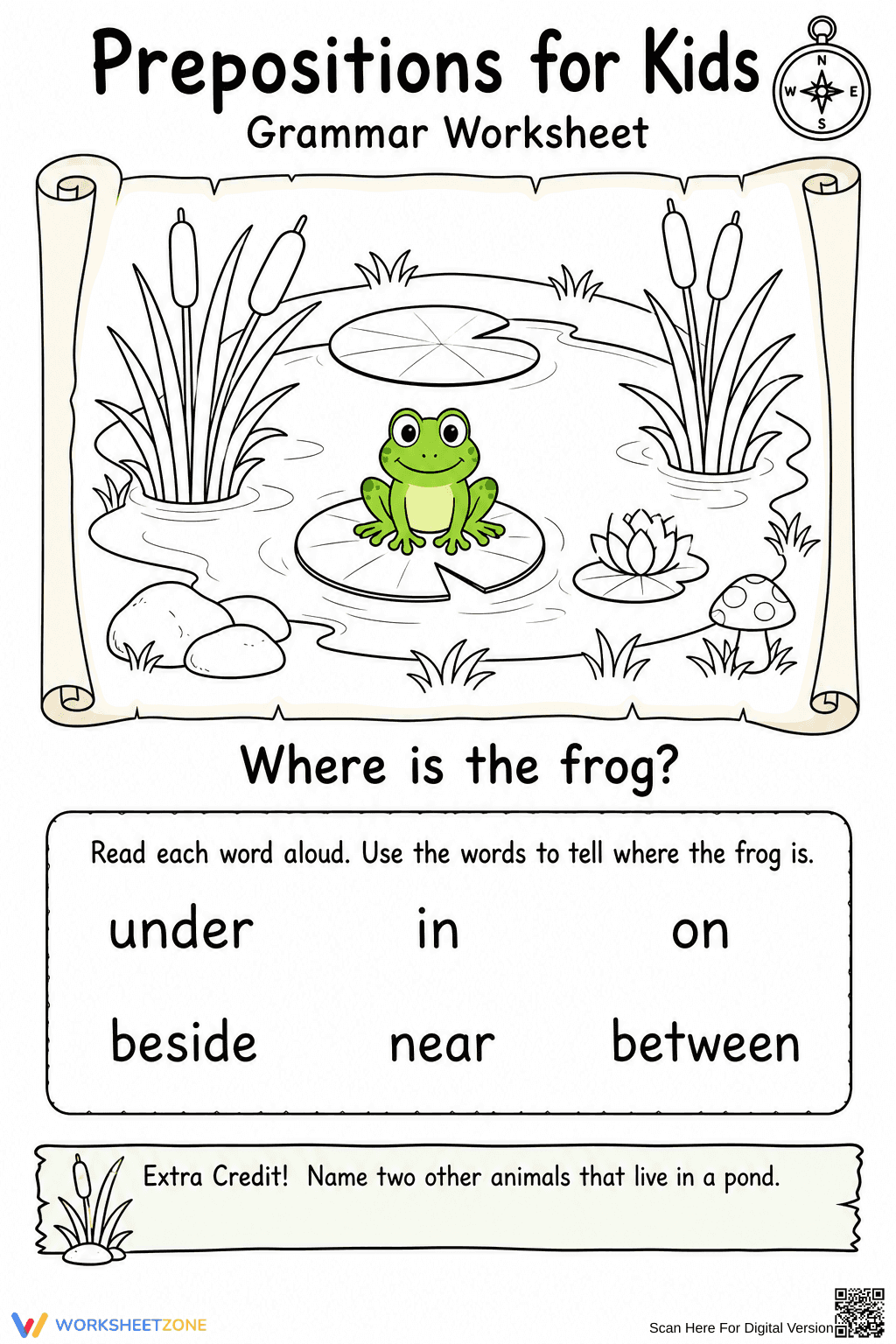
This Preschool positional words worksheet helps early learners identify and use prepositions to describe spatial relationships. By observing a frog in a pond environment, students develop the vocabulary needed to explain where objects are located. This activity builds a foundation for both descriptive writing and reading comprehension through visual cues.
At a Glance
- Grade: Preschool · Subject: English Language Arts
- Standard:
CCSS.ELA-LITERACY.L.K.1.E— Use frequently occurring prepositions like in, on, and under- Skill Focus: Positional words and spatial awareness
- Format: 1 page · 6 tasks · Answer key included · PDF
- Best For: Introduction to grammar and spatial vocabulary
- Time: 10–15 minutes
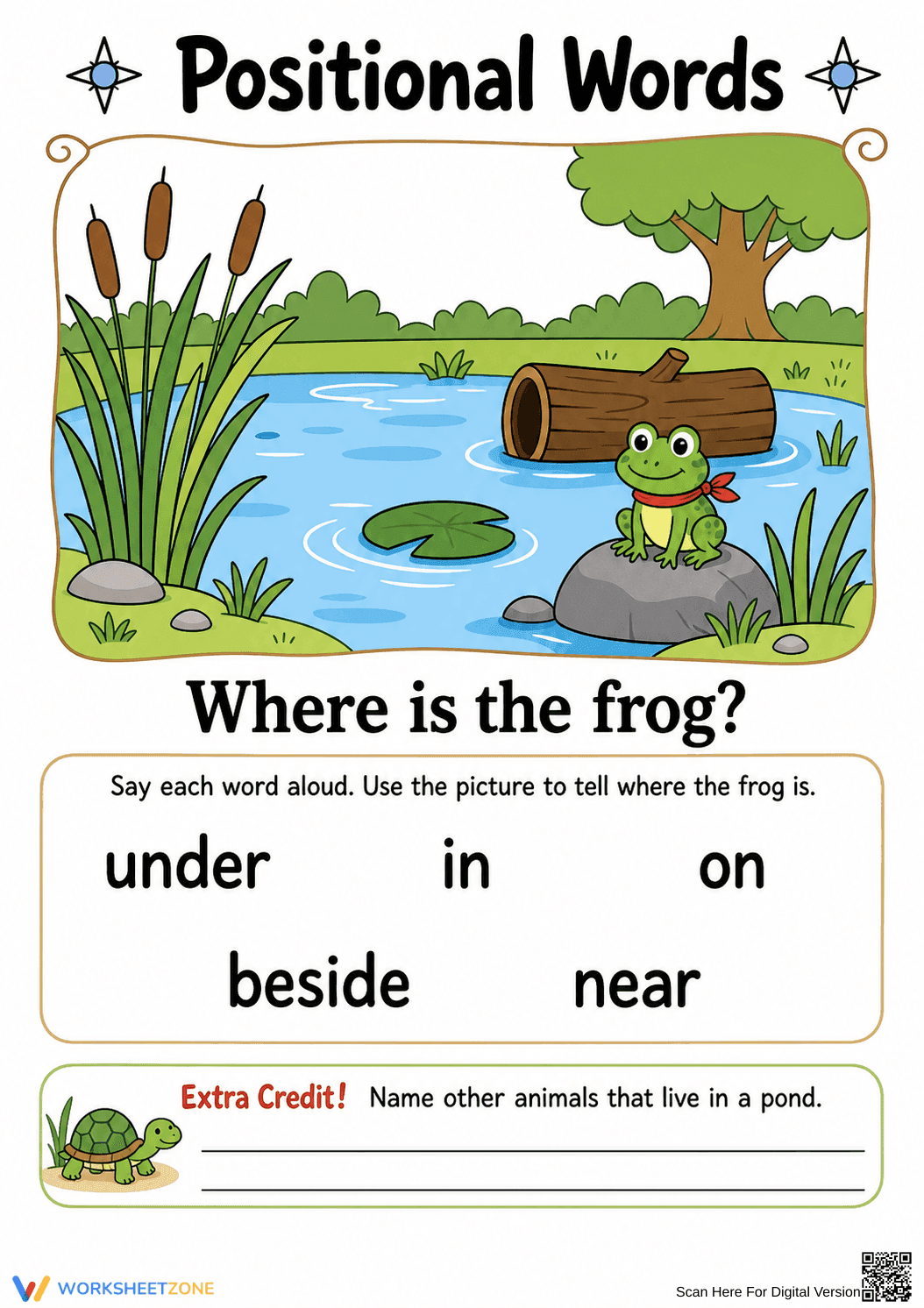
The worksheet features a vibrant pond scene with a frog, a log, and lily pads. Below the illustration, a word bank includes five essential prepositions: under, in, on, beside, and near. Students are prompted to say the words aloud and apply them to the image. An extra credit section at the bottom encourages science integration by asking for other pond-dwelling animals, fostering broader environmental awareness.
Zero-Prep Workflow
This resource is designed for a zero-prep classroom workflow. Teachers can print the PDF in under 30 seconds. Distribution takes less than a minute, as the instructions are self-explanatory for young learners when read aloud. Reviewing the answers as a whole group provides an immediate formative assessment of student understanding, bringing total teacher prep time to nearly zero.
Standards Alignment
This activity aligns with CCSS.ELA-LITERACY.L.K.1.E, which requires students to use the most frequently occurring prepositions. While designed for Preschool, it serves as an excellent bridge to Kindergarten expectations. This standard code can be copied directly into lesson plans, IEP goals, or district curriculum mapping tools to ensure instructional alignment across early childhood levels.
How to Use It
Use this worksheet during a direct instruction lesson on "where" words. After reading a picture book about animals, distribute the page to practice the new vocabulary. Alternatively, place it in a literacy center as a guided activity. Teachers should observe if students can physically point to the "on" or "beside" positions in the drawing to check for conceptual mastery before moving to independent writing.
Who It's For
This resource is ideal for Preschool and Kindergarten students, as well as English Language Learners (ELLs) who need visual support for prepositional phrases. It pairs naturally with a science unit on animal habitats or a "Living and Non-Living Things" lesson. The clear illustrations provide the necessary scaffolding for students with limited reading proficiency to succeed independently.
According to Fisher & Frey (2014), the gradual release of responsibility begins with clear modeling of academic language, such as the positional words found in this resource. This worksheet supports the "I Do" and "We Do" phases of learning by providing a concrete visual anchor for abstract concepts like "near" and "beside." Research from the RAND AIRS 2024 report suggests that integrating visual literacy with grammar instruction significantly improves retention in early childhood settings. By connecting the standard CCSS.ELA-LITERACY.L.K.1.E to a recognizable pond environment, students are more likely to transfer these linguistic skills to their own speech and writing. This 1-page printable offers a structured yet accessible way to meet foundational ELA requirements while fostering critical thinking through its integrated science prompt.


