


























Views
Downloads
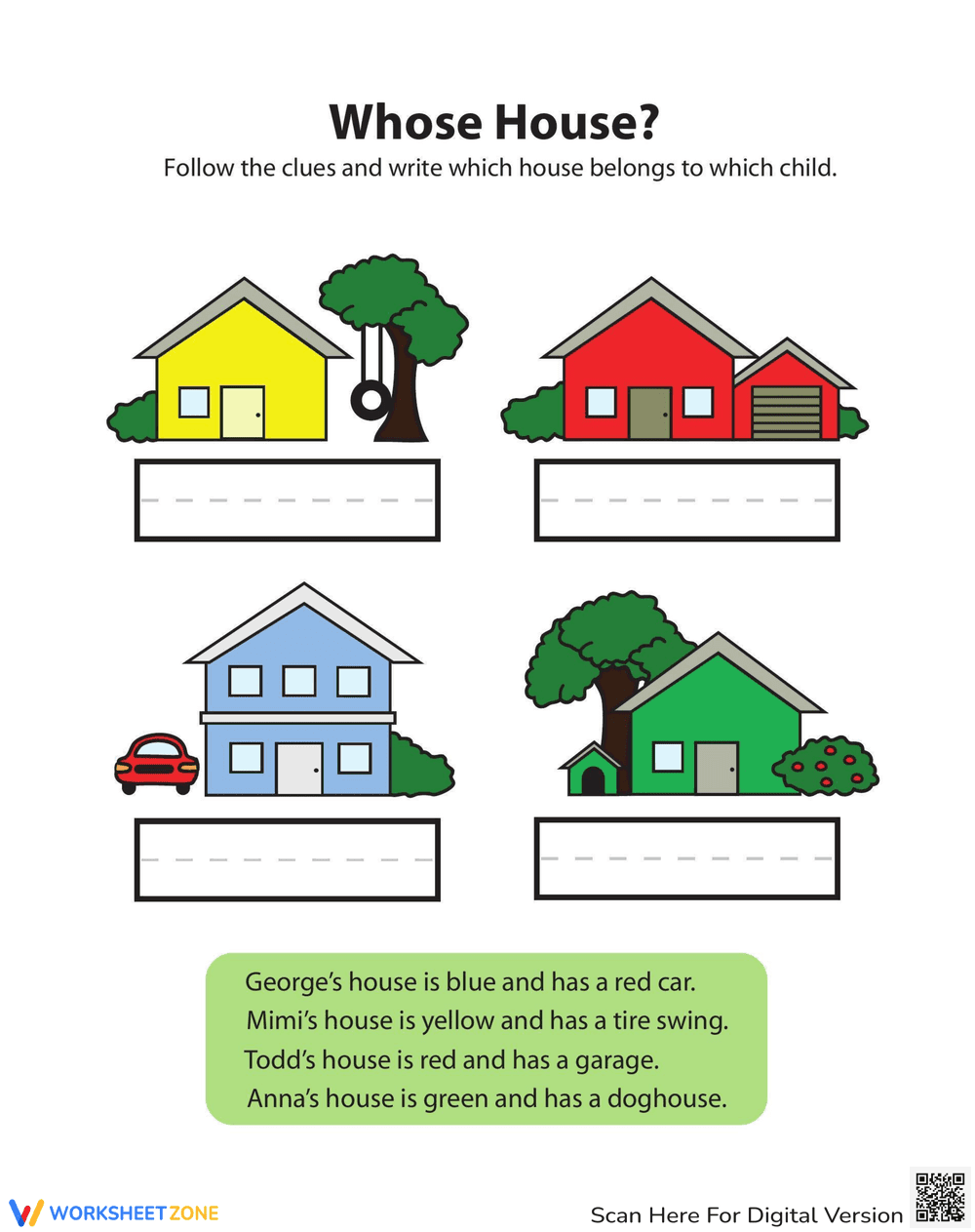

Printable Pre-Reading House Game Worksheet for Preschool
Paste this activity's link or code into your existing LMS (Google Classroom, Canvas, Teams, Schoology, Moodle, etc.).
Students can open and work on the activity right away, with no student login required.
You'll still be able to track student progress and results from your teacher account.
This printable preschool reading worksheet helps early learners build essential comprehension skills by matching descriptive clues to the correct houses. Students practice reading simple sentences, identifying key details, and writing names to demonstrate understanding. This engaging activity builds confidence in young readers as they transition from letter recognition to sentence-level comprehension.
At a Glance
- Grade: Preschool · Subject: Early Literacy
- Standard:
CCSS.ELA-LITERACY.RL.K.1— Ask and answer questions about key details in a short text- Skill Focus: Clue matching and reading comprehension
- Format: 1 page · 4 problems · No answer key · PDF
- Best For: Independent practice, literacy centers, or guided reading
- Time: 10–15 minutes
What's Inside
This single-page PDF features four colorful house illustrations, each with distinct visual characteristics like a tire swing, a garage, a red car, or a doghouse. Below the illustrations, a clear green text box contains four simple descriptive sentences. Students read the clues and write the correct child's name in the designated handwriting lines under each house.
Zero-Prep Workflow
This resource is designed for immediate classroom integration. Follow these three simple steps:
- Print (1 minute): Print the single-page PDF in color to preserve the visual clues.
- Distribute (1 minute): Hand out the sheets and read the instructions aloud.
- Review (3 minutes): Guide students through the clues, highlighting key vocabulary.
With under two minutes of prep time, this is perfect for sub plans or morning work.
Standards Alignment
This activity aligns directly with the Common Core State Standard CCSS.ELA-LITERACY.RL.K.1, which requires students to ask and answer questions about key details in a text. By matching the written descriptions to the correct illustrations, students demonstrate their ability to extract meaning from print. Both standard codes can be copied directly into lesson plans, IEP goals, or district curriculum mapping tools.
How to Use It
Use this worksheet during small-group guided reading instruction. Read the clues aloud and ask students to point to the corresponding house before writing the name. Alternatively, assign it as a formative assessment after teaching color words and basic nouns. Observe whether students can independently connect the written words "blue" or "garage" to the correct image. This task typically takes 10 to 15 minutes to complete.
Who It's For
This activity is tailored for preschool and pre-kindergarten students who are developing early literacy skills. It is also suitable for kindergarteners needing extra support with reading comprehension. Pair this worksheet with a read-aloud book about houses or neighborhoods to build background knowledge and vocabulary before students begin the matching task.
Early literacy development relies heavily on the integration of visual aids and text to build comprehension. According to research from Fisher & Frey (2014) on the gradual release of responsibility, scaffolding reading tasks with clear visual cues helps young learners bridge the gap between decoding and understanding. This worksheet utilizes structured clues and familiar illustrations to support cognitive processing, allowing preschool students to practice critical thinking without feeling overwhelmed. By matching descriptive sentences to specific images, children practice key informational processing skills that form the foundation for later reading success. The alignment with standard CCSS.ELA-LITERACY.RL.K.1 ensures that the activity targets essential early reading behaviors, making it a valuable tool for early childhood educators. Teachers can confidently integrate this resource into their daily literacy routines to support diverse learners as they develop foundational reading skills.


