


























Views
Downloads
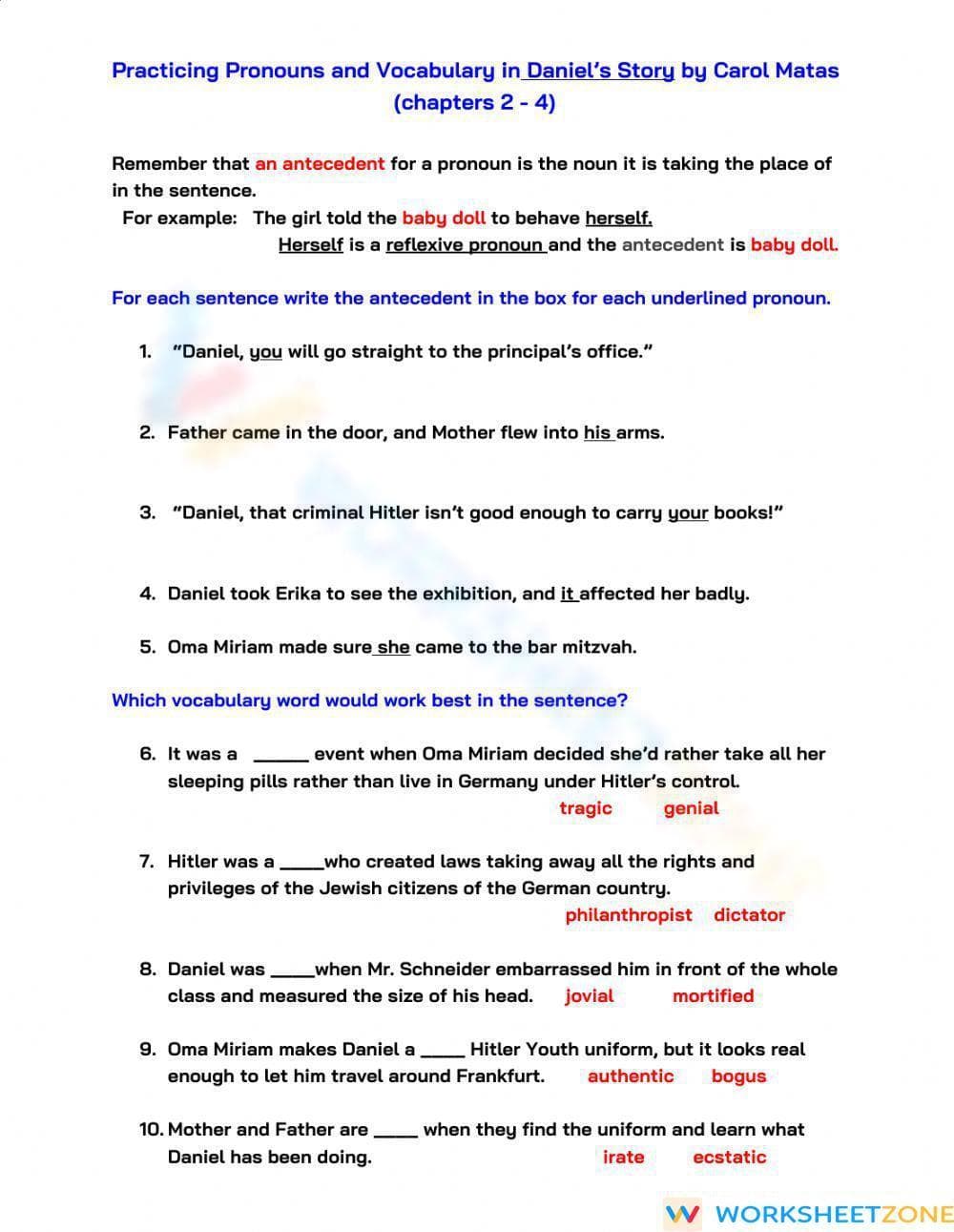

Printable Pronouns Worksheet | Daniel's Story Grade 6-11
Paste this activity's link or code into your existing LMS (Google Classroom, Canvas, Teams, Schoology, Moodle, etc.).
Students can open and work on the activity right away, with no student login required.
You'll still be able to track student progress and results from your teacher account.
This focused English Language Arts worksheet helps middle and high school students master pronoun usage within the poignant context of Carol Matas’s Daniel’s Story. By applying grammar rules to literary excerpts, learners strengthen their command of standard English conventions while deepening their engagement with the text. It’s an essential tool for reinforcing language precision during a Holocaust literature unit.
At a Glance
- Grade: 6–11 · Subject: English Language Arts (ELA)
- Standard:
CCSS.ELA-LITERACY.L.6.1— Ensure pronouns are in the proper case and match antecedents accurately.- Skill Focus: Pronoun Case and Antecedent Agreement
- Format: 1 page · 12 problems · Answer key included · PDF
- Best For: Literary grammar integration and formative assessment
- Time: 15–20 minutes
What’s Inside
The worksheet features twelve carefully selected sentences derived from the narrative of Daniel’s Story. Students must identify and correct pronoun errors or select the appropriate pronoun case to complete the text. This single-page resource includes a clear word bank for support, ensuring students can focus on the application of grammar rules. A comprehensive answer key is provided for quick grading or student self-correction.
Skill Progression
The activity follows a structured progression to ensure student success. It begins with guided practice, where students identify pronouns in simple context clues. It then moves into supported practice, requiring learners to differentiate between subjective and objective cases in complex sentences. Finally, independent practice challenges students to apply these skills to original text analysis, mirroring the gradual release of responsibility model of I Do, We Do, You Do.
Standards Alignment
This resource is directly aligned with CCSS.ELA-LITERACY.L.6.1, which requires students to demonstrate command of the conventions of standard English grammar. Specifically, it targets the ability to ensure that pronouns are in the proper case (subjective, objective, possessive) and match their antecedents. Both standard codes can be copied directly into lesson plans, IEP goals, or district curriculum mapping tools to track student progress toward mastery.
How to Use It
Incorporate this worksheet during the "during reading" phase of a Daniel’s Story unit to reinforce grammar in a meaningful context. It serves as an excellent formative assessment tool; teachers can observe if students struggle with possessive vs. objective cases while reviewing the day's reading. Expected completion time is approximately 20 minutes, making it an ideal "bell-ringer" or exit ticket to gauge understanding of pronoun mechanics.
Who It’s For
Designed for students in grades 6 through 11, this worksheet is particularly effective for those studying Holocaust literature or requiring targeted grammar intervention. It provides necessary scaffolding for English Language Learners through its contextualized sentences. This resource pairs naturally with a character analysis anchor chart or a direct instruction lesson on pronoun-antecedent agreement to provide a comprehensive learning experience for diverse learners.
Research emphasizes the importance of contextualized grammar instruction, where students retain language skills more effectively when applied directly to literature. This worksheet connects pronoun mechanics to Daniel’s Story. Aligned with CCSS.ELA-LITERACY.L.6.1, it requires students to evaluate pronoun case and agreement in twelve instances. By bridging skill practice and literary analysis, this resource supports integrated language skills. Educators can rely on this tool for rigorous evidence of student proficiency in pronoun usage, developing precision for high-level writing and textual interpretation.


