


























0
Views
0
Downloads

0.0
0
Save
0 Likes
Share
Sort Kinetic and Potential Energy
0 Views
0 Downloads
Paste this activity's link or code into your existing LMS (Google Classroom, Canvas, Teams, Schoology, Moodle, etc.).
Students can open and work on the activity right away, with no student login required.
You'll still be able to track student progress and results from your teacher account.
Information
Description
What It Is:
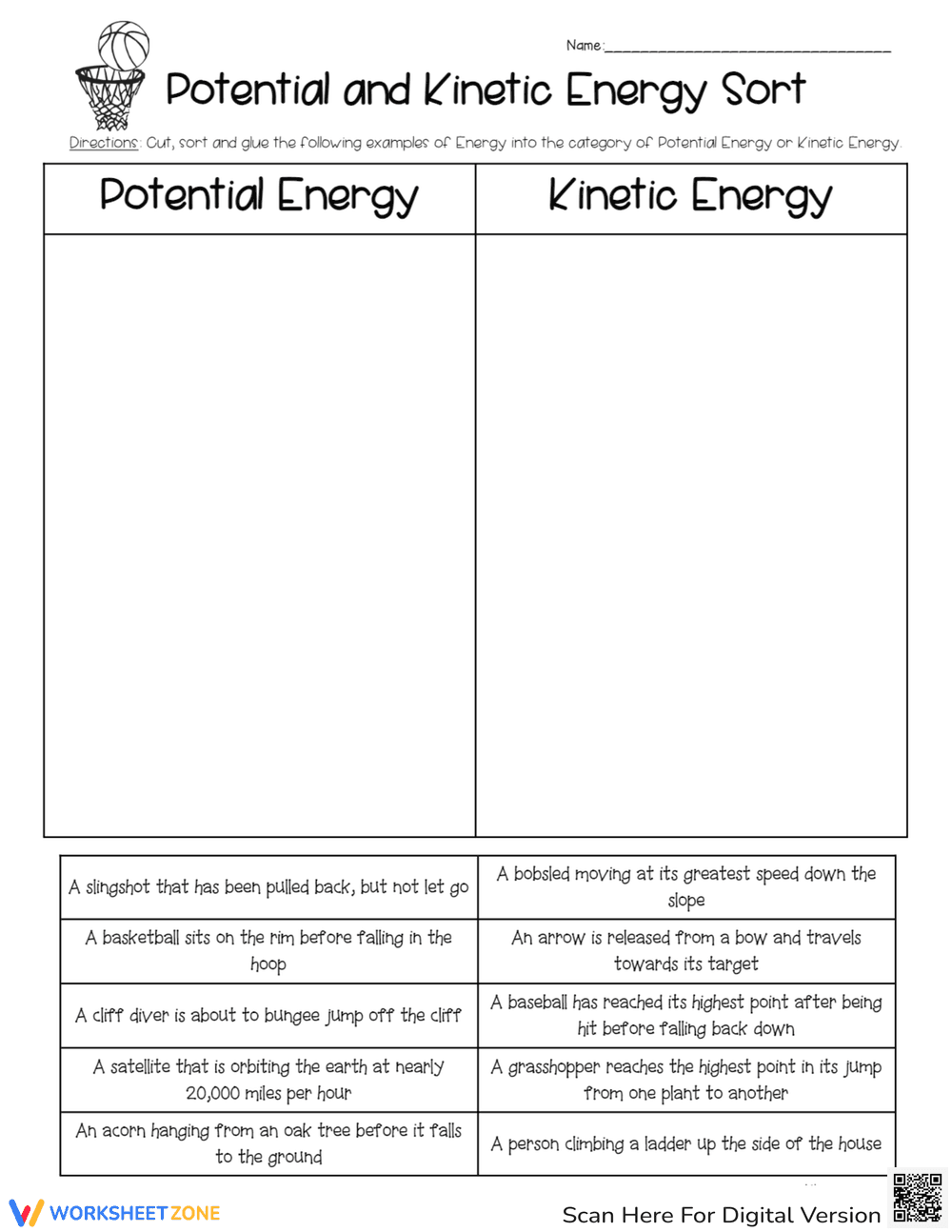
This is an educational worksheet designed as a cut-and-paste activity focused on potential and kinetic energy. Students are asked to sort examples of energy into two categories: potential energy and kinetic energy. Examples include a slingshot pulled back, a basketball on the rim, a bobsled moving down a slope, and a person climbing a ladder.
Grade Level Suitability:
This worksheet is most suitable for grades 4-6. The concepts of potential and kinetic energy are typically introduced in these grades, and the examples provided are relatable and easy to understand for this age group. The cut-and-paste format also provides a hands-on learning experience.
Why Use It:
This worksheet reinforces the understanding of potential and kinetic energy through real-world examples. It encourages critical thinking as students must analyze each scenario and determine whether the energy is stored (potential) or in motion (kinetic). The hands-on activity promotes engagement and active learning.
How to Use It:
First, have students cut out the examples of energy provided at the bottom of the worksheet. Then, instruct them to read each example carefully and decide whether it represents potential or kinetic energy. Finally, students glue each example into the appropriate column on the worksheet.
Target Users:
This worksheet is ideal for elementary and middle school science teachers looking for a supplemental activity to teach or reinforce the concepts of potential and kinetic energy. It is also beneficial for students who are visual or kinesthetic learners, as it involves both visual sorting and physical manipulation.
This is an educational worksheet designed as a cut-and-paste activity focused on potential and kinetic energy. Students are asked to sort examples of energy into two categories: potential energy and kinetic energy. Examples include a slingshot pulled back, a basketball on the rim, a bobsled moving down a slope, and a person climbing a ladder.
Grade Level Suitability:
This worksheet is most suitable for grades 4-6. The concepts of potential and kinetic energy are typically introduced in these grades, and the examples provided are relatable and easy to understand for this age group. The cut-and-paste format also provides a hands-on learning experience.
Why Use It:
This worksheet reinforces the understanding of potential and kinetic energy through real-world examples. It encourages critical thinking as students must analyze each scenario and determine whether the energy is stored (potential) or in motion (kinetic). The hands-on activity promotes engagement and active learning.
How to Use It:
First, have students cut out the examples of energy provided at the bottom of the worksheet. Then, instruct them to read each example carefully and decide whether it represents potential or kinetic energy. Finally, students glue each example into the appropriate column on the worksheet.
Target Users:
This worksheet is ideal for elementary and middle school science teachers looking for a supplemental activity to teach or reinforce the concepts of potential and kinetic energy. It is also beneficial for students who are visual or kinesthetic learners, as it involves both visual sorting and physical manipulation.


