


























Views
Downloads
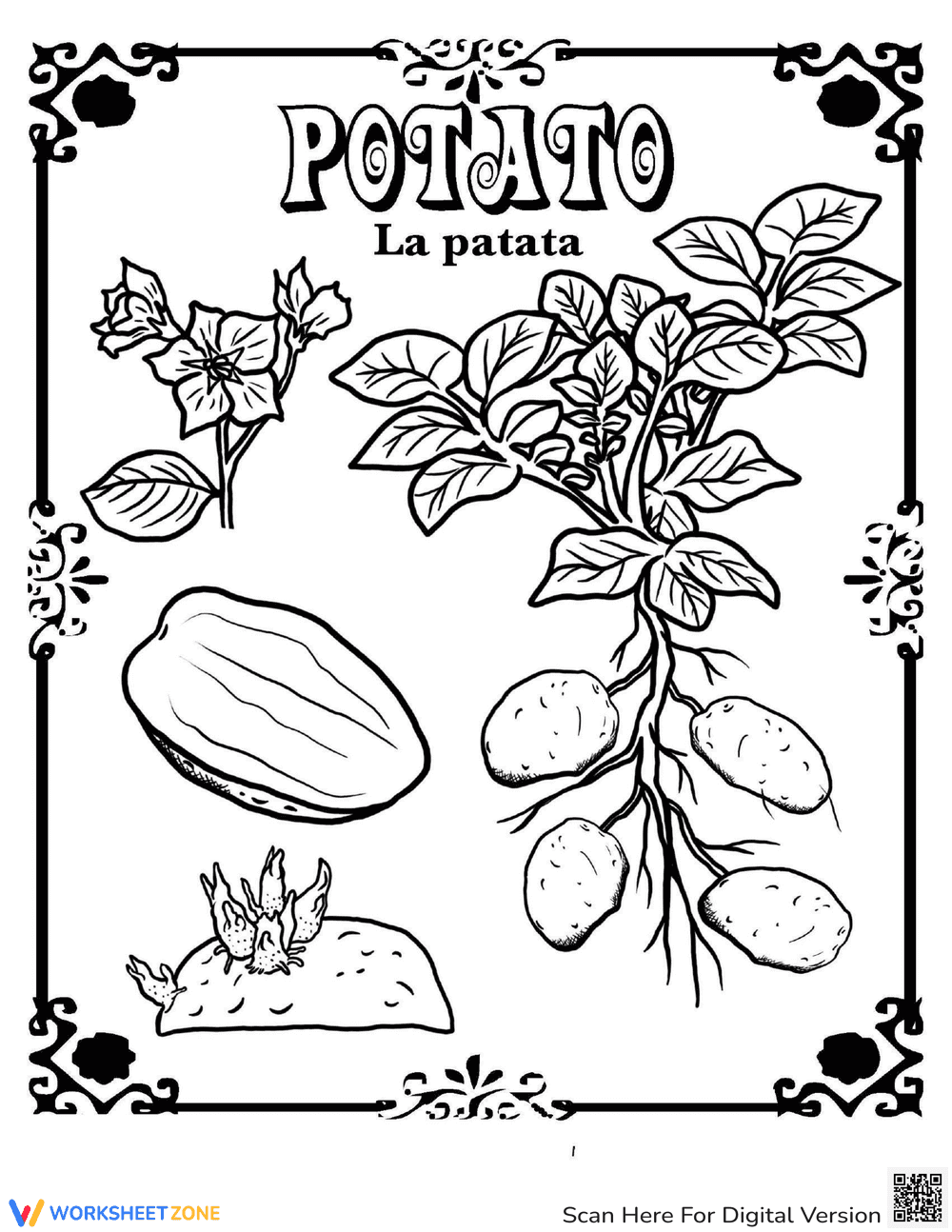

Kindergarten Potato in Spanish — Printable No-Prep Worksheet
Paste this activity's link or code into your existing LMS (Google Classroom, Canvas, Teams, Schoology, Moodle, etc.).
Students can open and work on the activity right away, with no student login required.
You'll still be able to track student progress and results from your teacher account.
This printable worksheet introduces kindergarten students to bilingual vocabulary by connecting the English word "potato" with its Spanish translation "la patata." Through coloring detailed illustrations of potato plant stages, young learners build early literacy skills and expand their vocabulary. Students connect visual representations of nature with new language terms.
At a Glance
- Grade: Kindergarten · Subject: Early Literacy
- Standard:
CCSS.ELA-LITERACY.L.K.6— Use newly acquired words and phrases in conversations- Skill Focus: Bilingual vocabulary and plant identification
- Format: 1 page · 1 task · No answer key · PDF
- Best For: Morning work or bilingual vocabulary introduction
- Time: 15–20 minutes
What's Inside
This single-page PDF features clear, high-quality line drawings showing the life cycle and anatomy of a potato plant. It includes labeled illustrations of a potato sprout, a flowering stem, a cross-section of a potato, and the underground root system with growing tubers. The top of the page displays the words "POTATO" and "La patata" in bold, colorable fonts, providing a dual-language learning experience.
Zero-Prep Workflow
This resource offers a zero-prep workflow for busy educators. First, print the single-page PDF in under 1 minute. Next, distribute the coloring sheets to students with crayons or colored pencils, taking less than 1 minute. Finally, review the vocabulary words as a group, taking 5 minutes to practice pronunciation. The entire setup requires less than 2 minutes of teacher preparation, making it an ideal sub plan or transition activity.
Standards Alignment
This worksheet aligns with the primary standard CCSS.ELA-LITERACY.L.K.6, which focuses on helping kindergarten students acquire and use new words and phrases. Additionally, it supports early science standards by introducing the physical structures of plants. Both standard codes can be copied directly into lesson plans, IEP goals, or district curriculum mapping tools.
How to Use It
Use this worksheet during direct instruction to introduce a unit on food, plants, or Spanish vocabulary. Alternatively, assign it as a quiet independent activity after reading a story about gardening. For a quick formative assessment, observe students as they color and ask them to point to the potato sprout while saying the Spanish word aloud. Expect completion within 15 to 20 minutes.
Who It's For
This coloring page is designed for kindergarten students, English language learners, and dual-language immersion classes. It accommodates diverse learning needs by combining visual art with language acquisition. Pair this worksheet with a read-aloud book about vegetables or a real potato specimen to create a hands-on, multi-sensory learning experience.
This educational resource supports early language acquisition by integrating visual arts with bilingual vocabulary development. According to research by Fisher & Frey (2014) on vocabulary instruction, combining visual representations with word labels enhances word retention and conceptual understanding in early childhood education. By coloring the labeled parts of the potato plant, students engage in dual-coding, which reinforces the connection between the English word "potato" and the Spanish term "la patata." This worksheet aligns directly with standard CCSS.ELA-LITERACY.L.K.6, helping young learners build a foundation for communication. The simple, structured layout allows teachers to introduce basic botany concepts alongside language lessons, maximizing instructional time. Using this worksheet helps students develop fine motor skills while building a diverse vocabulary, making it a valuable addition to any early childhood or bilingual classroom curriculum.


