


























Views
Downloads



Essential Potatoes and Tomatoes Reading Worksheet | Grade 5
Paste this activity's link or code into your existing LMS (Google Classroom, Canvas, Teams, Schoology, Moodle, etc.).
Students can open and work on the activity right away, with no student login required.
You'll still be able to track student progress and results from your teacher account.
This informational reading worksheet provides a comprehensive look at the history of potatoes and tomatoes, from their origins in the Andes Mountains to their global popularity today. Students engage with a high-interest non-fiction passage, building critical reading stamina and vocabulary acquisition skills through structured text analysis and evidence-based comprehension questions designed for upper elementary learners.
At a Glance
- Grade: 5 · Subject: ELA
- Standard:
CCSS.ELA-LITERACY.RI.5.2— Determine two or more main ideas and explain how they are supported by key details- Skill Focus: Informational Text Analysis
- Format: 3 pages · 5 problems · Answer key included · PDF
- Best For: Close reading and vocabulary practice
- Time: 25–35 minutes
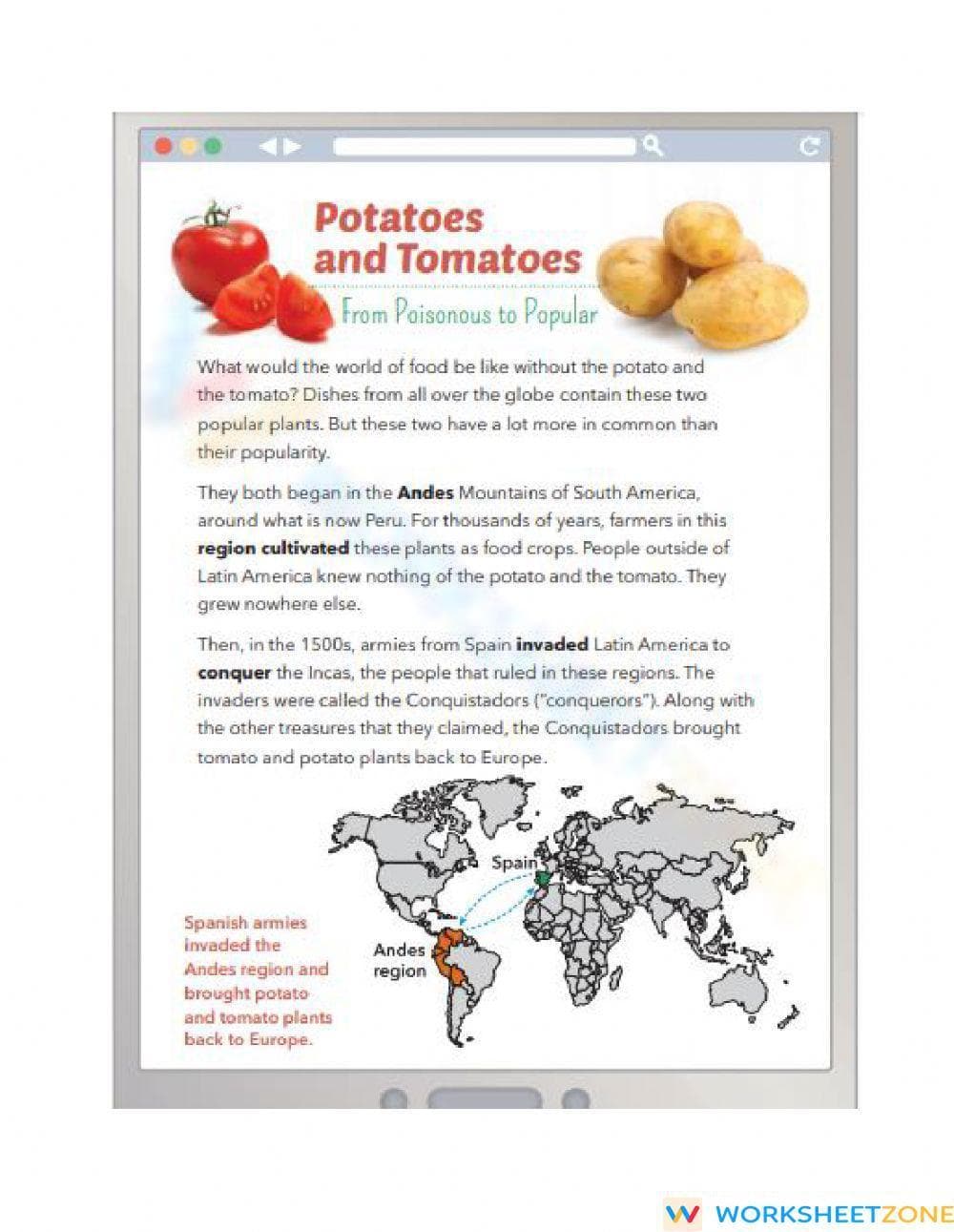
The resource includes a two-page non-fiction article with maps, followed by a worksheet page. This final page features a "Key Vocabulary" section defining six academic terms such as "cultivated," along with five open-ended comprehension questions. These tasks require students to summarize findings, describe historical processes, and reflect on the cultural impact of these specific crops.
Skill Progression
- Guided practice begins with a robust vocabulary bank that anchors student understanding of the historical narrative before they engage with the text.
- Supported practice involves analyzing the two-page passage, which uses bolded terms and visual aids like world maps to help students track the movement of crops from South America to Europe.
- Independent practice concludes with five rigorous short-answer questions that move from literal recall to higher-order synthesis and personal reflection on the text’s content.
Standards Alignment
Aligned to CCSS.ELA-LITERACY.RI.5.2, students determine main ideas supported by key details. The worksheet also supports vocabulary acquisition under CCSS.ELA-LITERACY.RI.5.4 through domain-specific vocabulary practice. Both standard codes can be copied directly into lesson plans, IEP goals, or district curriculum mapping tools.
How to Use It
Ideal for "during-reading" support or a "post-reading" assessment. Teachers should observe if students use the provided maps when answering questions about crop history. Expected completion time is 30 minutes. This allows for a thorough review of the vocabulary and the reflective questions.
Who It's For
For students in Grades 4, 5, and 6, this is effective for practice with non-fiction structures. It pairs well with geography or history lessons. Differentiation can be achieved by providing sentence starters for the summary question or by working through the vocabulary list together as a class.
According to the RAND AIRS 2024 analysis of instructional materials, the integration of multi-modal features—such as the maps and vocabulary headers found in this worksheet—is critical for helping Grade 5 students bridge the gap between literal decoding and deep conceptual understanding of informational texts. By focusing on CCSS.ELA-LITERACY.RI.5.2, this resource directly addresses the developmental need for students to identify and summarize complex historical narratives through evidence-based reasoning. Research from Fisher & Frey (2014) highlights that structured vocabulary support combined with gradual-release comprehension tasks allows learners to internalize domain-specific language more effectively than isolated memorization. This worksheet provides that exact scaffold, ensuring students not only learn about the Andes region and the Conquistadors but also master the skill of extracting and organizing key informational details. This systematic approach supports long-term literacy gains and prepares students for the increased complexity of middle school literature and non-fiction requirements.


