


























Views
Downloads

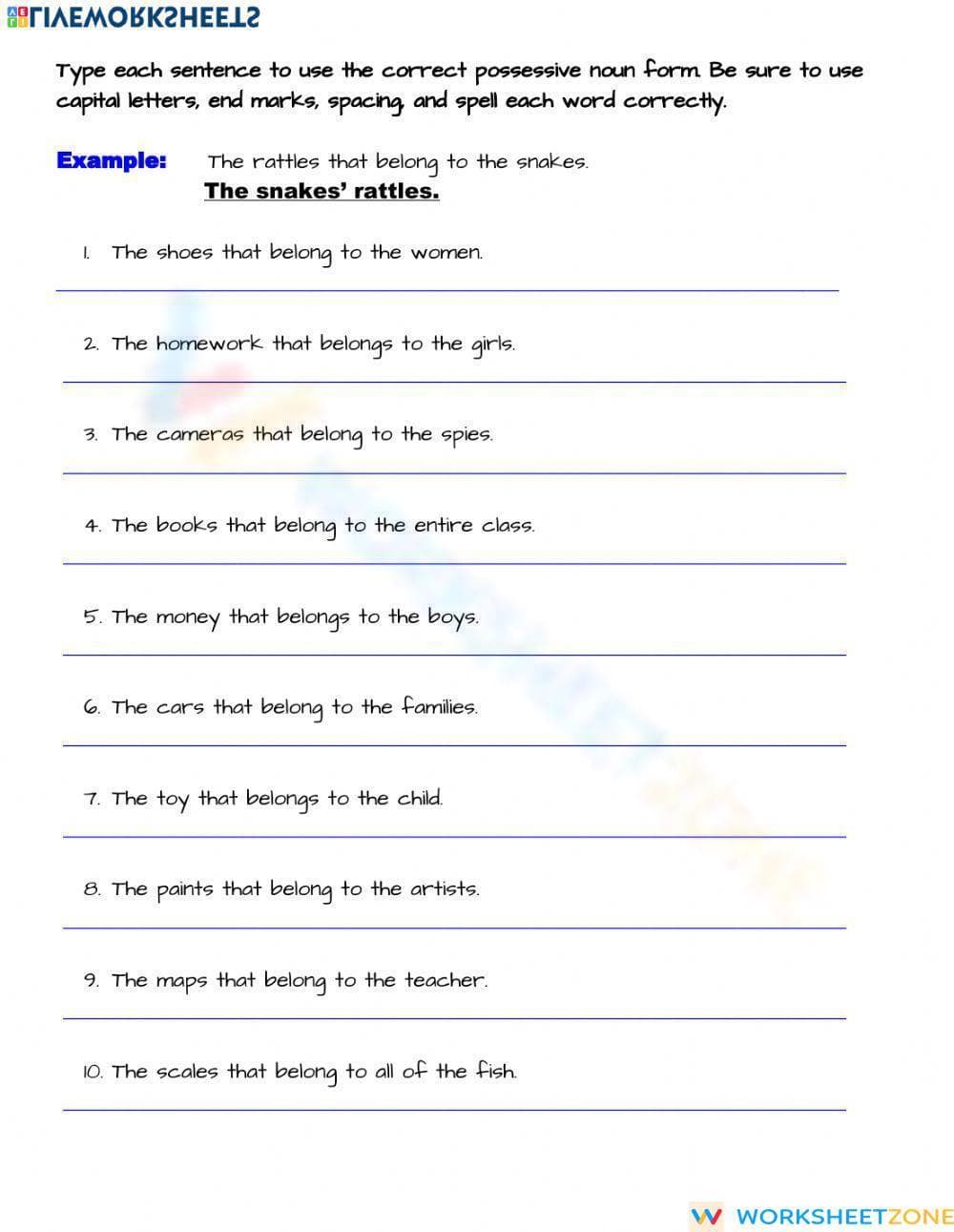

Essential Possessive Nouns Worksheet | Grade 4 ELA Aligned
Paste this activity's link or code into your existing LMS (Google Classroom, Canvas, Teams, Schoology, Moodle, etc.).
Students can open and work on the activity right away, with no student login required.
You'll still be able to track student progress and results from your teacher account.
This comprehensive Grade 4 possessive nouns worksheet provides students with focused practice in forming singular and plural possessives across 36 distinct tasks. By systematically converting base nouns into their possessive counterparts, learners develop the grammatical precision necessary for clear writing. This resource ensures students master the placement of apostrophes in both regular and irregular nouns.
At a Glance
- Grade: 4 · Subject: English Language Arts
- Standard:
CCSS.ELA-LITERACY.L.3.2.D— Form and use possessives correctly in varied sentence structures - Skill Focus: Singular and Plural Possessive Formation
- Format: 2 pages · 36 problems · Answer key included · PDF
- Best For: Independent grammar practice and formative assessment
- Time: 15–20 minutes
The worksheet is structured as a clear, accessible grid that guides students through the transformation of 12 common nouns. Each row requires the student to provide the singular possessive, the plural form, and the plural possessive form, ensuring a deep understanding of how number and possession interact. The two-page PDF format includes a complete answer key for rapid grading or student self-correction.
Skill Progression
- Guided Practice: The initial tasks focus on regular singular nouns, allowing students to apply the basic 's rule with immediate success.
- Supported Practice: Students transition to regular plural nouns ending in -s, practicing the placement of the apostrophe after the existing suffix.
- Independent Practice: The final challenge involves irregular plural nouns (such as "men" or "children"), requiring students to apply the 's rule to plural forms that do not end in -s.
This sequence follows the gradual-release model, moving from high-frequency regular patterns to more complex irregular applications.
Standards Alignment
This resource is strictly aligned to CCSS.ELA-LITERACY.L.3.2.D: "Form and use possessives." While introduced in Grade 3, mastery of this standard is critical for Grade 4 and 5 writing fluency. The worksheet also supports L.4.2.C by reinforcing correct capitalization and punctuation within word forms. Both standard codes can be copied directly into lesson plans, IEP goals, or district curriculum mapping tools.
How to Use It
This worksheet is ideal for use during the independent practice phase of a grammar lesson. After direct instruction on apostrophe rules, assign the grid to gauge student understanding of the distinction between pluralization and possession. For a quick formative assessment, observe if students correctly handle the irregular plural rows. Completion typically takes 15 to 20 minutes, making it a perfect bell-ringer or exit ticket.
Who It's For
Designed for general education students in Grades 3–5, this resource also provides excellent remedial support for middle schoolers struggling with apostrophe usage. The clear table layout serves as a scaffold for English Language Learners (ELLs) and students with processing needs. This worksheet pairs naturally with a mentor text passage where students can find and highlight possessive nouns before completing the practice grid.
Research indicates that isolated skill practice, when applied in writing, improves mechanical accuracy. This worksheet's structured format allows students to internalize linguistic patterns through repetitive interactions. Focusing on the L.3.2.D standard, this resource helps students differentiate singular and plural possessives, a common point of confusion. The 36 tasks guide learners from recognition to active generation of correct grammatical forms, building technical proficiency for complex syntactical structures. Educational analysts emphasize that clear, no-prep resources maximize instructional time and provide evidence-based practice for standard mastery and long-term retention.


