


























Views
Downloads

Essential Possessive Nouns Worksheet | Grade 3 Grammar
Paste this activity's link or code into your existing LMS (Google Classroom, Canvas, Teams, Schoology, Moodle, etc.).
Students can open and work on the activity right away, with no student login required.
You'll still be able to track student progress and results from your teacher account.
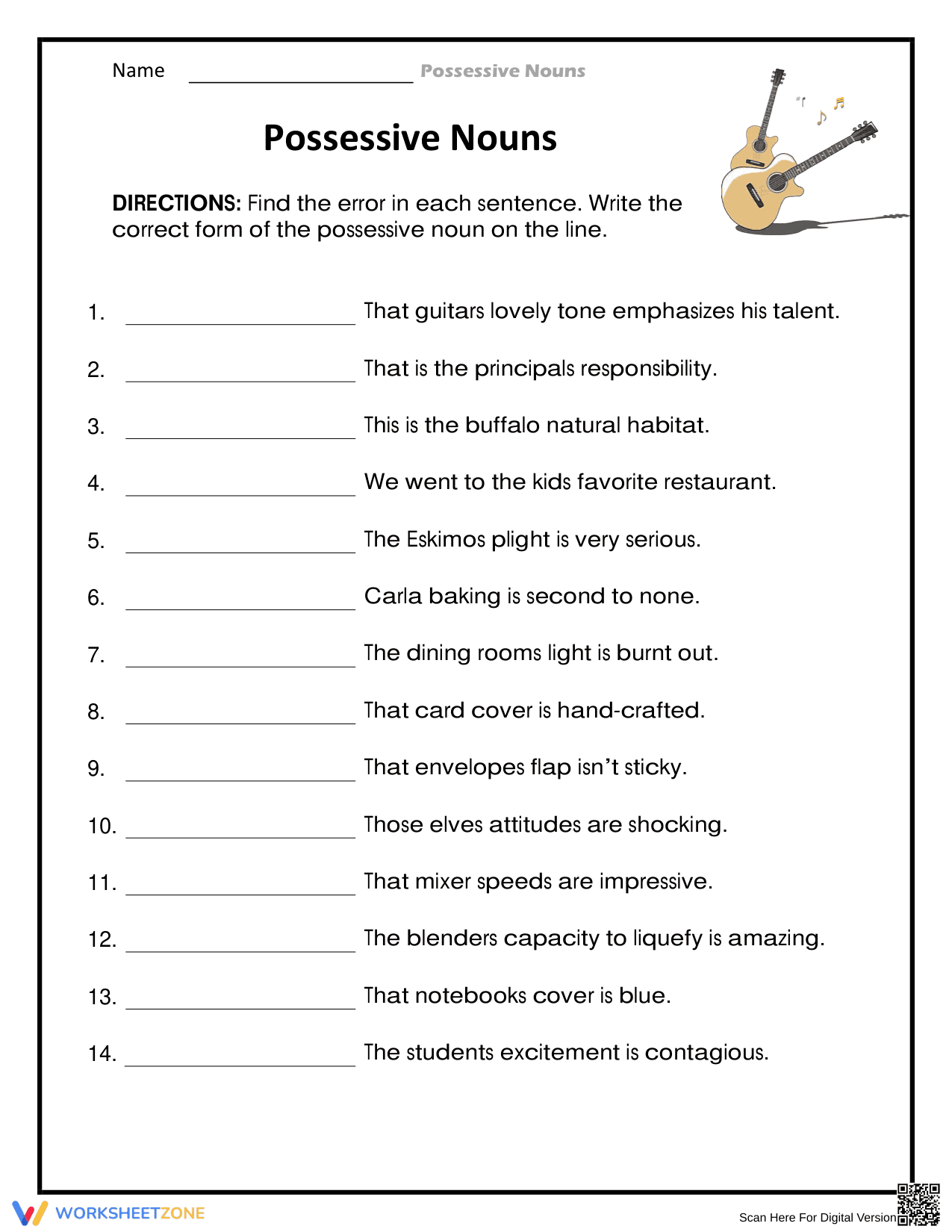
Master the mechanics of ownership with this focused grammar resource. This worksheet helps students identify and correct errors in possessive noun usage within complete sentences. By practicing the placement of apostrophes for both singular and plural nouns, learners strengthen their technical writing skills and improve overall sentence clarity in their daily compositions.
At a Glance
- Grade: 3 · Subject: English Language Arts
- Standard:
CCSS.ELA-LITERACY.L.3.2.D— Form and use possessives correctly in written sentences to show ownership- Skill Focus: Singular and Plural Possessive Nouns
- Format: 1 page · 14 problems · Answer key included · PDF
- Best For: Independent grammar practice and review
- Time: 15–20 minutes
This single-page printable provides 14 targeted sentences that challenge students to find and fix possessive errors. Each task requires the student to evaluate a sentence, identify the noun showing ownership, and rewrite the correct form on a provided line. The layout is clean and distraction-free, featuring a helpful reference image of guitars to engage visual learners.
The zero-prep workflow for this resource is designed for busy educators. Simply print the PDF, which takes less than 30 seconds, and distribute it to your class. Students can begin working immediately as the directions are self-explanatory. Reviewing the 14 answers takes approximately two minutes using the included key, making this an ideal solution for emergency sub plans or bell-ringers.
This resource is directly aligned to CCSS.ELA-LITERACY.L.3.2.D, which requires students to form and use possessives. It also supports general conventions of standard English grammar. This standard code can be copied directly into lesson plans, IEP goals, or district curriculum mapping tools to ensure all instructional minutes are focused on grade-level mastery.
Use this worksheet as a formative assessment after a direct instruction lesson on apostrophes. As students work through the 14 sentences, observe if they are confusing plural nouns with possessive nouns—a common hurdle in early writing. Completion typically takes 15 to 20 minutes, making it a perfect fit for a literacy center rotation or a homework assignment.
This practice set is designed for Grade 3 students but provides excellent scaffolding for Grade 2 learners or review for Grade 4. It pairs naturally with a mentor text that features varied possessive nouns. For students needing more support, teachers can highlight the noun in each sentence before the student attempts to add the apostrophe.
Grammar instruction is most effective when integrated into meaningful contexts, yet targeted practice remains a vital component of skill acquisition. According to research from Fisher & Frey (2014), the gradual release of responsibility model benefits significantly from structured independent tasks that reinforce specific linguistic rules like the formation of possessive nouns. By isolating the CCSS.ELA-LITERACY.L.3.2.D standard through 14 focused exercises, students can build the necessary muscle memory to apply these rules in their independent writing. This worksheet provides that essential bridge between recognizing a rule and applying it consistently. Providing immediate feedback using the answer key further solidifies the student's understanding of singular and plural ownership. This evidence-based approach ensures that learners do not just memorize where an apostrophe goes but understand the relationship between the noun and the object it possesses within the broader English language structure.


