




























Views
Downloads

Pond Life Worksheet | Grade K-1 Essential Printable

Paste this activity's link or code into your existing LMS (Google Classroom, Canvas, Teams, Schoology, Moodle, etc.).
Students can open and work on the activity right away, with no student login required.
You'll still be able to track student progress and results from your teacher account.
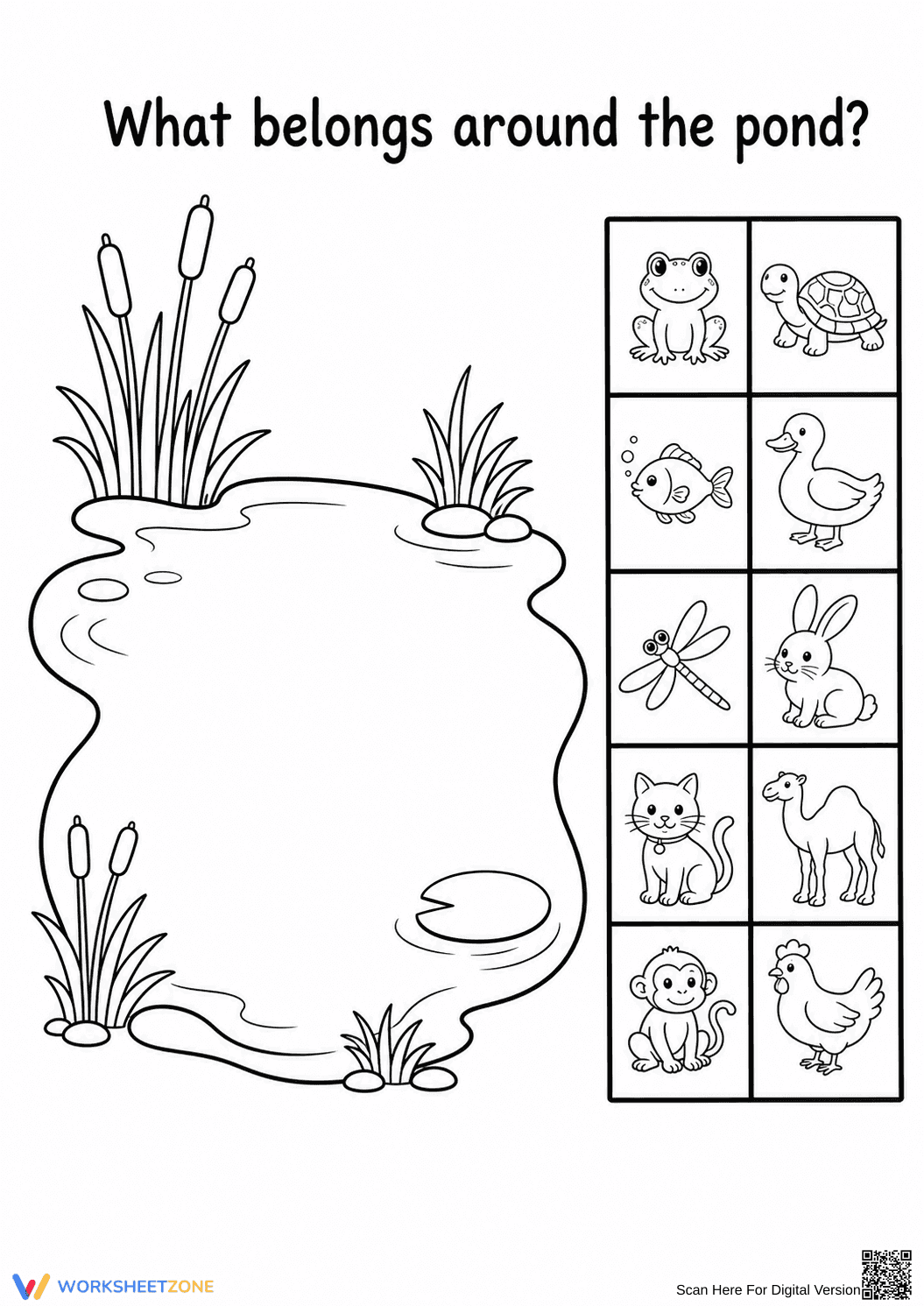
This Grade K-1 Pond Life worksheet provides a high-interest animal sorting activity that strengthens foundational categorization and language skills. Students observe 10 different animals and determine which species belong in a pond ecosystem. By identifying appropriate habitats, early learners develop the critical thinking skills necessary for scientific observation and descriptive writing.
At a Glance
- Grade: K–1 · Subject: ELA · Science
- Standard:
CCSS.ELA-LITERACY.L.K.5.A— Sort common objects into categories to gain a sense of the concepts they represent- Skill Focus: Habitat Classification
- Format: 1 page · 10 tasks · Answer key included · PDF
- Best For: Independent morning work or science centers
- Time: 10–15 minutes
This single-page PDF features a large, inviting illustration of a pond ecosystem complete with cattails and water ripples. To the right, a vertical bank contains 10 clear, student-friendly animal illustrations including a frog, monkey, beaver, and turtle. The worksheet is designed for cut-and-paste or drawing lines, providing a tactile experience that reinforces cognitive associations. A comprehensive answer key is included to facilitate rapid grading or self-correction.
The zero-prep design allows teachers to implement this activity in under two minutes. First, print the single page and distribute it to your Grade K-1 students. Second, because the visual cues are intuitive, students can complete the 10 classification tasks with minimal teacher intervention. Finally, use the included answer key for a 30-second review. This makes it an ideal choice for emergency sub plans or quiet transitions between instructional blocks.
This worksheet is primarily aligned to CCSS.ELA-LITERACY.L.K.5.A, which requires students to sort common objects into categories to gain a sense of the concepts the categories represent. By distinguishing between pond-dwelling animals and those from other habitats, students practice the semantic grouping required for vocabulary acquisition. This standard code can be copied directly into lesson plans, IEP goals, or district curriculum mapping tools.
Use this worksheet as a formative assessment during a unit on ecosystems or as a follow-up to a read-aloud about freshwater habitats. Teachers should observe whether students can justify their choices, noting if they recognize that certain animals (like the monkey) are non-examples. The expected completion time is approximately 10 to 15 minutes, depending on whether students color the illustrations.
This resource is specifically crafted for Kindergarten and First Grade students, including English Language Learners who benefit from the strong visual support. It pairs naturally with non-fiction picture books about wetlands or direct instruction on animal characteristics. The simple layout ensures that the focus remains on the skill of classification rather than complex navigation.
The Pond Life worksheet addresses the foundational literacy and science skill of categorization, a critical component of early cognitive development. According to the ScienceDirect TpT Analysis (2024), high-quality visual sorting activities improve student retention of domain-specific vocabulary by creating strong mental schemas. By engaging with CCSS.ELA-LITERACY.L.K.5.A, students move beyond rote memorization to active conceptual sorting. This 10-task exercise provides a structured environment for students to apply their knowledge of animal habitats. Research suggests that early exposure to classification tasks predicts later success in scientific inquiry and reading comprehension. This printable resource serves as a reliable tool for classroom teachers seeking to bridge the gap between abstract concepts and observable patterns through focused, standards-aligned practice.


