


























Views
Downloads

Polygon Hunt Worksheet | Grade 3 Essential Math
Paste this activity's link or code into your existing LMS (Google Classroom, Canvas, Teams, Schoology, Moodle, etc.).
Students can open and work on the activity right away, with no student login required.
You'll still be able to track student progress and results from your teacher account.
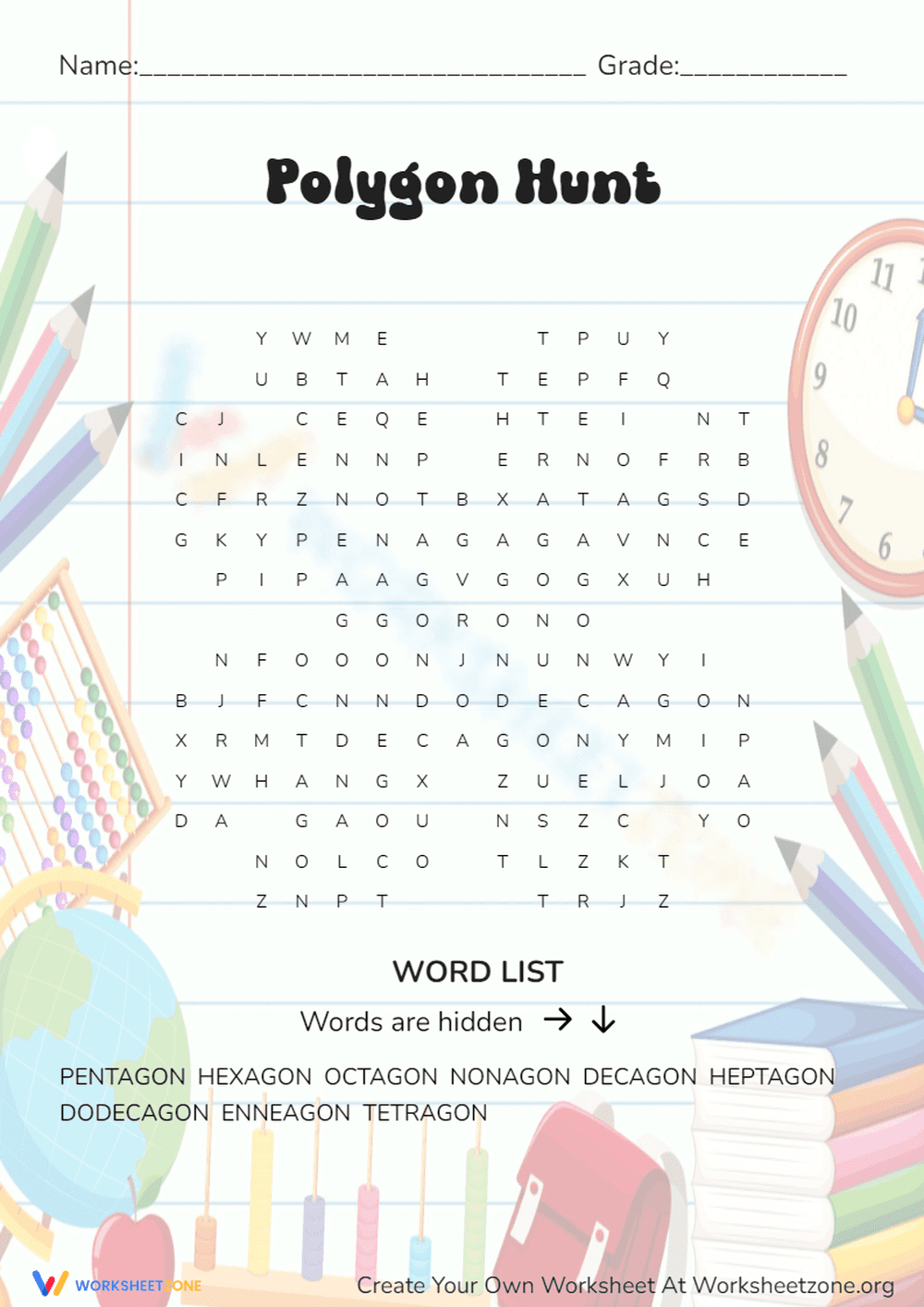
This Polygon Hunt worksheet helps students master geometry vocabulary by identifying and locating nine distinct polygon names within a structured word search. By engaging with terms like nonagon and dodecagon, learners reinforce their ability to recognize shape attributes and spelling. It provides a fun, low-stakes environment for students to solidify their understanding of mathematical terminology.
At a Glance
- Grade: 3 · Subject: Math
- Standard:
CCSS.MATH.CONTENT.3.G.A.1— Understand that shapes in different categories may share attributes- Skill Focus: Geometry Vocabulary
- Format: 1 page · 9 problems · Answer key included · PDF
- Best For: Early finishers and vocabulary reinforcement
- Time: 15–20 minutes
This single-page PDF features a clear, themed word search grid containing nine specific polygon names. The word list includes common shapes like pentagons and hexagons alongside more complex terms like enneagon and dodecagon. The layout includes a name and grade header, a word bank with directional cues, and vibrant classroom-themed illustrations to keep students engaged throughout the activity.
Teachers can implement this activity in under 2 minutes. First, print the required number of copies for the class. Second, distribute the sheets as a warm-up or transition activity. Third, review the vocabulary terms together or use the included answer key for quick self-correction. This resource is an ideal grab-and-go option for substitute folders or unexpected schedule changes during the school day.
The primary focus is CCSS.MATH.CONTENT.3.G.A.1, which requires students to reason with shapes and their attributes. By identifying these specific names, students categorize polygons based on their number of sides and angles. Both standard codes can be copied directly into lesson plans, IEP goals, or district curriculum mapping tools to ensure compliance with state frameworks.
Use this worksheet during the independent practice phase of a geometry unit to reinforce spelling and recognition of multi-sided figures. It also serves as an excellent formative assessment tool; observe which students struggle to identify the more complex prefixes to target future instruction. Expected completion typically takes 15 to 20 minutes depending on student familiarity with the terms.
This resource is designed for third-grade students but is adaptable for second through fifth grades depending on vocabulary exposure. It is particularly helpful for English Language Learners who need visual and repetitive engagement with math terms. Pair this with a polygon anchor chart or a hands-on shape-sorting lesson for maximum impact in the classroom.
According to the RAND AIRS 2024 report, integrating vocabulary-focused activities like word searches into mathematics instruction significantly improves student retention of technical terminology. This worksheet aligns with CCSS.MATH.CONTENT.3.G.A.1 by requiring students to process the linguistic labels for geometric attributes, a critical step in developing spatial reasoning. Research from Fisher & Frey (2014) emphasizes that word hunts serve as effective scaffolds for academic language acquisition, allowing students to interact with complex terms like enneagon and heptagon in a non-threatening format. By isolating the vocabulary from complex calculation, learners can focus entirely on the morphological structure of math words. This 1-page resource provides 9 specific tasks that bridge the gap between simple shape recognition and advanced geometric classification. It is a proven tool for reinforcing the foundational language necessary for higher-level geometry and standardized test success.


