




























Views
Downloads

Printable Segment Addition Postulate & Geometry Worksheet

Paste this activity's link or code into your existing LMS (Google Classroom, Canvas, Teams, Schoology, Moodle, etc.).
Students can open and work on the activity right away, with no student login required.
You'll still be able to track student progress and results from your teacher account.
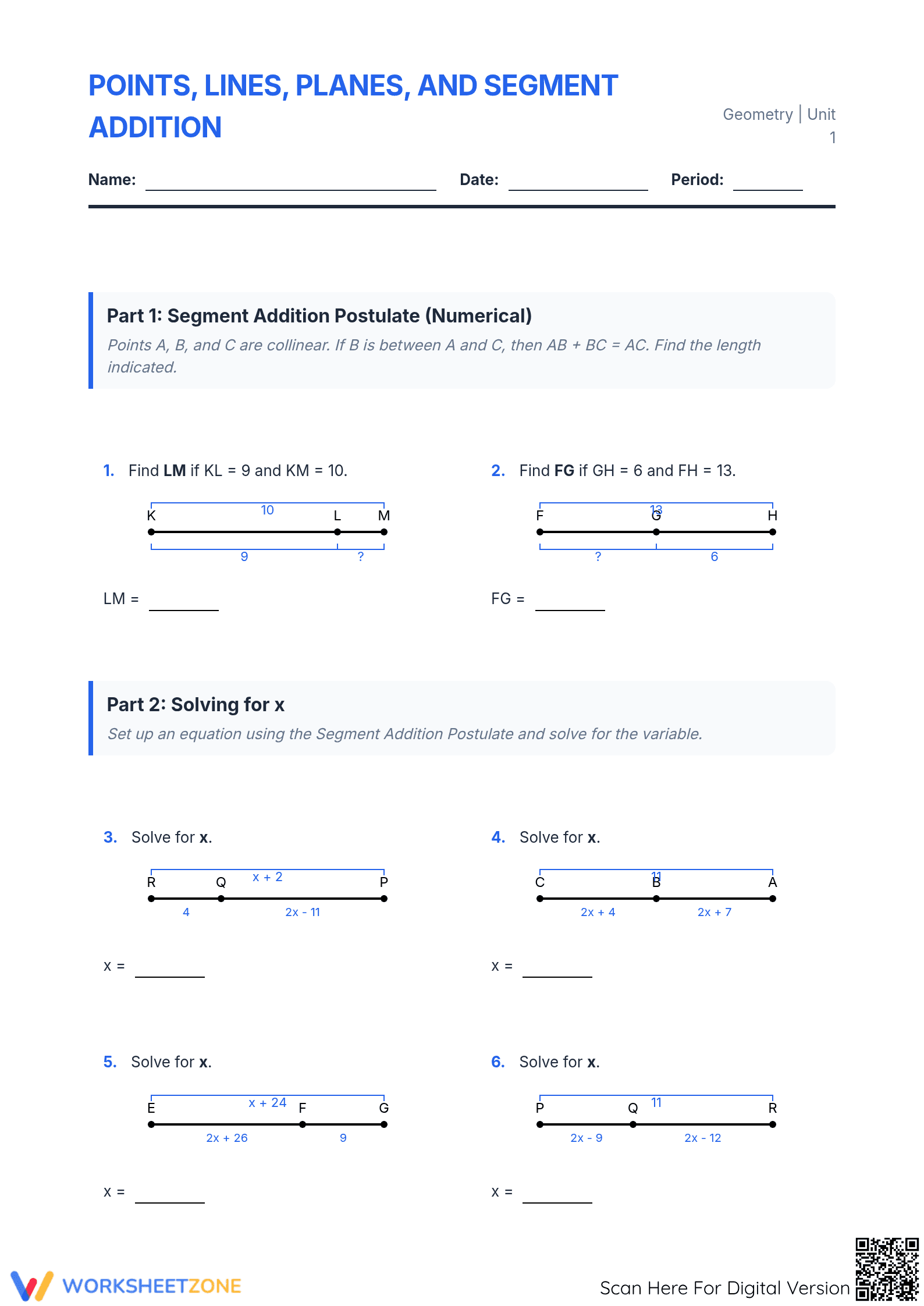
Students master the Segment Addition Postulate and the essential vocabulary of Euclidean geometry through this comprehensive Grade 8–9 practice resource. By working through numerical calculations, algebraic modeling, and precise sketching, learners build a rock-solid foundation in how points, lines, and planes interact. This worksheet ensures students gain a deep conceptual grasp of defined and undefined terms.
At a Glance
- Grade: 8–9 · Subject: Math
- Standard:
CCSS.MATH.CONTENT.HSG.CO.A.1— Know precise definitions of point, line, and distance along a line- Skill Focus: Segment Addition Postulate
- Format: 4 pages · 18 problems · Answer key included · PDF
- Best For: High school geometry introduction and review
- Time: 45–60 minutes
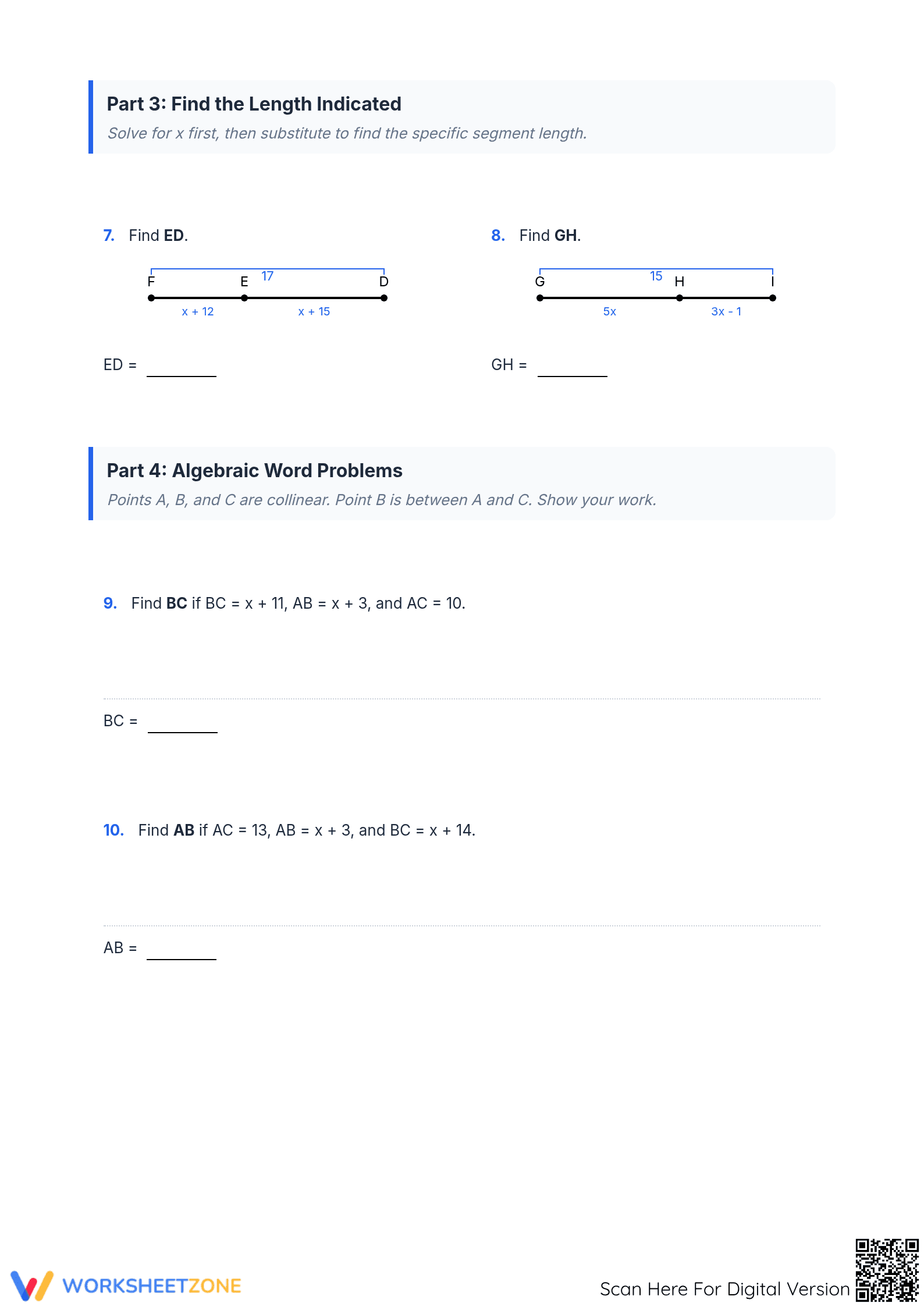
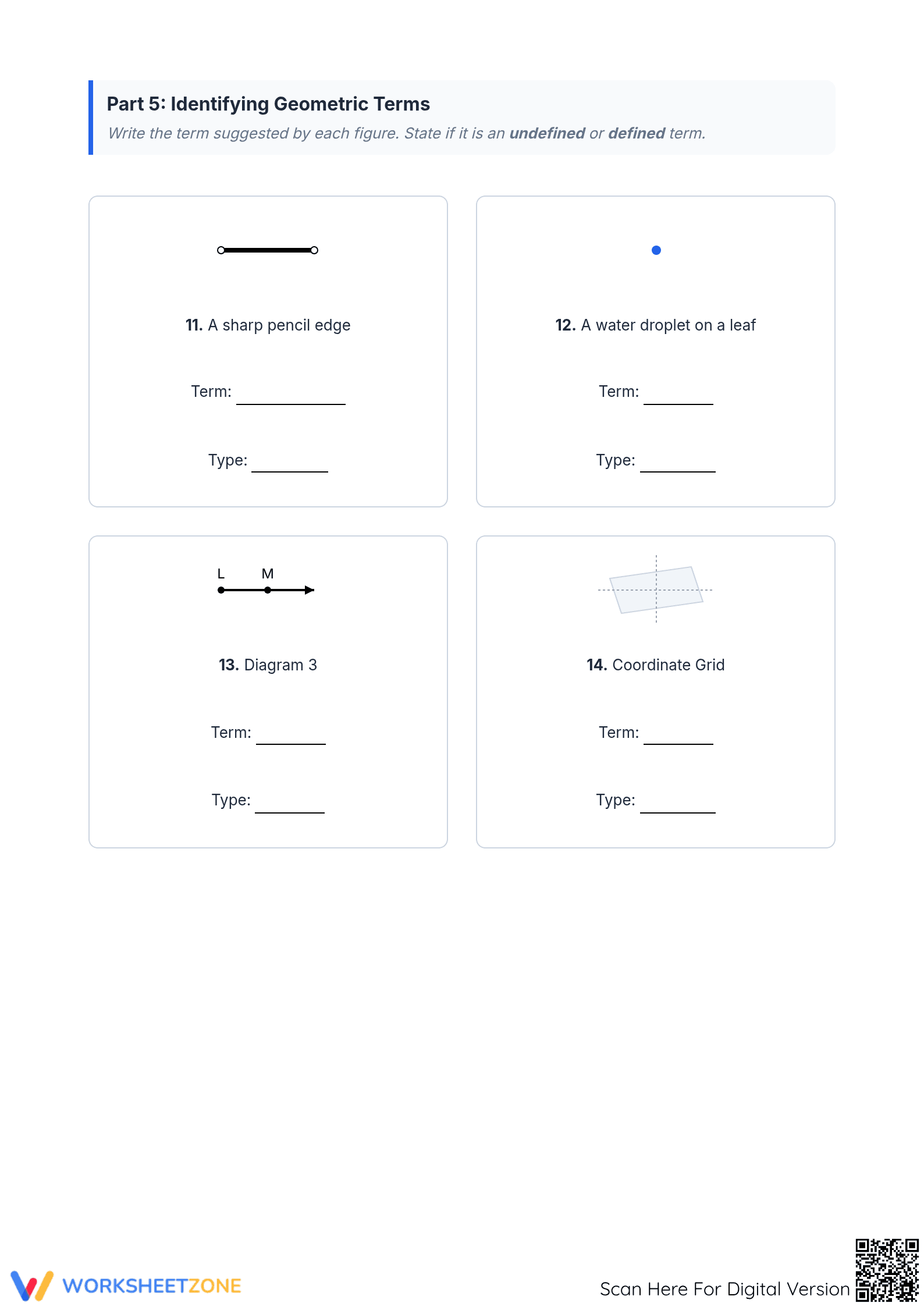
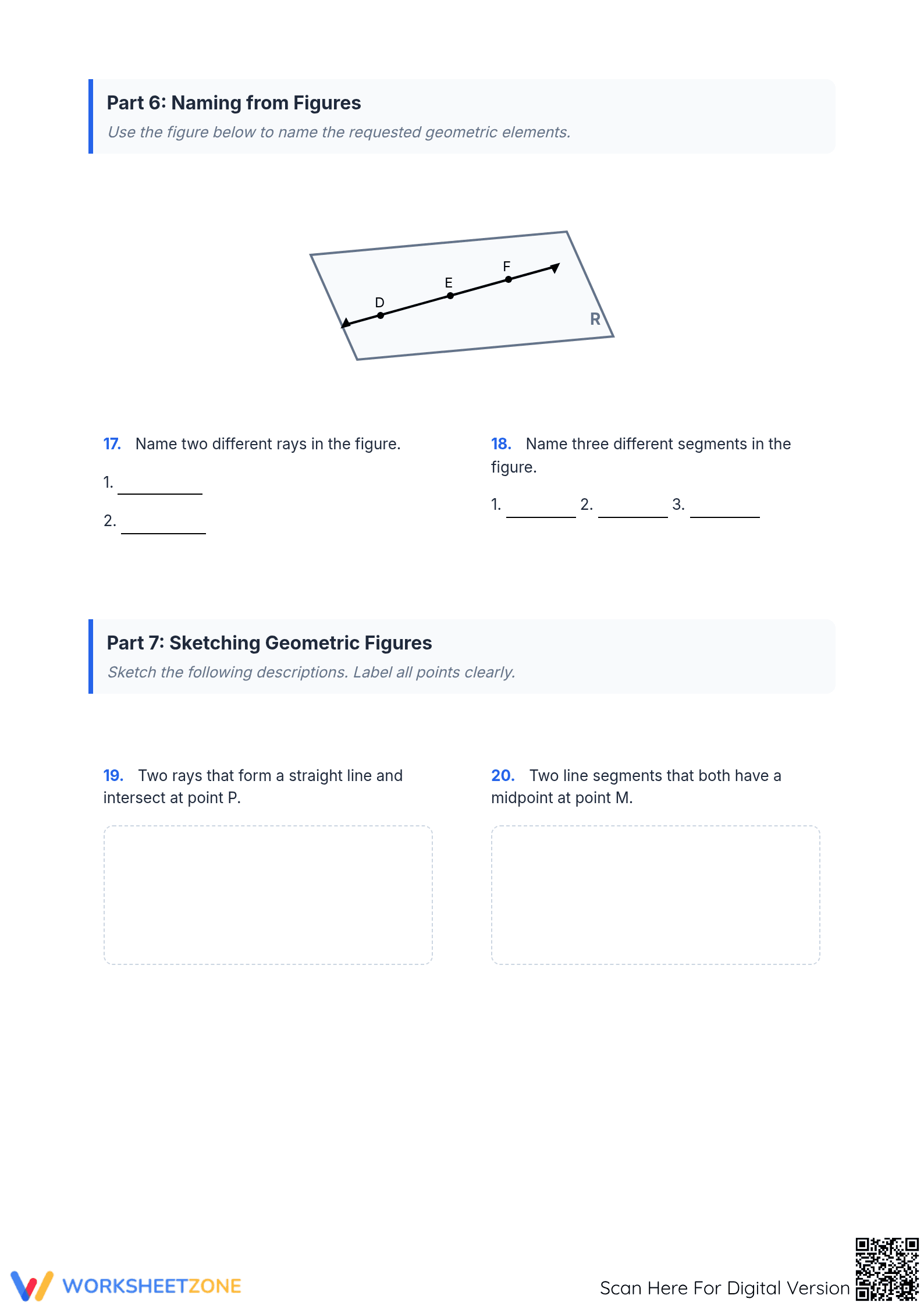
This four-page resource contains seven distinct sections that systematically build geometric fluency. It includes numerical segment problems, algebraic equations for segment lengths, word problems requiring collinear point analysis, and a comprehensive review of defined versus undefined terms. The package comes with a complete answer key, featuring step-by-step solutions for all algebraic components to facilitate quick grading.
- Guided Practice (Numerical): 2 initial problems focus on basic collinear relationships using numerical values to establish the core logic of segment sums.
- Supported Practice (Algebraic): 8 problems transition learners into solving for 'x' and finding specific segment lengths, requiring the translation of visual diagrams into linear equations.
- Independent Application: 8 multifaceted tasks challenge students to identify defined and undefined terms, name figures, and sketch complex geometric descriptions from scratch.
This sequence follows a gradual-release model, moving from teacher-led "I Do" numerical examples to "You Do" independent sketching and terminology classification.
This resource is primarily aligned with CCSS.MATH.CONTENT.HSG.CO.A.1, which focuses on precise definitions of geometric elements based on the undefined notions of point, line, and plane. It also supports algebraic standards by requiring students to create and solve linear equations that represent geometric relationships. Both standard codes can be copied directly into lesson plans, IEP goals, or district curriculum mapping tools.
Use this worksheet as a main instructional tool after introducing the Segment Addition Postulate to transition students from basic arithmetic to algebraic thinking. It also serves as an excellent diagnostic tool to check for misconceptions regarding 'betweenness' or collinearity. Teachers should observe students during the sketching portion to ensure they understand how to represent intersections accurately. Expected completion time is 45 to 60 minutes.
This worksheet is designed for Grade 8 and Grade 9 students enrolled in introductory Geometry or Algebra-integrated math courses. It is particularly effective for students who require visual scaffolds to connect symbolic equations with physical diagrams. Pair this resource with a geometry passage or an anchor chart on geometric undefined terms for a complete lesson module.
The CCSS.MATH.CONTENT.HSG.CO.A.1 standard requires students to master the precise definitions of points, lines, and planes as the foundation for all geometric reasoning. This worksheet facilitates this mastery by guiding students through the Segment Addition Postulate, a critical bridge between arithmetic and algebraic geometry. According to Fisher & Frey (2014), the gradual release of responsibility model—moving from numerical examples to word problems and creative sketching—is essential for developing cognitive independence. By requiring students to not only calculate but also identify defined versus undefined terms, this resource ensures a deep conceptual grasp rather than mere procedural fluency. This approach aligns with modern instructional frameworks that prioritize the synthesis of multiple representational modes, including visual diagrams and symbolic notation. Teachers can utilize the included multi-part structure to provide scaffolds for struggling learners while ensuring that all 18 tasks help students meet the rigorous demands of high school geometry standards.


