


























Views
Downloads

Essential Point-Slope and Slope-Intercept Form Worksheet
Paste this activity's link or code into your existing LMS (Google Classroom, Canvas, Teams, Schoology, Moodle, etc.).
Students can open and work on the activity right away, with no student login required.
You'll still be able to track student progress and results from your teacher account.
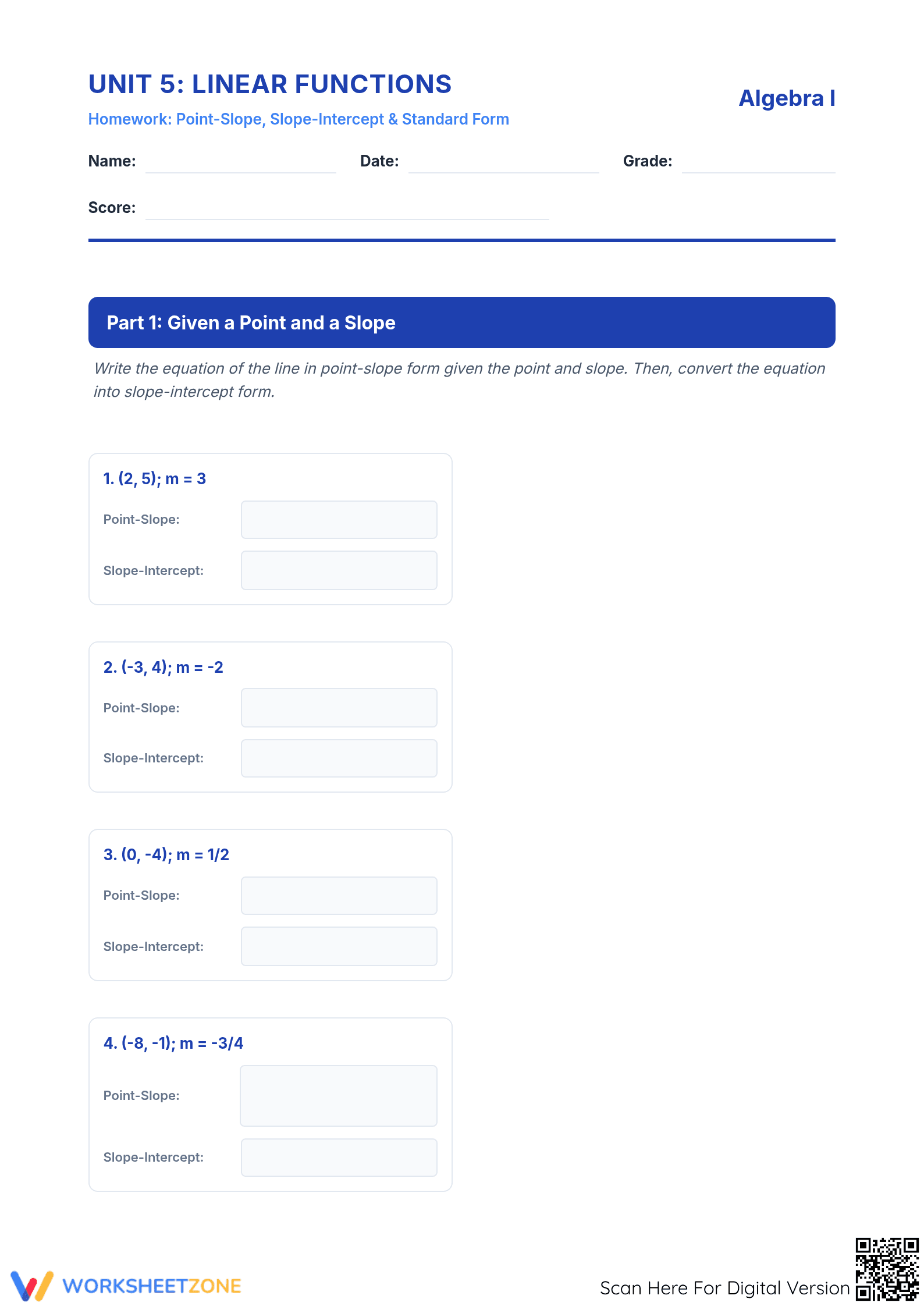
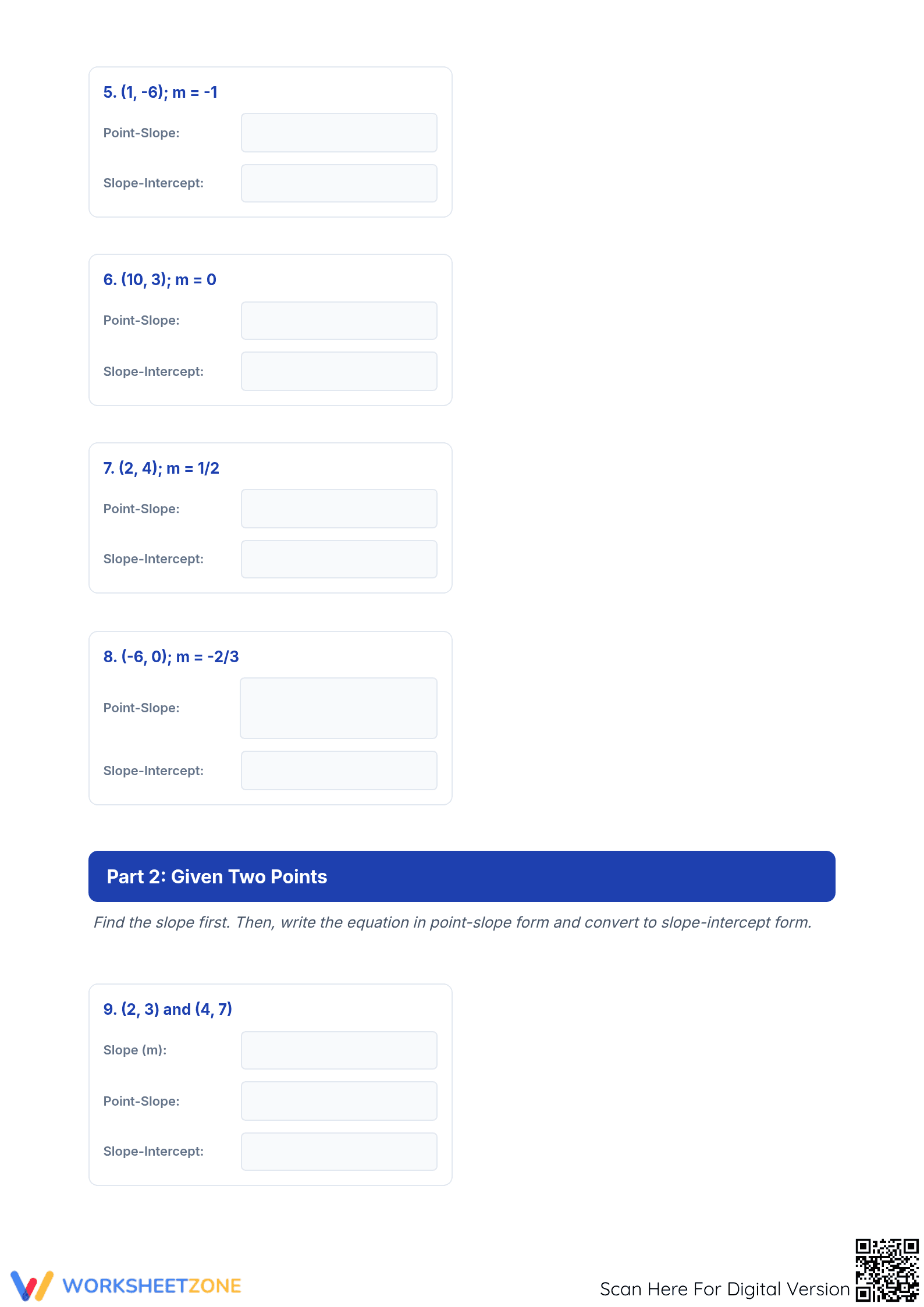
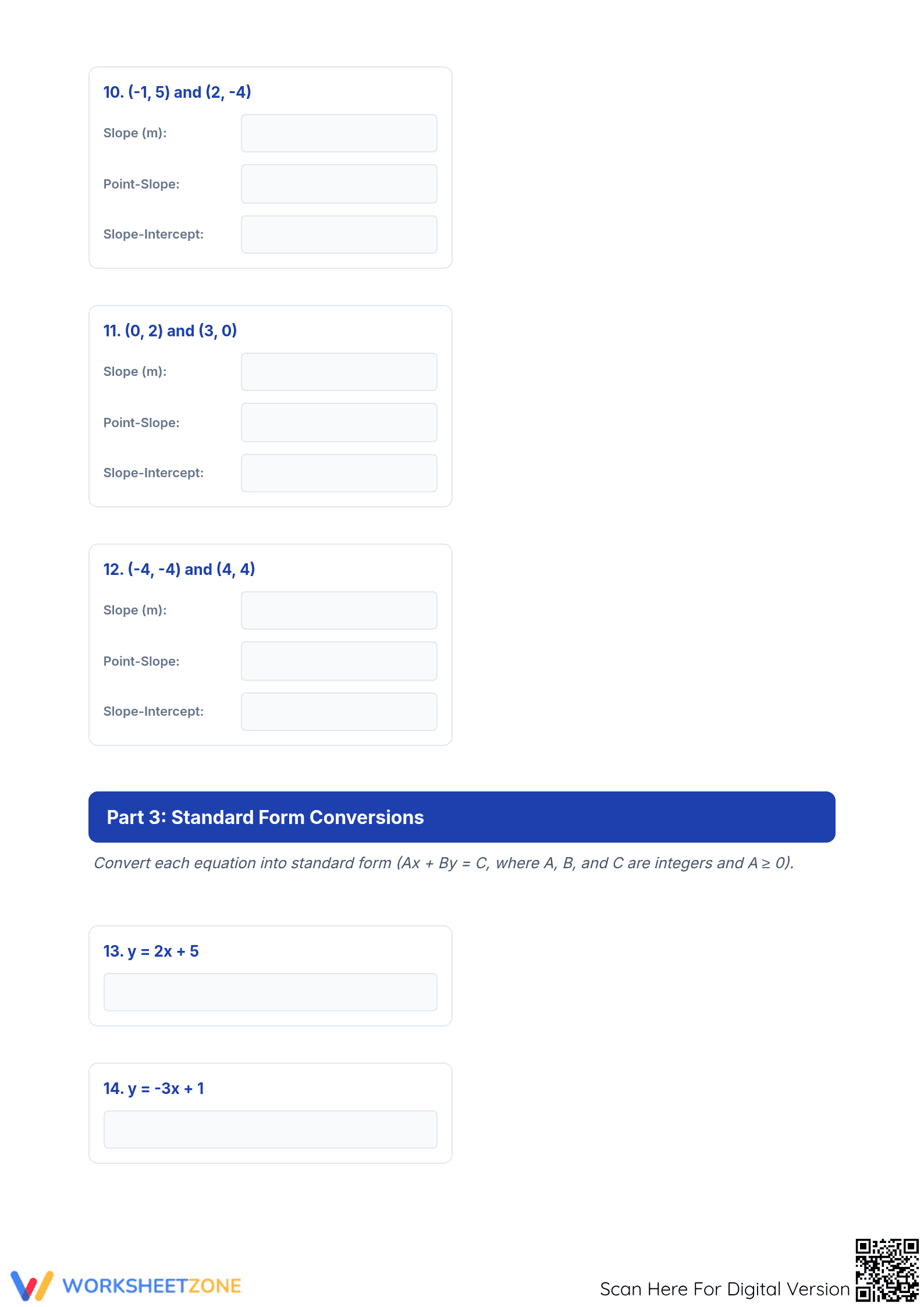
This comprehensive Algebra I worksheet targets the essential skill of manipulating linear equations. Students master the transition between point-slope, slope-intercept, and standard forms through 18 targeted exercises. By working through these varied problem types, learners develop a deep conceptual understanding of how linear relationships are represented algebraically and graphically on a coordinate plane.
At a Glance
- Grade: 9 · Subject: Algebra I
- Standard:
HSA.CED.A.2— Create equations in two variables to represent relationships and graph them on axes- Skill Focus: Linear Equation Form Conversions
- Format: 4 pages · 18 problems · Answer key included · PDF
- Best For: Linear functions homework or mastery practice
- Time: 45–60 minutes
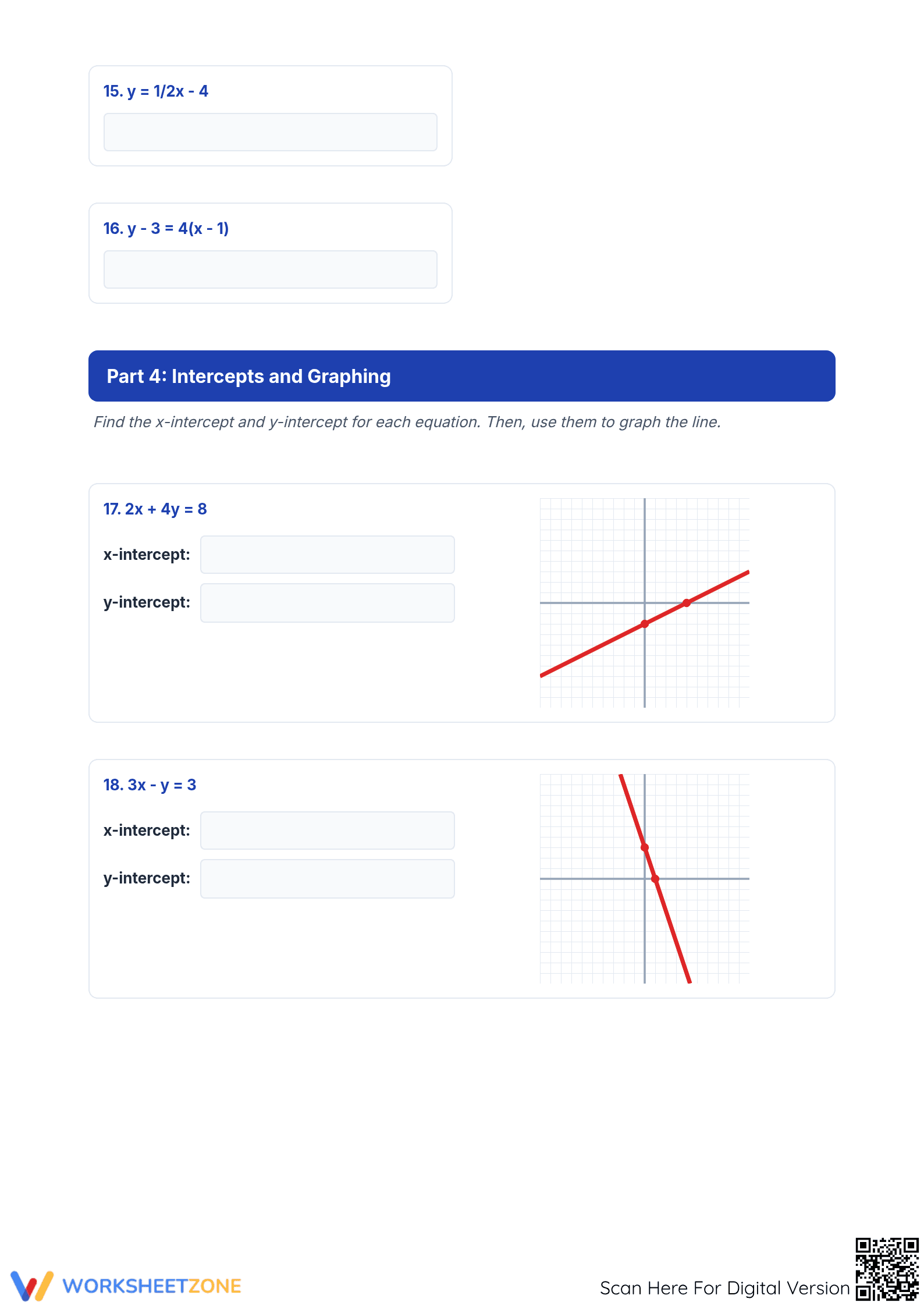
This four-page PDF is a structured exploration of linear functions. It contains 18 multi-step problems divided into four distinct parts. The layout provides ample workspace for calculations and includes pre-drawn coordinate grids for the graphing section. A complete, step-by-step answer key is provided to facilitate quick grading or student self-correction during independent work.
Skill Progression
- Guided practice: Part 1 provides 8 problems where students are given a point and a slope, requiring them to write the point-slope form before converting to slope-intercept.
- Supported practice: Parts 2 and 3 require students to calculate slopes from two points and perform standard form conversions with increasing complexity.
- Independent practice: Part 4 challenges students to identify intercepts and graph lines independently.
This gradual-release model ensures that students move from basic identification to full graphical application using the I Do, We Do, You Do method.
Standards Alignment
The primary focus is HSA.CED.A.2, which requires students to create equations in two or more variables to represent relationships between quantities. Additionally, the graphing component supports HSF.IF.C.7.A by asking students to graph linear functions and show intercepts. Both standard codes can be copied directly into lesson plans, IEP goals, or district curriculum mapping tools.
How to Use It
This resource is ideal for use as a summative homework assignment following a lesson on linear forms. Teachers can also utilize Part 2 as a mid-lesson formative assessment to check for understanding of slope calculations before moving to standard form conversions. During instruction, observe how students handle negative slopes or zero slopes (Problem 6) to identify common misconceptions early. Expected completion time ranges from 45 to 60 minutes.
Who It's For
This worksheet is designed for Grade 9 Algebra I students but serves as an excellent review for Grade 10 students entering Geometry or Algebra II. It is particularly effective for students who benefit from structured workspace and clear visual cues. Pair this worksheet with a linear functions anchor chart or a digital graphing calculator session for a complete instructional experience.
Aligning with NAEP frameworks for mathematical complexity, this worksheet emphasizes the transition between algebraic representations and their graphical counterparts. Research indicates that fluency in converting between linear forms—specifically point-slope and slope-intercept—is a critical predictor of success in higher-level calculus and physics courses. By providing 18 structured opportunities for practice, this resource addresses the "fluency with procedures" strand identified by the National Research Council as essential for mathematical proficiency. The inclusion of graphing intercepts directly maps to NAEP's measurement of algebraic reasoning and spatial visualization skills. Students who master these conversions are better equipped to model real-world data and interpret the rate of change in various contexts. This resource provides the rigorous, standards-aligned practice necessary to bridge the gap between abstract symbolic manipulation and concrete visual representation of linear functions in high school mathematics.


