


























Views
Downloads


Plymouth Colony Reading Comprehension | Essential Grade 8-9
Paste this activity's link or code into your existing LMS (Google Classroom, Canvas, Teams, Schoology, Moodle, etc.).
Students can open and work on the activity right away, with no student login required.
You'll still be able to track student progress and results from your teacher account.
This Grade 8-9 reading comprehension packet explores the Plymouth Colony, focusing on the Pilgrims' journey and early governance. Students analyze historical narratives to extract key details about the Mayflower Compact and interactions with the Wampanoag people, building high-level literacy skills while engaging with foundational American history.
At a Glance
- Grade: 8-9 · Subject: ELA / History
- Standard:
CCSS.ELA-LITERACY.RI.8.1— Cite strong and thorough textual evidence to support analysis of what the text says.- Skill Focus: Informational Text Analysis
- Format: 5 pages · 11 problems · Answer key included · PDF
- Best For: No-prep history-themed ELA lessons
- Time: 35–45 minutes
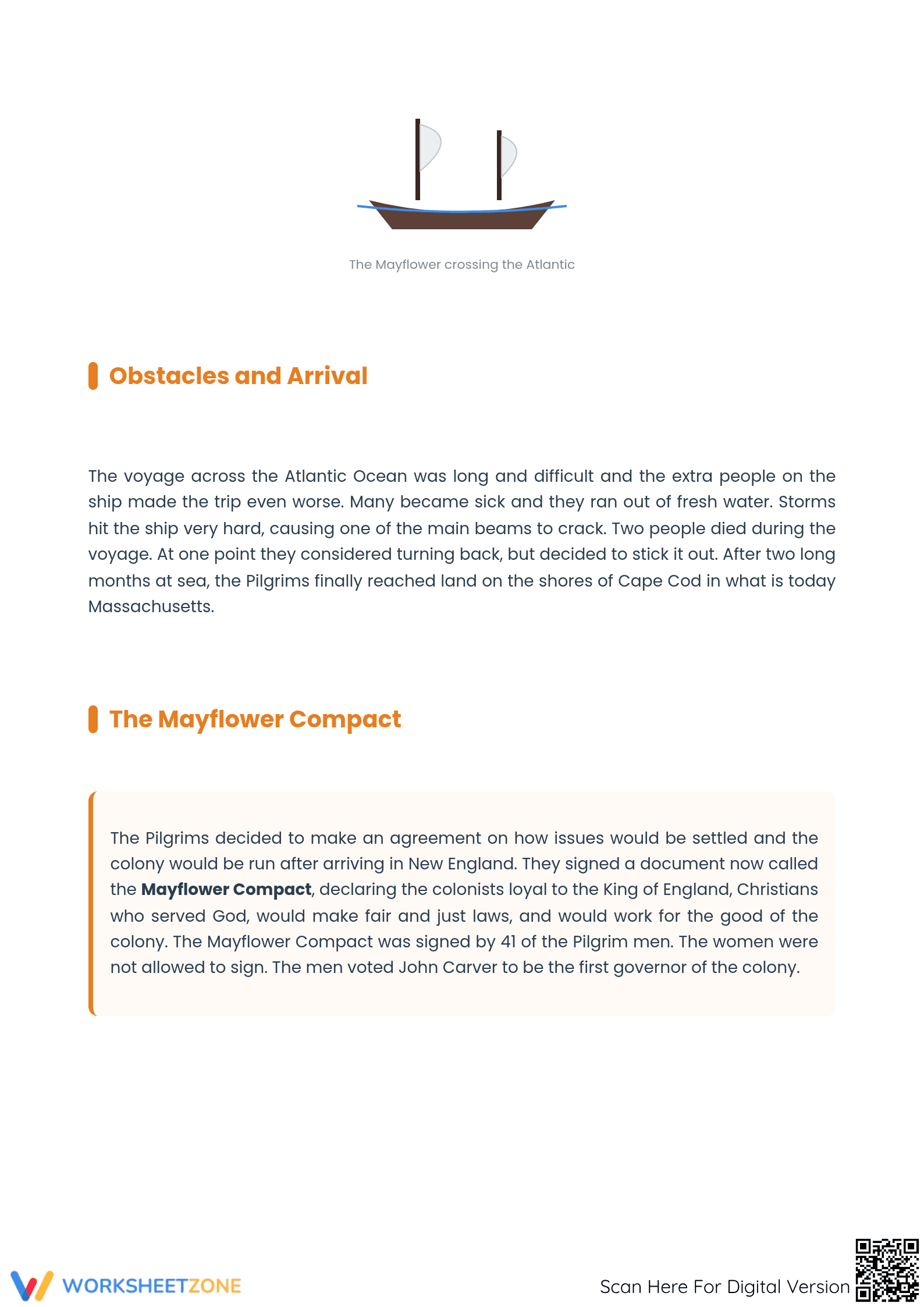
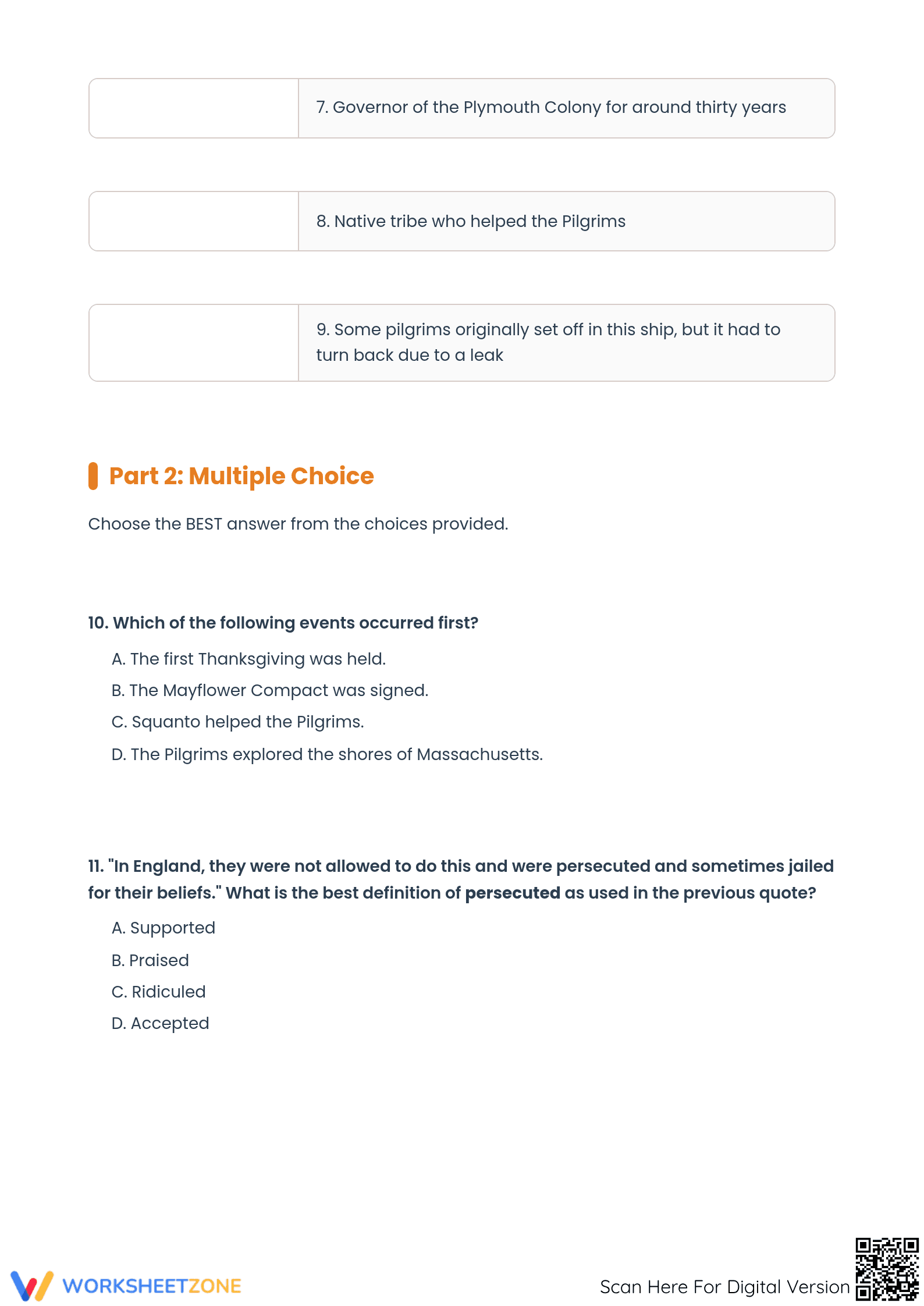
What's Inside: This 5-page packet includes a three-page reading passage divided into thematic sections: The Pilgrims, The Voyage, Obstacles and Arrival, The Mayflower Compact, Settlement, and Thanksgiving. The assessment features a 9-item identification word bank and multiple-choice questions testing factual recall and vocabulary acquisition. A full answer key is provided.
Zero-Prep Workflow
- Print (1 Minute): Print the 5-page PDF for your roster. The layout is optimized for black-and-white printing.
- Distribute (1 Minute): Hand out the packets. Clear headings allow students to work independently.
- Review (10 Minutes): Use the answer key to facilitate a class discussion or peer-grading session, reinforcing historical accuracy.
This streamlined process makes the worksheet ideal for emergency sub plans or busy instructional days.
Standards Alignment: Aligned to CCSS.ELA-LITERACY.RI.8.1, students cite evidence to identify historical figures and explain the Mayflower Compact's significance. It also supports CCSS.ELA-LITERACY.RI.8.4 by challenging students to determine the meaning of domain-specific words like "persecuted" and "separatists." Codes can be copied directly into lesson plans.
How to Use It: Assign this packet during the "Independent Practice" phase of a unit on Colonial America or early American literature. It serves as an excellent formative assessment to gauge reading stamina and comprehension. For a collaborative approach, have students work in pairs to find the specific paragraph that provides the answer for each identification task, marking the evidence directly in the text. Completion typically takes 35 to 45 minutes.
Who It's For: This worksheet is designed for Grade 8 and Grade 9 students who are developing their ability to synthesize complex historical information. It is particularly effective for inclusive classrooms, as the structured word bank provides a scaffold for English Language Learners and students with IEPs. It pairs naturally with a primary source analysis of the Mayflower Compact or a direct instruction lesson on the Great Migration.
The use of structured informational texts in secondary ELA is supported by Fisher & Frey (2014), who emphasize that complex historical narratives provide the necessary friction for students to develop close-reading habits. By requiring students to map specific terms like "Wampanoag" and "William Bradford" back to their textual descriptions, this worksheet reinforces the cognitive link between vocabulary and conceptual understanding. Research from the NAEP suggests that students who engage with integrated social studies and literacy content demonstrate higher proficiency in identifying authorial intent and structural logic. This resource addresses CCSS.ELA-LITERACY.RI.8.1 by forcing a direct interaction with the text, ensuring that student claims are rooted in observable evidence rather than prior knowledge alone. Such evidence-based practice is a cornerstone of college and career readiness, providing a stable foundation for the more advanced rhetorical analysis required in later high school grades and standardized testing environments.


