


























Views
Downloads
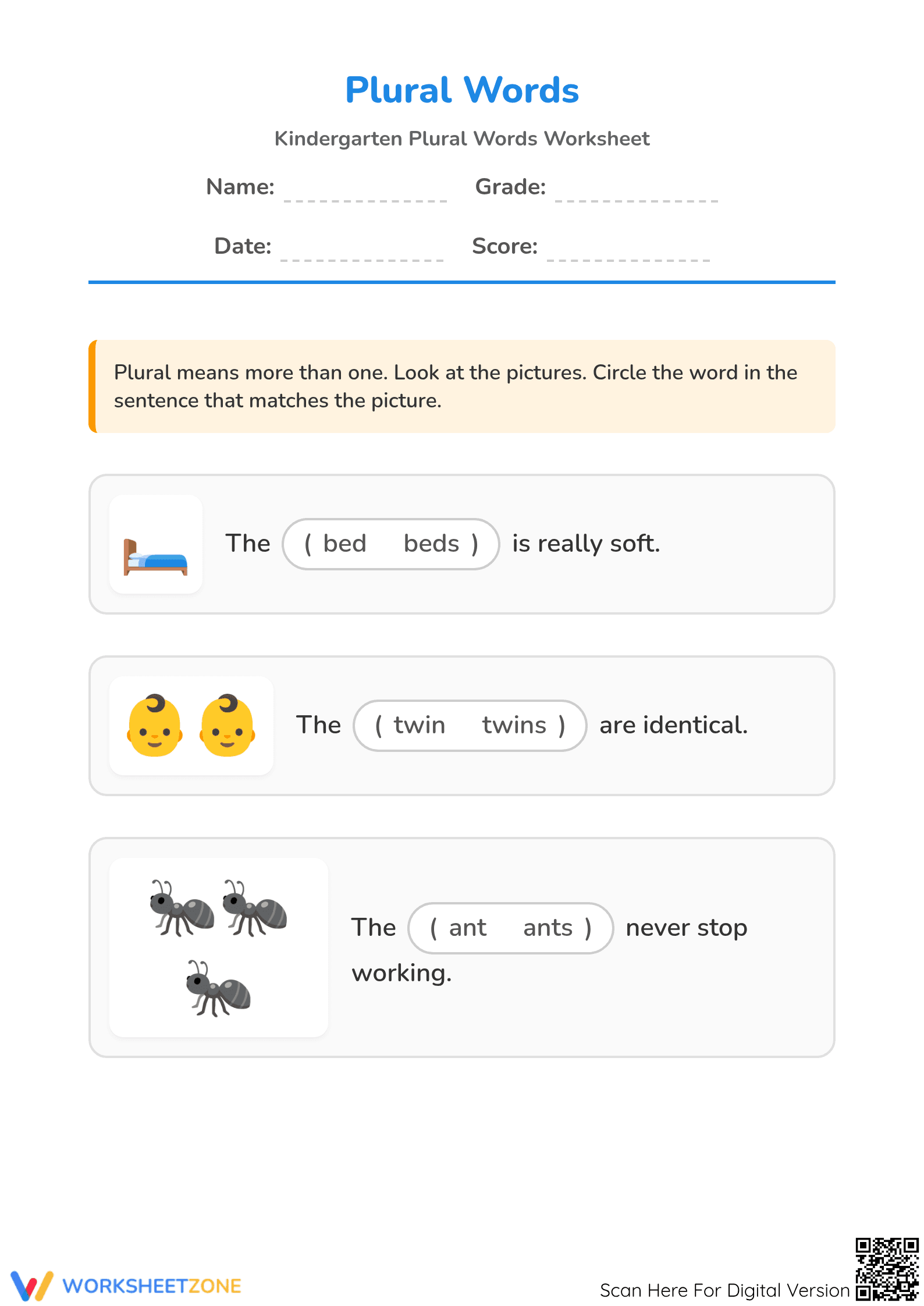


Kindergarten Plural Words Worksheet | Essential Practice
Paste this activity's link or code into your existing LMS (Google Classroom, Canvas, Teams, Schoology, Moodle, etc.).
Students can open and work on the activity right away, with no student login required.
You'll still be able to track student progress and results from your teacher account.
This Kindergarten plural words worksheet helps young learners distinguish between singular and plural nouns by adding the suffix -s. Students observe clear visual cues and select the correct word form to complete simple sentences. It provides a foundational understanding of quantity and grammar, ensuring students can identify more than one in written contexts.
At a Glance
- Grade: Kindergarten · Subject: ELA
- Standard:
CCSS.ELA-LITERACY.L.K.1.C— Form regular plural nouns by adding /s/ or /es/ to words- Skill Focus: Regular plural nouns (-s)
- Format: 2 pages · 8 problems · Answer key included · PDF
- Best For: Independent practice or morning work
- Time: 10–15 minutes
The resource consists of two high-quality PDF pages featuring eight distinct practice problems. Each task includes a vibrant illustration representing either a single object or a group, paired with a sentence containing a parenthetical choice between singular and plural forms. A comprehensive answer key is provided, allowing for quick grading or student self-correction. The layout is clean and distraction-free, perfect for early childhood learners.
Zero-Prep Workflow:
- Print: Select the two pages and hit print; no special settings or color ink required (1 minute).
- Distribute: Hand out the sheets during your grammar block or as a transition activity (30 seconds).
- Review: Use the included answer key to check student work or project it for a whole-class review (30 seconds).
Total teacher preparation time is under two minutes, making this an ideal solution for busy mornings or unexpected sub plans.
This worksheet is strictly aligned with CCSS.ELA-LITERACY.L.K.1.C, which requires students to form regular plural nouns orally or in writing by adding /s/ or /es/. By connecting visual representations of quantity to the written word, students build the morphological awareness necessary for early reading fluency. This standard code can be copied directly into lesson plans, IEP goals, or district curriculum mapping tools.
Use this worksheet during the independent practice phase of a lesson on nouns. After introducing the concept of more than one, assign these pages to assess individual student understanding. As a formative assessment, observe if students are counting the items in the pictures before looking at the word choices. Completion typically takes 10 to 15 minutes depending on reading level.
This resource is designed for Kindergarten students but serves as an excellent remedial tool for first graders needing a refresher on basic plurals. It is particularly effective for English Language Learners (ELLs) who benefit from the direct correlation between the images and the grammatical structures. Pair this with a physical sorting activity using classroom manipulatives for a multi-sensory experience.
According to the RAND AIRS 2024 report on early literacy, the integration of visual scaffolds with morphological tasks significantly improves a child's ability to internalize grammatical rules like pluralization. This worksheet targets CCSS.ELA-LITERACY.L.K.1.C by requiring students to identify the correct plural form (adding -s) based on pictorial evidence. Research indicates that Kindergarten students who master regular plurals early demonstrate higher levels of reading comprehension in later grades, as they spend less cognitive energy decoding word endings. By providing 8 structured tasks, this resource offers the repetitive exposure necessary for mastery. The inclusion of an answer key supports immediate feedback, a critical component of effective formative assessment in early childhood education. This evidence-based approach ensures that students move beyond rote memorization to a functional understanding of how word forms change to reflect quantity in the English language.


