


























Views
Downloads


Plural Words Worksheet | Essential Kindergarten ELA
Paste this activity's link or code into your existing LMS (Google Classroom, Canvas, Teams, Schoology, Moodle, etc.).
Students can open and work on the activity right away, with no student login required.
You'll still be able to track student progress and results from your teacher account.
This Kindergarten ELA worksheet helps young learners distinguish between singular and plural nouns through clear visual cues. By identifying the concept of "more than one," students build a foundational understanding of word classes and lexical structures. It provides a clear, engaging way to practice noun forms in a classroom or home setting.
At a Glance
- Grade: Kindergarten · Subject: ELA
- Standard:
CCSS.ELA-LITERACY.L.K.1.C— Form regular plural nouns orally by adding /s/ or /es/- Skill Focus: Singular vs. Plural Nouns
- Format: 2 pages · 6 problems · Answer key included · PDF
- Best For: Morning work or small group instruction
- Time: 10–15 minutes
What's Inside
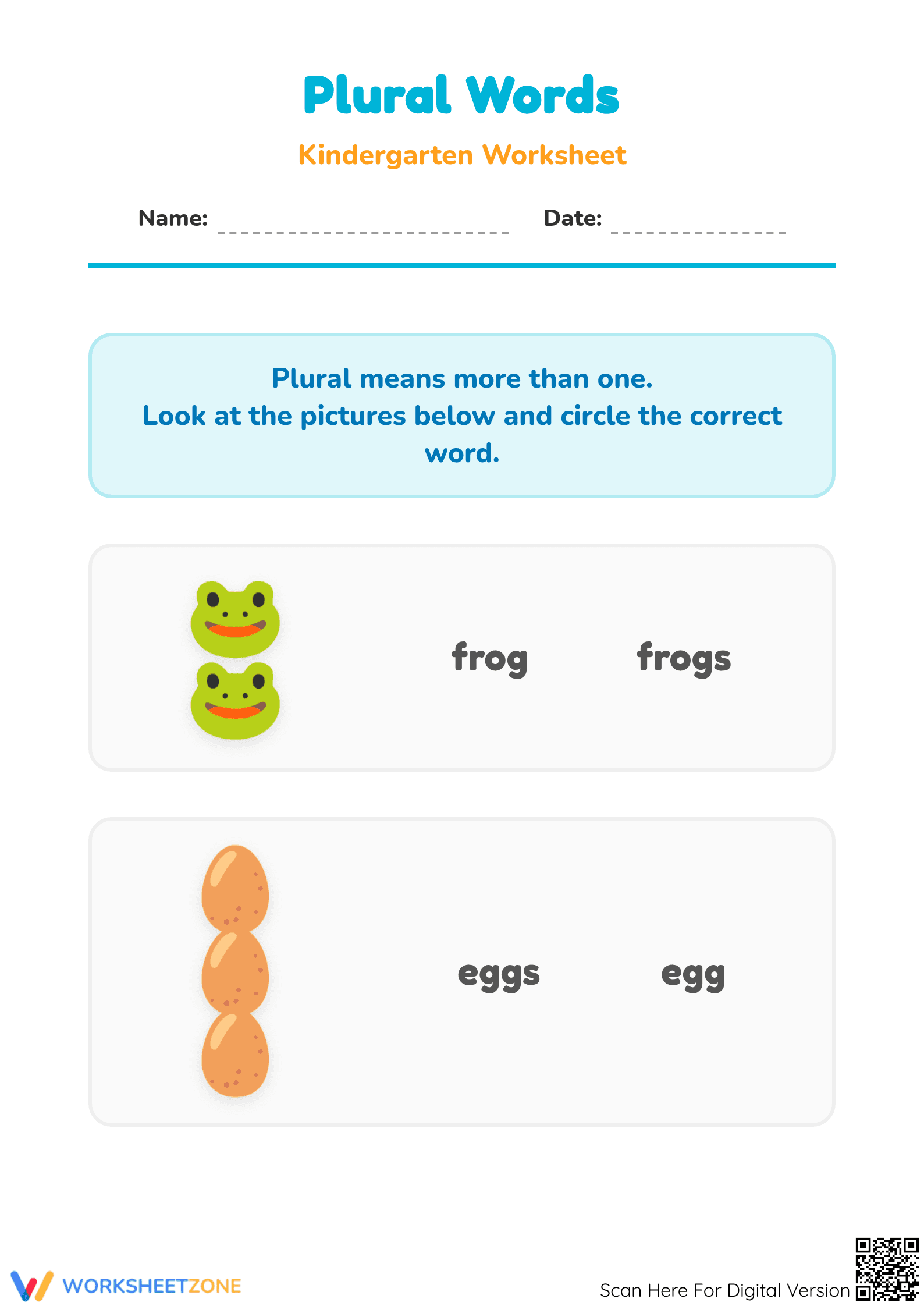
This resource contains 2 pages featuring 6 distinct tasks. Each problem uses high-quality visual icons, such as frogs, eggs, and leaves, to represent quantity. Students are asked to circle the correct word form that matches the image. The set includes both regular plurals and common irregulars like "feet" and "teeth" to provide a gentle challenge. A full answer key is included for quick grading.
Zero-Prep Workflow
- Print: Select the 2-page PDF and print enough copies for your roster (30 seconds).
- Distribute: Hand out the sheets during your language arts block or as a transition activity (1 minute).
- Review: Use the provided answer key to check for understanding or have students self-correct (5 minutes).
Total teacher preparation time is under 2 minutes, making this an ideal choice for emergency sub plans or last-minute literacy centers.
Standards Alignment
This worksheet aligns with CCSS.ELA-LITERACY.L.K.1.C: "Form regular plural nouns orally by adding /s/ or /es/ (e.g., dog, dogs; wish, wishes)." While the primary focus is Kindergarten, the inclusion of irregular forms serves as an introductory bridge to higher-level morphology standards. Both standard codes can be copied directly into lesson plans, IEP goals, or district curriculum mapping tools.
How to Use It
Assign this worksheet during direct instruction on noun forms or as a formative assessment after a read-aloud. For a quick observation tip, watch to see if students count the items in the image before selecting their answer. This indicates they are connecting the visual quantity to the linguistic plural marker. Expected completion time ranges from 10 to 15 minutes.
Who It's For
This resource is designed for Kindergarten students, but it is also highly effective for English Language Learners (ELL) or 1st-grade students needing a refresher. It pairs naturally with a singular/plural anchor chart or a direct instruction lesson on word endings.
Research from Fisher & Frey (2014) emphasizes the importance of visual scaffolding in early literacy. This worksheet utilizes high-quality icons to represent numerical quantity, allowing students to map the concept of plurality to specific lexical changes. By presenting both regular (frogs) and irregular (shelves) forms, the resource encourages pattern recognition in English morphology. According to the NAEP framework, early exposure to word parts and inflections is a significant predictor of later reading fluency. This 2-page PDF provides 6 targeted tasks that align with CCSS.ELA-LITERACY.L.K.1.C, ensuring that students move beyond simple rote memorization toward conceptual mastery of noun forms. The inclusion of an answer key facilitates immediate feedback, a critical component of the gradual release of responsibility model. Educators can reliably use this tool to document progress in foundational language standards.


