




























1 / 2
0
Views
0
Downloads


0.0
0
Save
0 Likes
Share
Plate Tectonics Worksheet: Boundaries and Questions
0 Views
0 Downloads

Paste this activity's link or code into your existing LMS (Google Classroom, Canvas, Teams, Schoology, Moodle, etc.).
Students can open and work on the activity right away, with no student login required.
You'll still be able to track student progress and results from your teacher account.
Information
Description
What It Is:
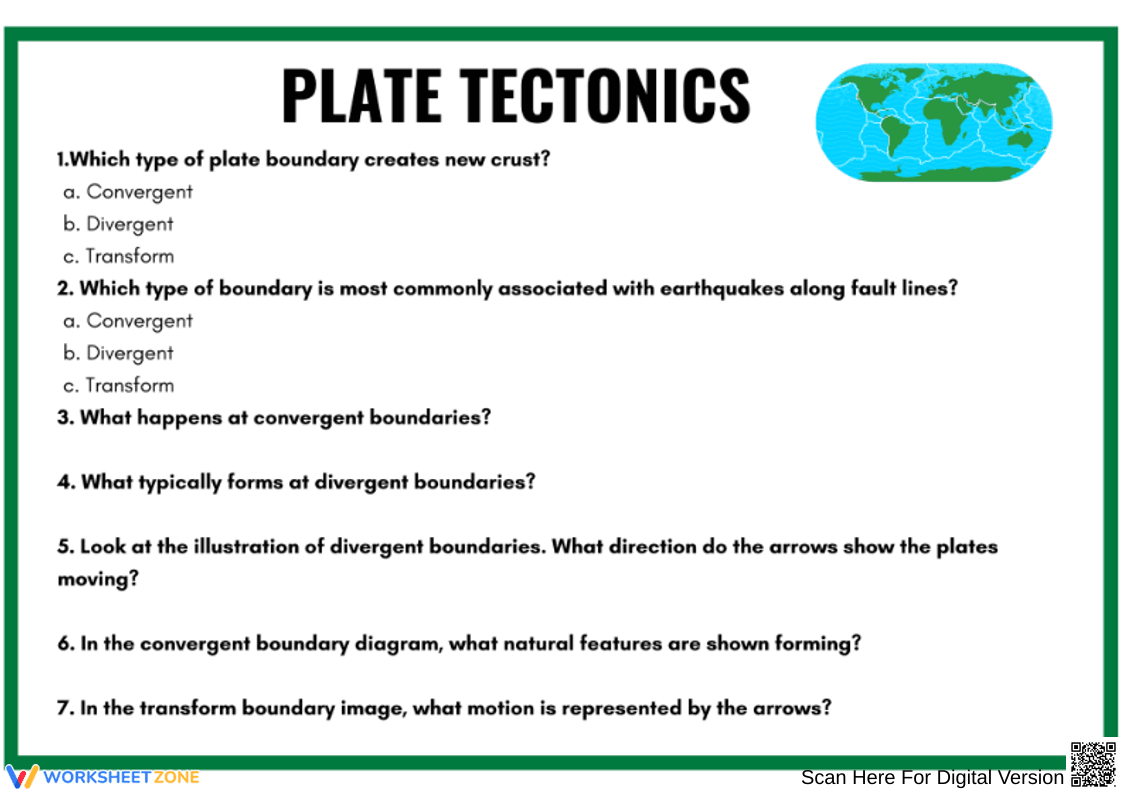
A two-page printable worksheet introducing the theory of plate tectonics and the three major types of plate boundaries: divergent, convergent, and transform. Page 1 provides visual explanations and diagrams, while Page 2 includes comprehension questions that help students apply what they’ve learned.
Why Use It:
This worksheet supports NGSS Earth science standards by building students’ understanding of plate movement, crust formation, earthquakes, volcanoes, and mountain building. It reinforces both vocabulary and conceptual knowledge through reading, diagrams, and critical-thinking questions.
How to Use It:
• Use as a class reading and discussion activity.
• Assign Page 2 as independent practice or homework.
• Pair with hands-on models or map activities that show real-world plate boundaries.
• Use as an assessment tool after a lesson or slideshow on plate tectonics.
Grade Suitability:
Best suited for Grades 4–7.
• Helpful for students learning Earth structure and geological processes.
• Supports both beginner and intermediate learners with visuals and scaffolded questions.
Target Users:
Teachers, homeschool educators, tutors, and students studying Earth science, plate tectonics, and geological features.
A two-page printable worksheet introducing the theory of plate tectonics and the three major types of plate boundaries: divergent, convergent, and transform. Page 1 provides visual explanations and diagrams, while Page 2 includes comprehension questions that help students apply what they’ve learned.
Why Use It:
This worksheet supports NGSS Earth science standards by building students’ understanding of plate movement, crust formation, earthquakes, volcanoes, and mountain building. It reinforces both vocabulary and conceptual knowledge through reading, diagrams, and critical-thinking questions.
How to Use It:
• Use as a class reading and discussion activity.
• Assign Page 2 as independent practice or homework.
• Pair with hands-on models or map activities that show real-world plate boundaries.
• Use as an assessment tool after a lesson or slideshow on plate tectonics.
Grade Suitability:
Best suited for Grades 4–7.
• Helpful for students learning Earth structure and geological processes.
• Supports both beginner and intermediate learners with visuals and scaffolded questions.
Target Users:
Teachers, homeschool educators, tutors, and students studying Earth science, plate tectonics, and geological features.


