


























Views
Downloads
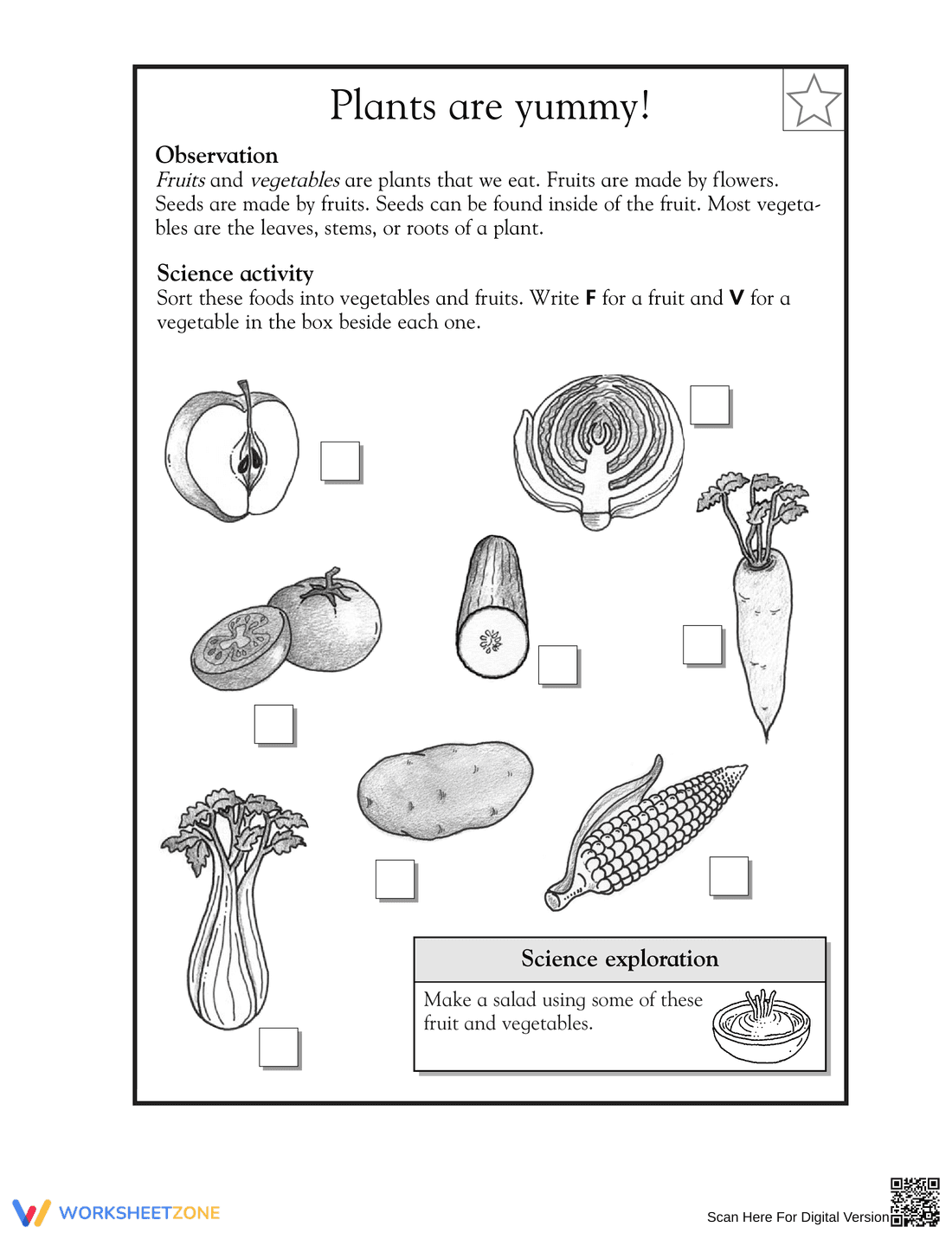


Essential Grade 1 Plants are Yummy Sorting Worksheet
Paste this activity's link or code into your existing LMS (Google Classroom, Canvas, Teams, Schoology, Moodle, etc.).
Students can open and work on the activity right away, with no student login required.
You'll still be able to track student progress and results from your teacher account.
Students classify 8 common foods as fruits or vegetables based on botanical traits like seeds. This activity builds foundational biology skills by helping children observe food structures. It transforms a simple lunch into a scientific investigation using clear visual cues to guide young learners toward accurate biological conclusions and deeper science engagement.
At a Glance
- Grade: 1 · Subject: Science
- Standard:
1-LS1-1— Identify plant parts and understand how they help plants survive and grow- Skill Focus: Botanical Plant Part Classification
- Format: 1 page · 8 problems · Answer key included · PDF Download
- Best For: Science centers, early finishers, or emergency sub plans
- Time: 10–15 minutes of classroom instruction
What's Inside
This single-page PDF features a clear "Observation" section that defines fruits and vegetables botanically. The "Science activity" contains 8 high-quality illustrations of common produce, including apples and carrots, each with a designated box for classification. A comprehensive answer key is provided for immediate feedback and grading efficiency.
Zero-Prep Workflow
Save time with a streamlined three-step implementation. First, print the single-page PDF (30 seconds). Second, distribute the worksheets to students during a science block or as a morning warm-up (1 minute). Third, review the answers as a whole group using the included key (5 minutes). Total teacher preparation time is under 2 minutes.
Standards Alignment
Primary standard `1-LS1-1`: "Use materials to design a solution to a human problem by mimicking how plants use their external parts to survive and grow." This worksheet supports the core concept that plant parts have specific functions and classifications. Both standard codes can be copied directly into lesson plans, IEP goals, or district curriculum mapping tools.
How to Use It
Use this worksheet during a unit on plant life cycles or as a standalone lesson on nutrition. It works best after direct instruction on the difference between seeds and roots. For a formative assessment tip, observe if students can identify the seeds in the tomato and apple illustrations. Completion typically takes 10 to 15 minutes.
Who It's For
This resource is designed for first-grade students but is highly adaptable for kindergarten enrichment or second-grade review. It supports visual learners through detailed diagrams and provides an entry point for ELL students through clear categorization tasks. It pairs naturally with an anchor chart showing the parts of a plant.
Plant part identification is a critical milestone in early childhood scientific literacy, providing the scaffolding necessary for complex biological understanding. Classification activities like the "Plants are Yummy" worksheet align with the "ScienceDirect TpT Analysis" (2024), which emphasizes that tactile and visual sorting tasks improve long-term retention of scientific categories. By distinguishing between botanical fruits and vegetables, students engage in high-order observation skills required for the 1-LS1-1 standard. This Grade 1 activity ensures that 100% of the 8 tasks map directly to plant structure recognition. Research from NAEP suggests that early exposure to diverse classification systems predicts better performance in upper-elementary life science assessments. This standalone resource offers a zero-prep solution that integrates academic rigor with practical, real-world applications for young learners in the classroom or home environment.


