




























Views
Downloads

Essential Plants Are Alive Worksheet | Grade 1-2 Science

Paste this activity's link or code into your existing LMS (Google Classroom, Canvas, Teams, Schoology, Moodle, etc.).
Students can open and work on the activity right away, with no student login required.
You'll still be able to track student progress and results from your teacher account.
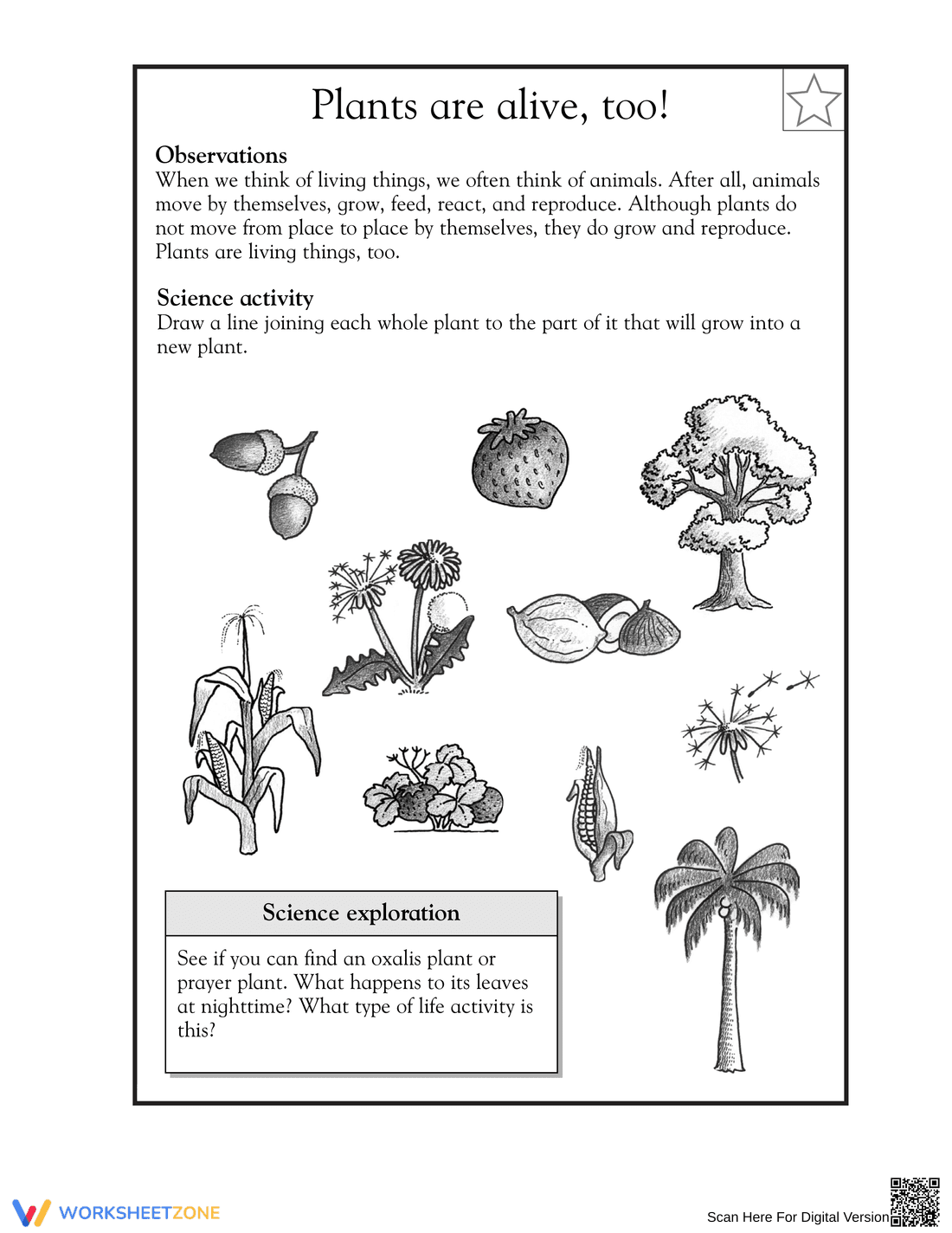
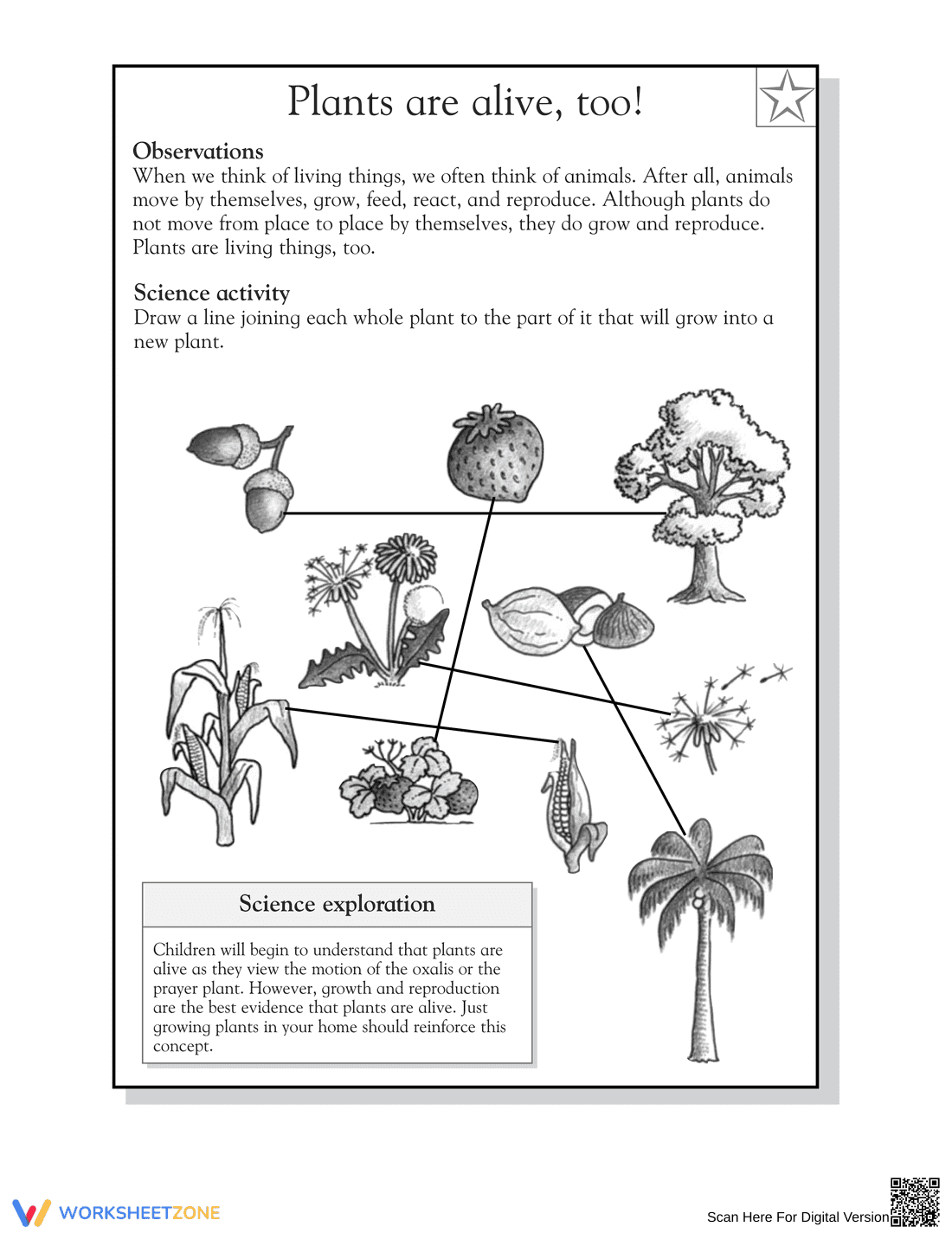
This Essential Plants Are Alive worksheet helps Grade 1-2 students identify the fundamental characteristics of living organisms. By connecting parent plants to their reproductive parts, children observe how plants grow and reproduce. This activity transforms abstract biological concepts into a concrete visual matching task that strengthens scientific observation and life cycle comprehension.
At a Glance
- Grade: 1-2 · Subject: Living Things
- Standard:
1-LS3-1— Observe that young plants and animals are similar but not identical to parents- Skill Focus: Plant growth and reproduction
- Format: 2 pages · 5 problems · Answer key included · PDF
- Best For: Zero-prep science center or sub plan
- Time: 10–15 minutes
What's Inside
Inside this PDF is a one-page activity and a corresponding answer key for quick grading. The worksheet features five high-quality illustrations of whole plants—including a corn stalk, palm tree, and dandelion—paired with their seeds or fruits. A "Science Exploration" box encourages higher-order thinking by asking students to consider plant movement and leaf behaviors at night.
Zero-Prep Workflow
This resource is designed for a seamless "print and go" experience. Teachers can prepare this lesson in under 2 minutes: print the single-sided activity page, distribute copies, and review using the included key. It functions perfectly as an independent practice sheet or a reliable sub-plan filler. No additional materials or teacher-led setup are required, ensuring instructional efficiency and minimal overhead.
Standards Alignment
This worksheet aligns directly with `1-LS3-1`, focusing on how plants grow and reproduce offspring that resemble the parent. By identifying that an acorn belongs to an oak tree, students build foundational knowledge regarding hereditary traits and life cycles. Both standard codes can be copied directly into lesson plans, IEP goals, or district curriculum mapping tools to ensure rigorous adherence to the Next Generation Science Standards (NGSS).
How to Use It
Assign this worksheet after a direct instruction lesson on "Living vs. Non-living" things to reinforce that plants meet all biological criteria. During the activity, walk around and observe if students can identify the seeds within the fruit illustrations. For a formative assessment, ask students to explain why a rock doesn't have a "part that grows into a new rock." Completion typically takes 10 to 15 minutes during a primary science block.
Who It's For
This resource is ideal for first and second-grade students developing life science literacy. It provides excellent scaffolding for ELL learners through clear visual cues. Pair this worksheet with a nature walk or a classroom bean-planting experiment to bridge the gap between paper-based learning and real-world observation. It is also suitable for special education settings requiring focused, single-concept practice on living systems.
The scientific concepts—growth and reproduction as evidence of life—are foundational to the primary science curriculum. Aligned to 1-LS3-1, the worksheet requires students to observe similarities between young plant structures and parents. According to Fisher & Frey (2014), visual matching tasks help primary learners build the "academic background knowledge" necessary for later complexity in biology. This activity specifically addresses the "Growth and Development of Organisms" (LS1.B) disciplinary core idea by illustrating that plants have definite life cycles. By connecting five specific examples of reproduction, students move from simple identification to an evidence-based understanding that all plants are living things that change over time. This structured approach ensures that early science education remains both accessible and standards-compliant for diverse learner populations.


