


























Views
Downloads

Plant Shapes and Sizes Worksheet | Essential Grade 2 Science
Paste this activity's link or code into your existing LMS (Google Classroom, Canvas, Teams, Schoology, Moodle, etc.).
Students can open and work on the activity right away, with no student login required.
You'll still be able to track student progress and results from your teacher account.
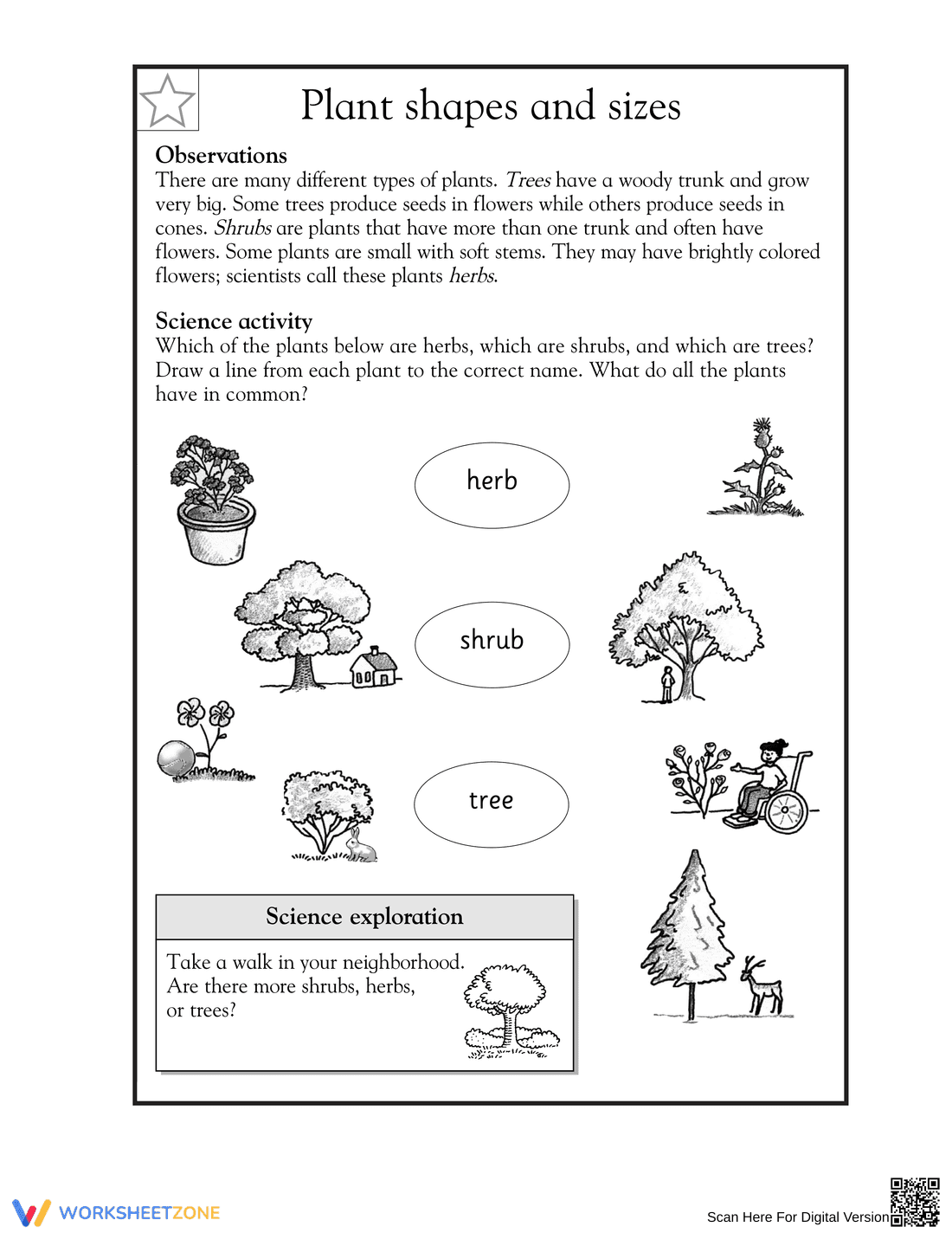
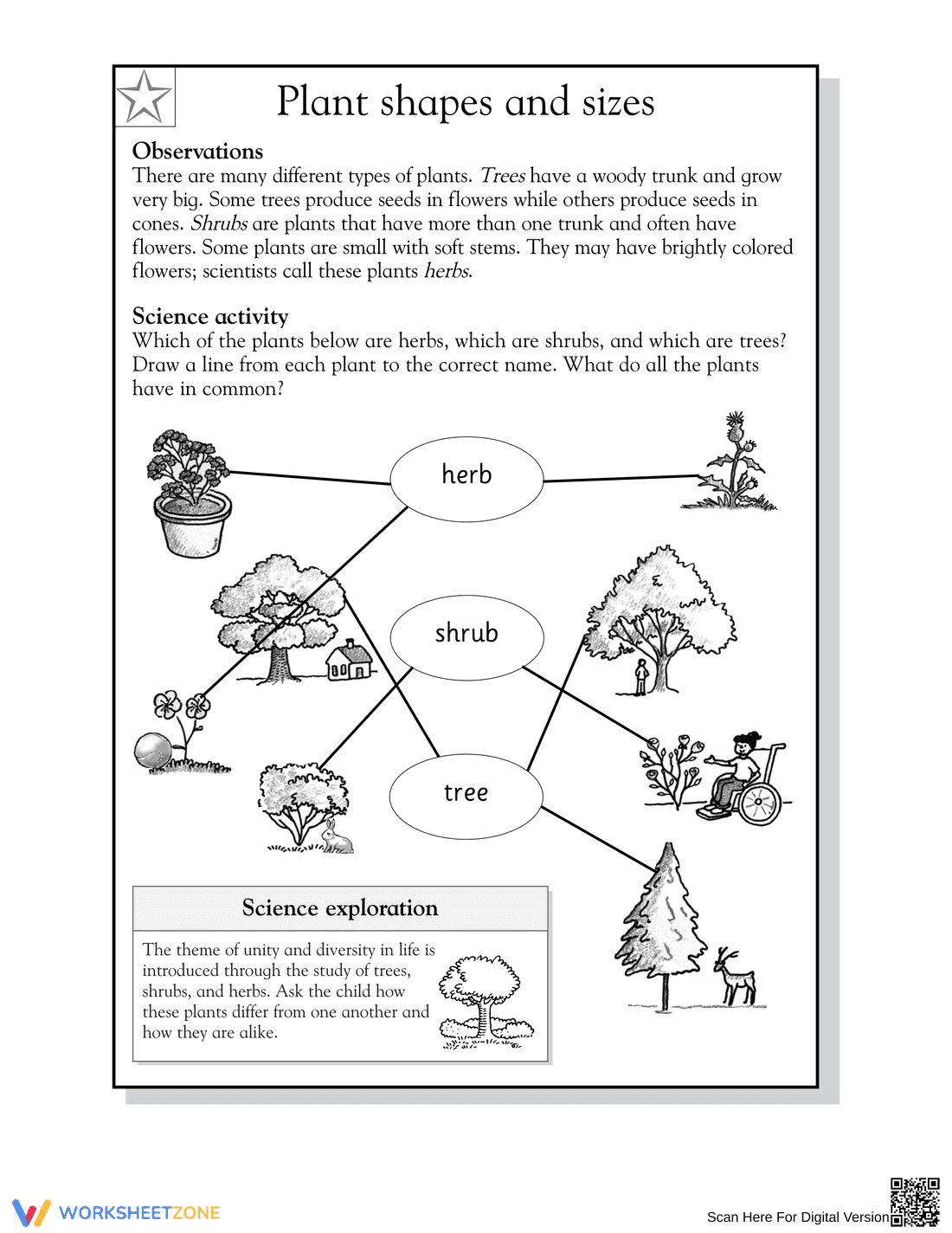
This Grade 2 science worksheet helps students distinguish between three primary plant categories: herbs, shrubs, and trees. By observing physical characteristics like stem texture and overall size, learners develop foundational botanical classification skills. Students will categorize various plant species, building the observational vocabulary necessary for more complex biological studies in later elementary grades.
At a Glance
- Grade: 2 · Subject: Living Things
- Standard:
2-LS4-1— Observe and compare the physical diversity of plants in their environment- Skill Focus: Classifying plants by physical characteristics
- Format: 1 page · 8 problems · Answer key included · PDF
- Best For: Independent practice or quick science assessment
- Time: 15–20 minutes
What's Inside
The worksheet features a concise "Observations" section that defines trees, shrubs, and herbs with specific criteria such as woody trunks versus soft stems. Following the instructional text, the "Science activity" presents eight distinct plant illustrations for students to identify and match to the correct category. The page concludes with a "Science exploration" extension prompt that encourages real-world application through a neighborhood nature walk.
Zero-Prep Workflow
This resource is designed for immediate classroom implementation. Follow a three-step process: Print the PDF (30 seconds), Distribute for a brief read-aloud of definitions (2 minutes), and Review the matching activity (5 minutes). Total teacher preparation time is under 2 minutes, making it ideal for sub plans or science block supplements.
Standards Alignment
The content is aligned to `2-LS4-1`, which requires students to make observations of plants and animals to compare the diversity of life in different habitats. By identifying the unique structures of herbs, shrubs, and trees, students provide evidence for plant diversity within their local environment. Both standard codes can be copied directly into lesson plans, IEP goals, or district curriculum mapping tools.
How to Use It
Use this worksheet during the "Explain" or "Elaborate" phase of a 5E lesson cycle on living things. Before distribution, display a real herb (like basil) and a woody branch to anchor the definitions. During independent work, move through the room to observe if students are using the "Observations" text as a reference. This serves as a quick formative assessment to see if learners can translate text-based definitions into visual identifications.
Who It's For
This activity is perfectly suited for Grade 1 and Grade 2 students beginning their exploration of life science. The clear illustrations provide differentiation for English Language Learners and visual thinkers, while the extension prompt offers a challenge for advanced students. It pairs naturally with a local nature walk or a classroom reading of "Trees, Leaves, and Bark" to deepen species-specific knowledge.
The classification of living things based on observable traits is a cornerstone of early scientific literacy. This worksheet aligns with EdReports 2024 findings, which emphasize providing Grade 2 students with structured opportunities to categorize biological data. By focusing on the 2-LS4-1 standard, the resource ensures students compare the diversity of life through physical evidence. Research indicates that bridging academic definitions with visual representations increases scientific vocabulary retention. This resource facilitates that bridge with clear illustrations and definitions of herbs, shrubs, and trees. The neighborhood exploration reinforces learning by moving the skill from the page to the real-world environment, a practice recommended for authentic science inquiry. This instructional approach supports long-term mastery by connecting classroom concepts to observable nature.


