


























Views
Downloads

Essential Plant Parts Worksheet | Grade 1 Science
Paste this activity's link or code into your existing LMS (Google Classroom, Canvas, Teams, Schoology, Moodle, etc.).
Students can open and work on the activity right away, with no student login required.
You'll still be able to track student progress and results from your teacher account.
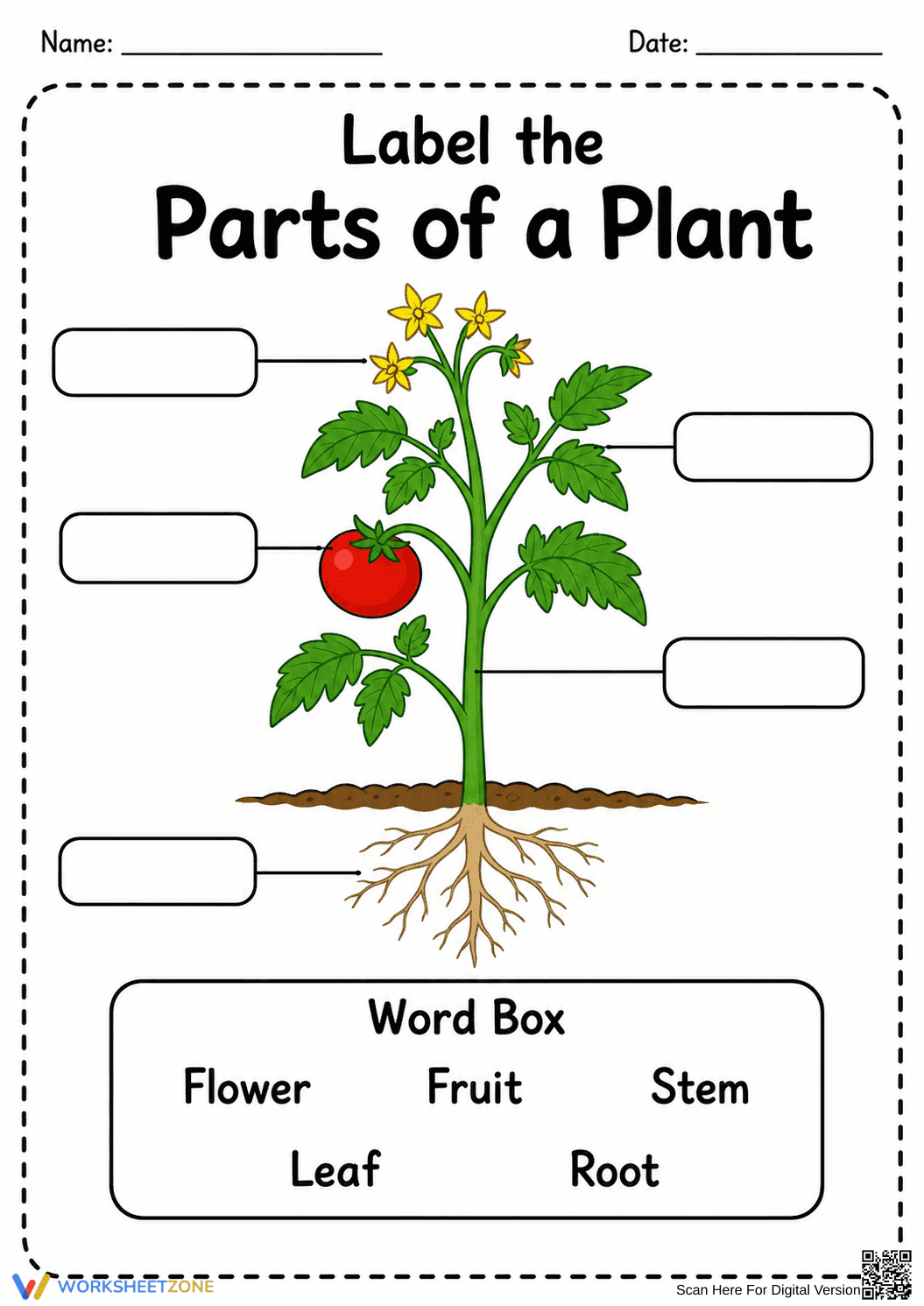
This Grade 1 science worksheet helps students identify and label the primary structures of a flowering plant. By connecting visual diagrams to scientific vocabulary, learners develop a foundational understanding of how different parts contribute to a plant's survival. It provides a clear, colored illustration of a tomato plant to engage young observers and facilitate recognition.
At a Glance
- Grade: 1 · Subject: Science
- Standard:
1-LS1-1— Use external parts of plants to help them survive, grow, and meet needs.- Skill Focus: Identifying plant structures
- Format: 1 page · 5 problems · Answer key included · PDF
- Best For: Introduction to botany and life cycles
- Time: 10–15 minutes
What's Inside: This single-page PDF features a high-quality colored diagram of a tomato plant. It includes five distinct labeling callouts pointing to the flower, fruit, stem, leaf, and root systems. A convenient word box at the bottom provides the necessary vocabulary, supporting early readers and English Language Learners as they match terms to the visual representation.
Zero-Prep Workflow
This resource is designed for immediate classroom implementation. 1. Print: Select the colored version for maximum engagement (30 seconds). 2. Distribute: Hand out to students as a quick check for understanding (30 seconds). 3. Review: Use the included answer key or project the image for a whole-class correction (1 minute). Total teacher preparation time is under two minutes, making it an ideal sub plan addition.
Standards Alignment
The primary standard is `1-LS1-1`, which focuses on how plants use their external parts to survive and grow. By identifying these parts, students build the prerequisite knowledge needed to explain their functions in later lessons. This standard code can be copied directly into lesson plans, IEP goals, or district curriculum mapping tools to ensure instructional compliance.
How to Use It
Use this worksheet during the "Explore" phase of a 5E lesson plan after observing real plants in the school garden. It also serves as an effective formative assessment tool at the end of a unit on living things. Teachers should observe if students can distinguish between the stem and the root system. Expect students to complete the labeling task within 10 to 15 minutes.
Who It's For
This resource is ideal for first-grade students, homeschoolers, and special education classrooms requiring visual supports. It pairs naturally with a hands-on seed-planting activity or a classroom anchor chart detailing the life cycle of a plant. The colored version is particularly helpful for students who benefit from high-contrast visual cues.
According to the RAND AIRS 2024 report, high-quality visual aids in early science education significantly improve vocabulary retention among primary learners. This worksheet aligns with the 1-LS1-1 standard by requiring students to recognize the external structures of plants, a critical step toward understanding biological systems. Research from Fisher & Frey (2014) emphasizes that providing a word bank alongside complex diagrams reduces cognitive load, allowing students to focus on the conceptual relationship between the label and the physical part. By identifying the flower, fruit, stem, leaf, and root, students demonstrate mastery of basic botanical anatomy. This 5-task activity provides measurable evidence of student progress in life science domains. Educators can utilize this data to inform future instruction on plant needs and environmental adaptations, ensuring that foundational concepts are solidified before moving to more abstract biological processes.


