


























Views
Downloads
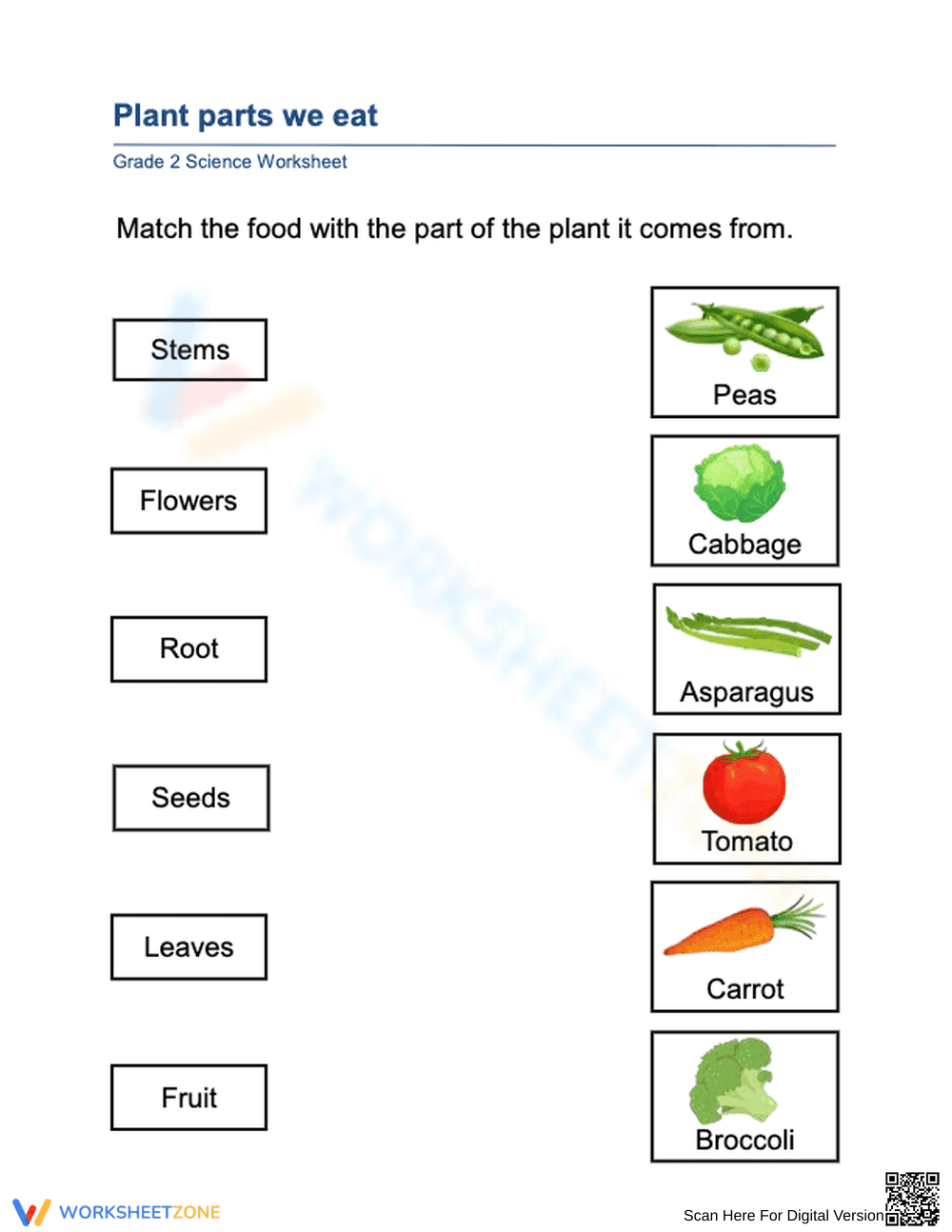

Essential Plant Parts We Eat Worksheet | Grade 2 Science
Paste this activity's link or code into your existing LMS (Google Classroom, Canvas, Teams, Schoology, Moodle, etc.).
Students can open and work on the activity right away, with no student login required.
You'll still be able to track student progress and results from your teacher account.
Identify edible plant parts with this focused Grade 2 Science worksheet. Students match common vegetables to the specific biological structures of a plant, such as roots, stems, and flowers. This activity reinforces botanical vocabulary and encourages students to think critically about the food they consume every day.
At a Glance
- Grade: 2 · Subject: Science
- Standard:
2-LS2-1— Identify how plants provide food and energy for living things- Skill Focus: Edible Plant Part Classification
- Format: 2 pages · 6 problems · Answer key included · PDF
- Best For: Independent practice or homework
- Time: 10–15 minutes
This 2-page PDF includes a matching activity where students connect images of peas, cabbage, asparagus, tomatoes, carrots, and broccoli to their corresponding plant parts. The first page features the student task with clear illustrations, while the second page provides a complete answer key with red connecting lines for rapid grading.
Designed for busy teachers, this resource requires minimal management. Simply print the worksheet (30 seconds), distribute it to your Grade 2 class (1 minute), and use the included answer key for a quick visual review (30 seconds). The total prep time is under 2 minutes, making it an ideal choice for emergency sub plans or science centers.
This worksheet is aligned to 2-LS2-1, which focuses on plant growth and the role of plants in ecosystems. By identifying the parts of plants we eat, students build a foundation for understanding plant life cycles and human dependency on botanical resources. Both standard codes can be copied directly into lesson plans, IEP goals, or district curriculum mapping tools.
Use this worksheet during a unit on Life Science after a direct instruction lesson on plant anatomy. It serves as an excellent formative assessment to check if students can distinguish between stems (like asparagus) and roots (like carrots). For a hands-on extension, bring in real samples of the foods listed and have students sort them physically before completing the paper task.
This resource is tailored for Grade 2 students but is also suitable for Grade 1 enrichment or Grade 3 review. It supports visual learners through high-quality illustrations and benefits English Language Learners (ELLs) by pairing clear botanical terms with recognizable food items. Pair this with a plant-part anchor chart or a reading passage about garden vegetables.
Botanical literacy in early elementary grades is a critical precursor to understanding complex biological systems. According to EdReports 2024, high-quality science materials for Grade 2 must bridge observable phenomena—like the food on a dinner plate—with scientific classification. This "Plant Parts We Eat" worksheet facilitates this transition by requiring students to categorize 6 distinct food items into categories of stems, flowers, roots, seeds, leaves, and fruit. By aligning to standard 2-LS2-1, the resource ensures that students are meeting national benchmarks for Life Science while engaging in practical, real-world application. Research from ScienceDirect TpT Analysis indicates that matching activities with clear visual scaffolds significantly improve retention of scientific nomenclature in younger learners. This printable PDF provides a structured environment for students to master the primary edible structures of common plants in 15 minutes or less.


