


























Views
Downloads

Printable Plant Habitats and Adaptations Worksheet | Grade 2
Paste this activity's link or code into your existing LMS (Google Classroom, Canvas, Teams, Schoology, Moodle, etc.).
Students can open and work on the activity right away, with no student login required.
You'll still be able to track student progress and results from your teacher account.
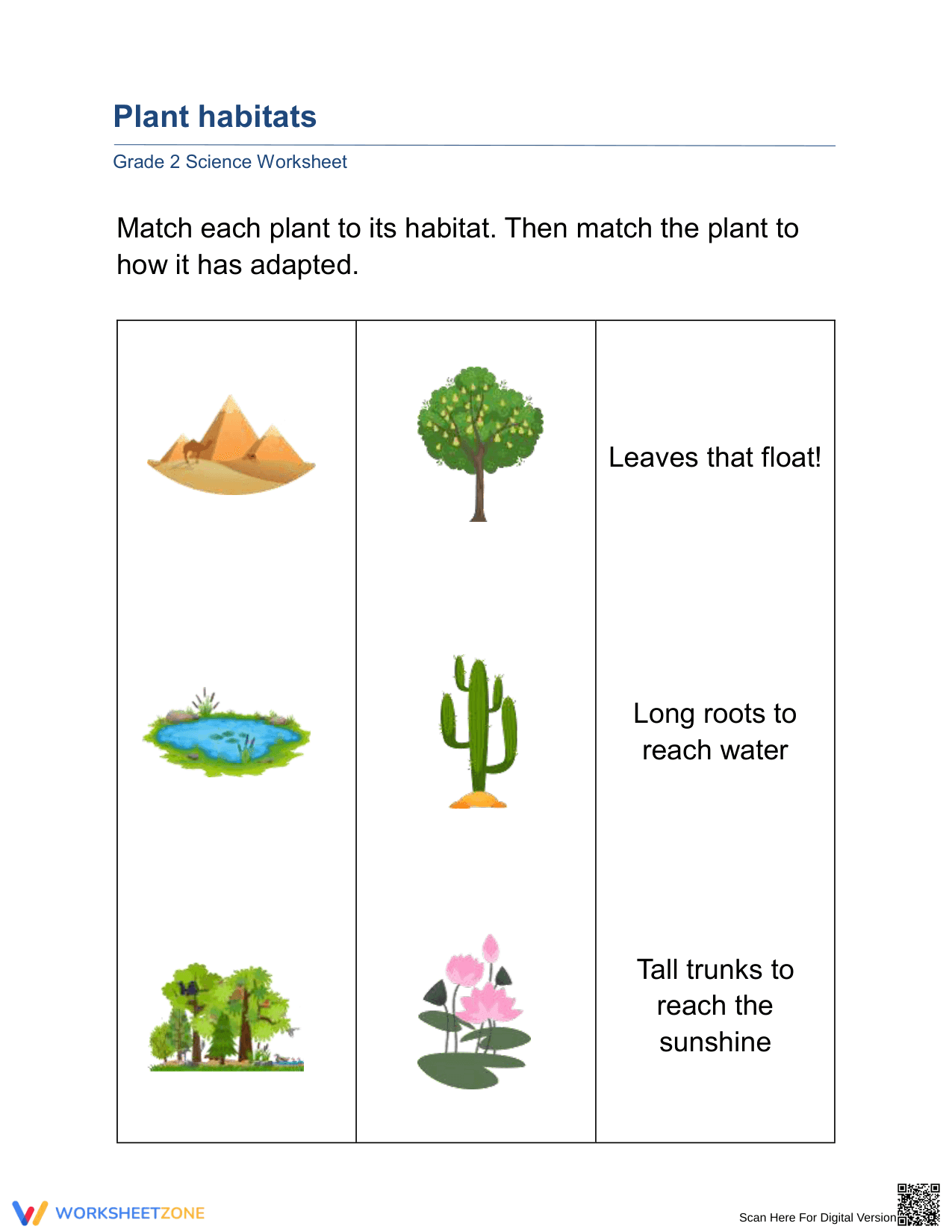
Mastering the relationship between living things and their environments is a foundational pillar of early science education. This plant habitats worksheet guides Grade 2 students through the critical process of identifying how specific physical structures enable survival in diverse biomes. By connecting visual representations of habitats to specialized plant traits, learners develop a concrete understanding of biological adaptation.
At a Glance
- Grade: 2 · Subject: Science
- Standard:
2-LS4-1— Make observations of plants and animals to compare the diversity of life in different habitats- Skill Focus: Plant Adaptations and Environmental Matching
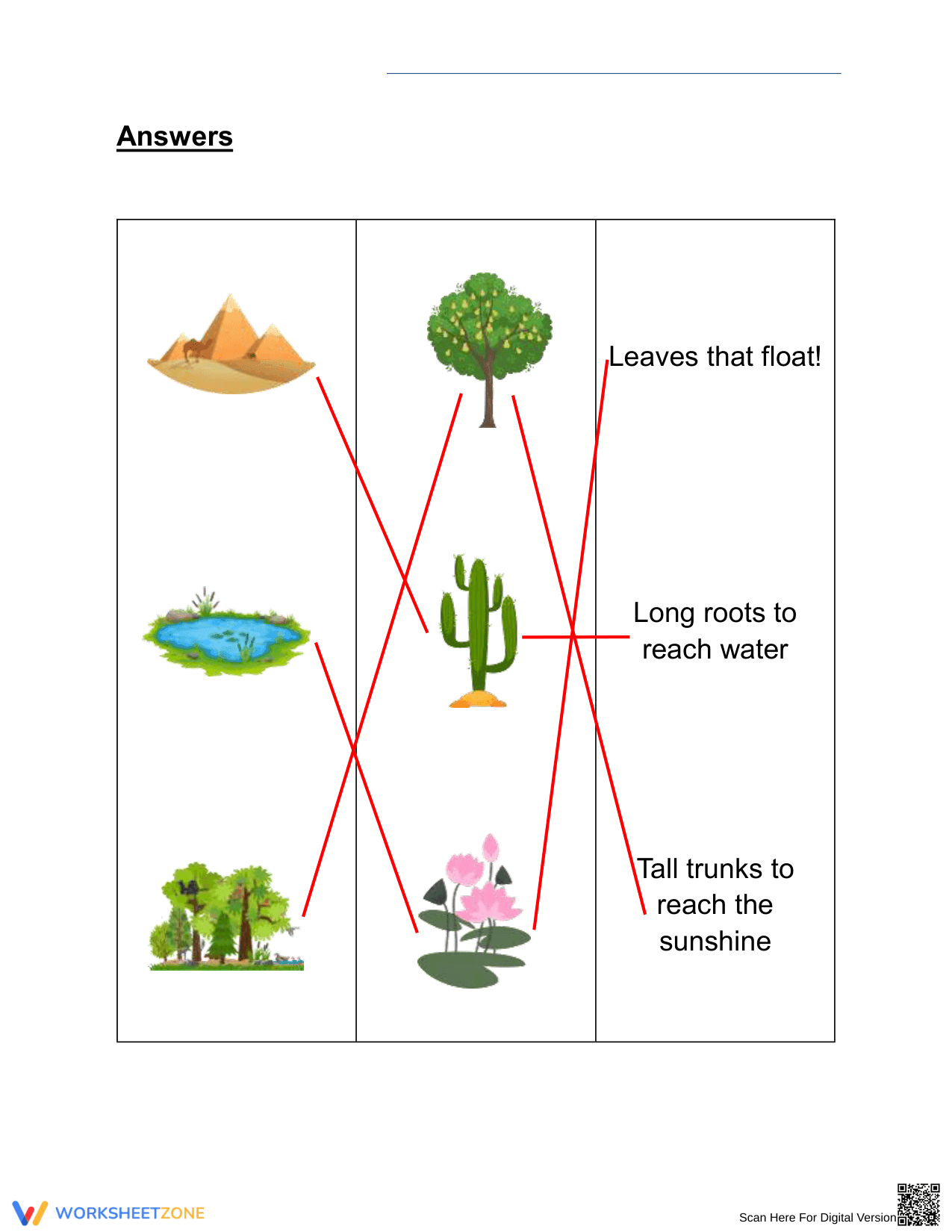
- Format: 1 page · 6 matching tasks · Answer key included · PDF
- Best For: Individual practice or science center rotations
- Time: 10–15 minutes
This focused one-page PDF features a dual-matching logic designed to reinforce multi-step reasoning. Students interact with three distinct habitat zones—desert, pond, and forest—pairing them first with representative flora like cacti and water lilies. The second layer of the task requires students to link each plant to its specific survival mechanism, such as floating leaves or deep root systems. The layout is clean and visually driven, including a comprehensive answer key.
Designed for high-impact instruction with minimal teacher overhead, this resource follows a seamless three-step workflow. First, print the single-page document in seconds. Second, distribute to students as a bell-ringer or exit ticket. Third, review the matching logic as a whole class using the provided answer key to address common misconceptions about structural adaptations. Total preparation time remains under two minutes, making it an ideal candidate for emergency sub plans.
This resource is explicitly aligned to `2-LS4-1`, which requires students to make observations of plants and animals to compare the diversity of life in different habitats. By requiring students to differentiate between the structures of a desert cactus and a pond lily, the worksheet provides direct evidence of a student's ability to categorize life forms based on environmental niches. This standard code can be copied directly into lesson plans or IEP goals.
The worksheet is most effective when used during the "Elaborate" phase of a lesson cycle, following direct instruction on biomes. As students work, observe whether they can articulate why a cactus requires long roots versus why a tree needs a tall trunk; these verbal justifications provide valuable formative data on conceptual depth. Expect most Grade 2 learners to complete the matching sequence independently within a ten-minute window.
Tailored for Grade 2 classrooms, this resource also enriches Grade 1 students or reviews for Grade 3. For extra support, provide a physical anchor chart with real-world photos. It pairs naturally with introductory life cycle units.
Early exposure to biological adaptation is essential for developing scientific literacy as outlined in the NGSS framework. Research shows dual-layered matching, linking organisms to their environment and then to specific functional traits, significantly improves retention of structural biology concepts. This worksheet moves students beyond simple identification toward understanding "form follows function." By focusing on 2-LS4-1 mastery through observable structures like floating leaves and deep water-seeking roots, it helps students explain life's diversity through environmental survival. This evidence-based approach provides a rigorous foundation for more advanced life science.


