


























Views
Downloads


Essential Place Value Worksheet: Value of Underlined Digits
Paste this activity's link or code into your existing LMS (Google Classroom, Canvas, Teams, Schoology, Moodle, etc.).
Students can open and work on the activity right away, with no student login required.
You'll still be able to track student progress and results from your teacher account.
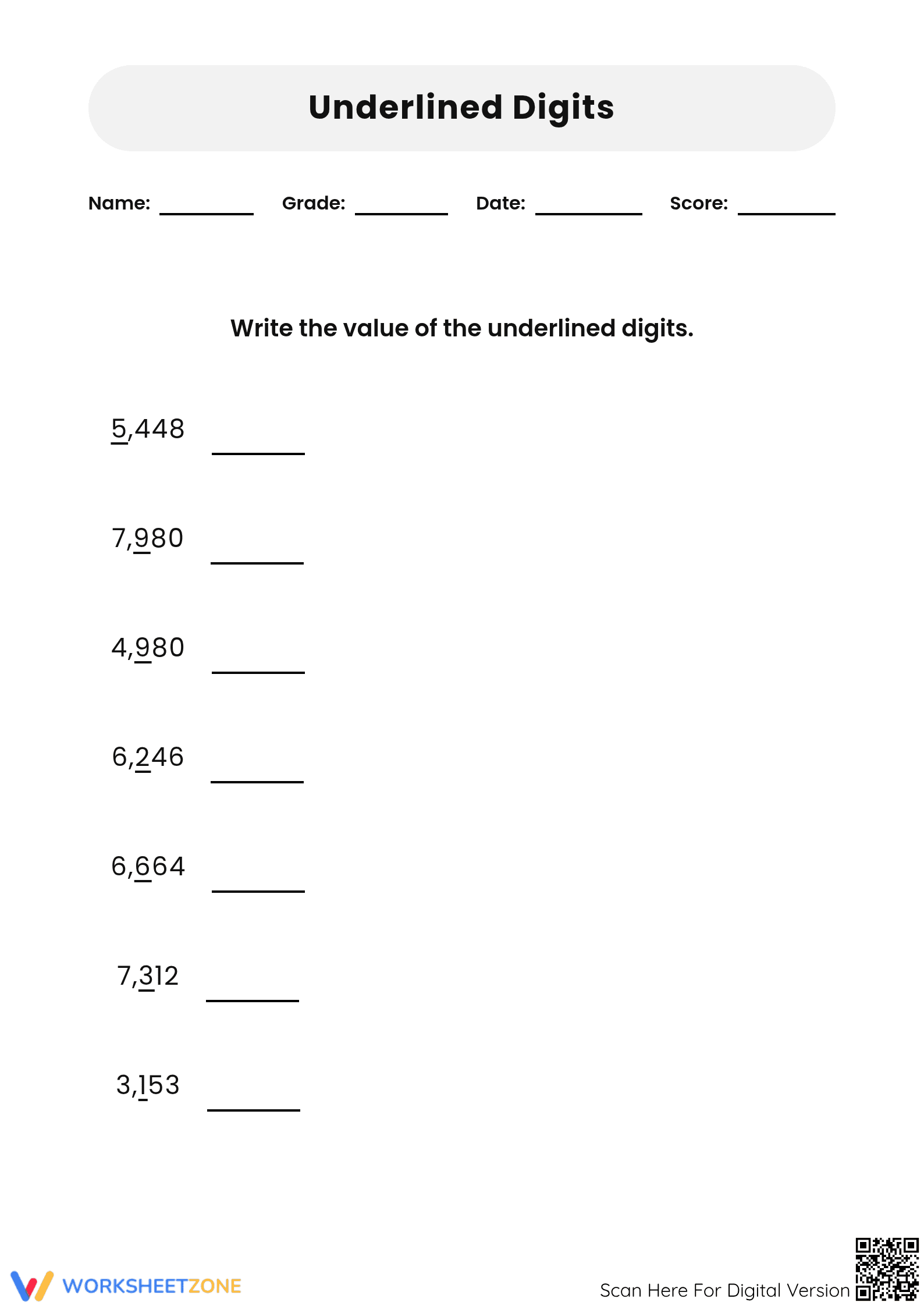
Mastering place value is the cornerstone of number sense in elementary mathematics. This 4-page Grade 4 worksheet focuses on identifying the specific value of digits within multi-digit numbers. Students develop the fluency needed to understand the structural logic of the base-ten system.
At a Glance
- Grade: 4 · Subject: Math
- Standard:
CCSS.MATH.CONTENT.4.NBT.A.2— Read and write multi-digit whole numbers and identify digit values.- Skill Focus: Place Value Identification
- Format: 4 pages · 30 problems · Answer key included · PDF
- Best For: Independent Practice or Formative Assessment
- Time: 20–30 minutes
What's Inside
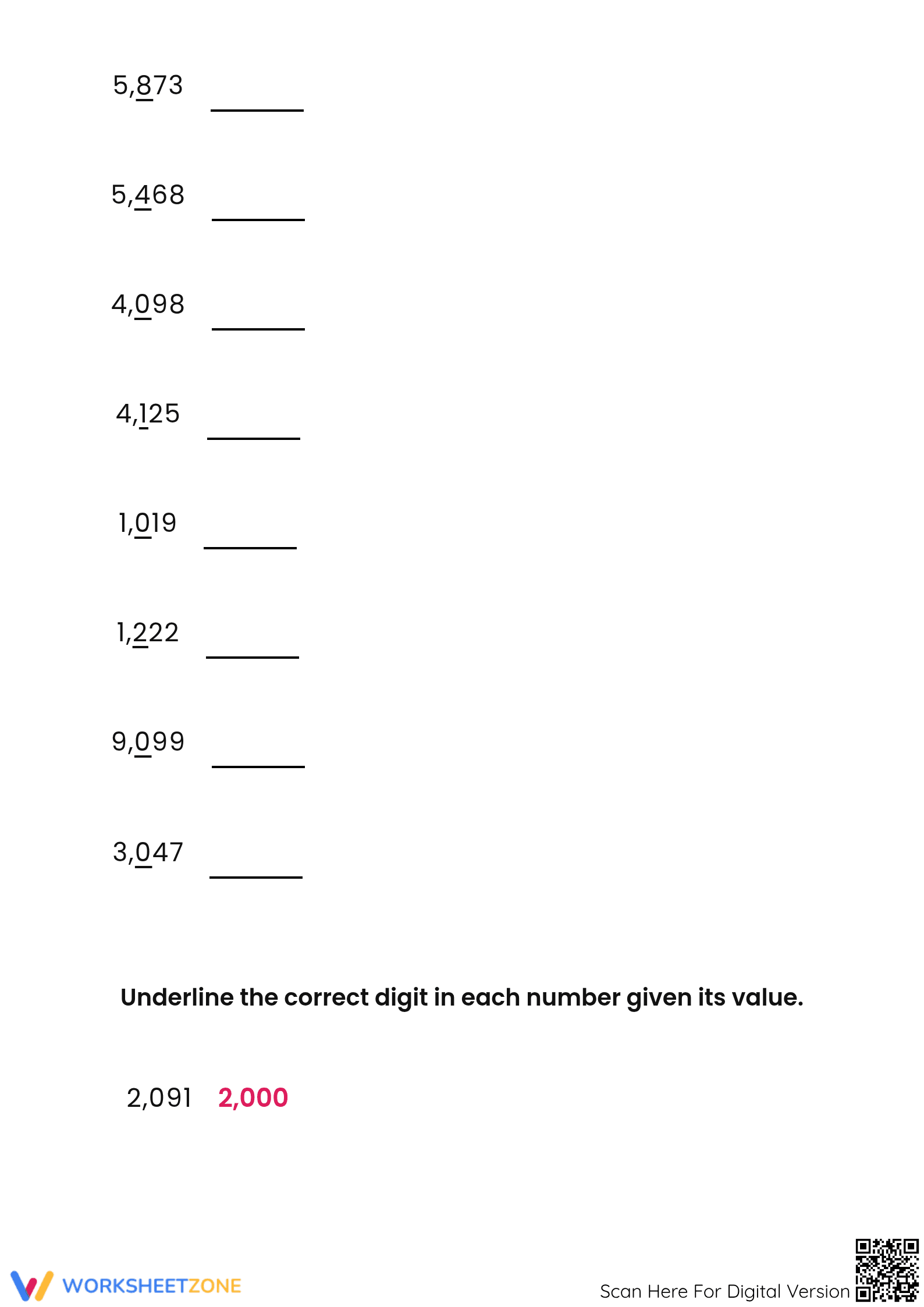
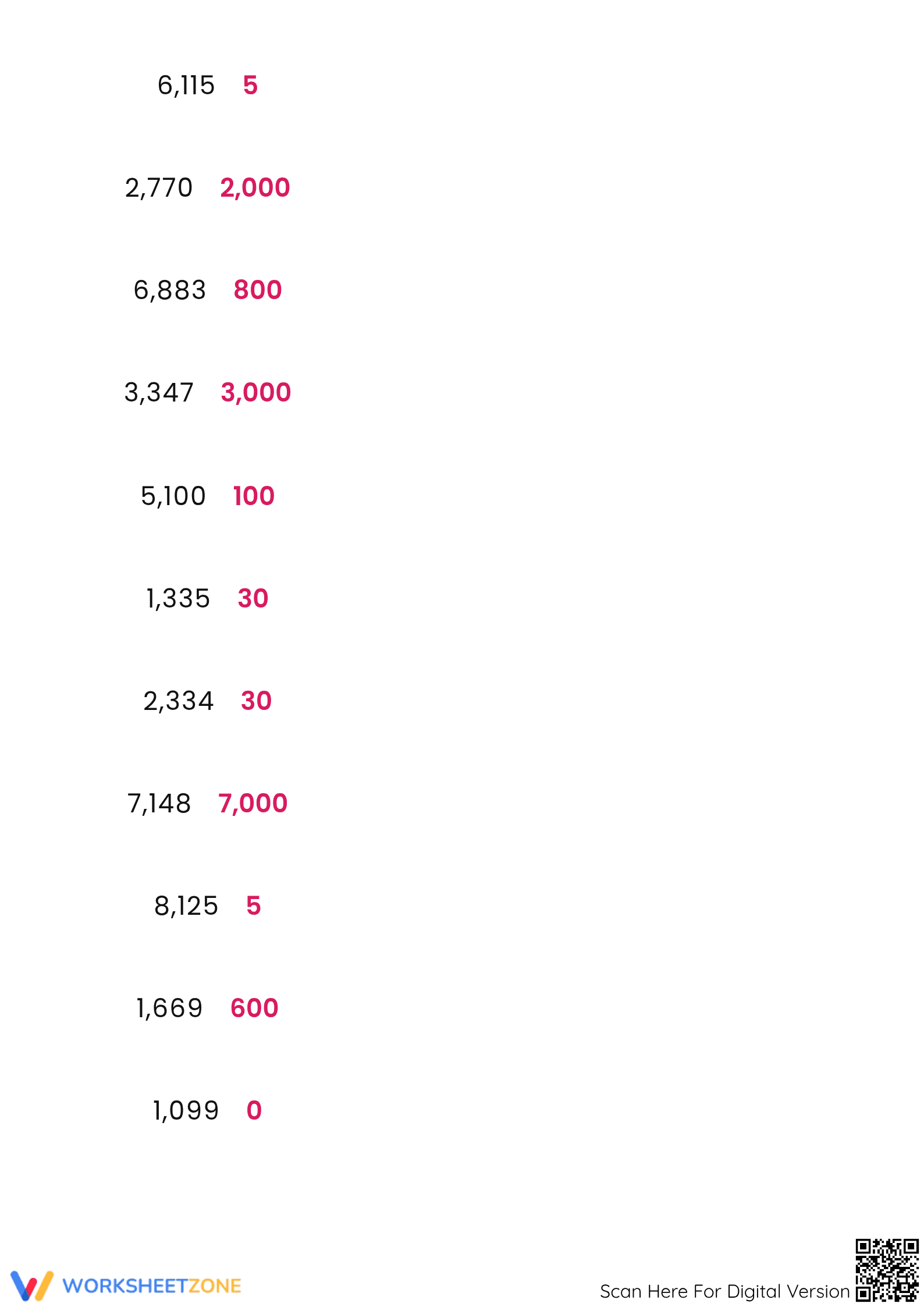
This printable PDF package contains four pages of targeted place value practice. The worksheet features two task formats: identifying the value of an underlined digit and underlining a digit based on a given value. With 30 unique problems spanning thousands and ten-thousands, students learn to differentiate between face value and place value. A complete answer key is included for rapid grading.
Skill Progression
- Guided Practice: Problems focus on identifying values in four-digit numbers to build confidence.
- Supported Practice: Tasks introduce the inverse operation, requiring students to locate digits based on provided values.
- Independent Practice: Final pages present a mix of task types with larger numbers for mastery.
This sequence adheres to the gradual-release model, moving students from 'I Do' to 'You Do' through targeted place value practice.
Standards Alignment
This resource targets CCSS.MATH.CONTENT.4.NBT.A.2: "Read and write multi-digit whole numbers using base-ten numerals, number names, and expanded form." The worksheet specifically addresses the meanings of digits in each place. Standard codes can be copied directly into lesson plans, IEP goals, or district curriculum mapping tools to ensure vertical alignment across Grade 4 and 5 classrooms.
How to Use It
Use this resource during the "We Do" or "You Do" phases of a lesson. Teachers can assign the first page as guided practice following direct instruction. Alternatively, the multi-page format is perfect for math centers or weekly homework. Observe if students confuse face value with place value (e.g., writing "3" instead of "300") to identify needs for intervention. Expected completion time is 20 to 30 minutes.
Who It's For
Designed for Grade 4 and 5 students refining their understanding of large numbers. It helps learners who struggle with the abstract nature of expanded form and need practice identifying the "worth" of a digit. The clear layout supports students with executive functioning challenges. This resource pairs well with anchor charts or base-ten blocks for students requiring additional visual support during independent work or small-group remediation sessions.
Developing a robust understanding of place value is a critical prerequisite for success in multi-digit multiplication and long division. Research from the NAEP highlights that students who master digit-value relationships early in the Grade 4 curriculum demonstrate significantly higher proficiency in subsequent operations. This worksheet, aligned to CCSS.MATH.CONTENT.4.NBT.A.2, provides the high-repetition, low-distraction environment necessary for cognitive encoding of base-ten structures. By utilizing dual task formats—identification and location—the resource requires students to process numerical data through multiple cognitive pathways, a strategy supported by Fisher & Frey (2014) as essential for the gradual release of responsibility. The inclusion of an answer key ensures that students receive the timely verification required to prevent the fossilization of mathematical misconceptions. This printable resource serves as a reliable tool for building the mathematical fluency demanded by modern rigorous standards, ensuring students are ready for higher-order algebraic thinking.


