


























Views
Downloads

Essential Place Value Template Worksheet | Grade 2-4
Paste this activity's link or code into your existing LMS (Google Classroom, Canvas, Teams, Schoology, Moodle, etc.).
Students can open and work on the activity right away, with no student login required.
You'll still be able to track student progress and results from your teacher account.
Help students master number composition with this comprehensive place value template and practice pack. This resource transitions learners from visual decomposition to abstract manipulation across three pages. By focusing on the relationship between digits and values, students develop the foundational fluency required for advanced multi-digit operations and mathematical reasoning.
At a Glance
- Grade: 2–4 · Subject: Mathematics
- Standard:
CCSS.MATH.CONTENT.4.NBT.A.2— Read and write multi-digit whole numbers using base-ten numerals and forms- Skill Focus: Place Value Forms and Digit Identification
- Format: 3 pages · 14 problems · Answer key included · PDF
- Best For: Small group number sense intervention
- Time: 25–35 minutes
What's Inside
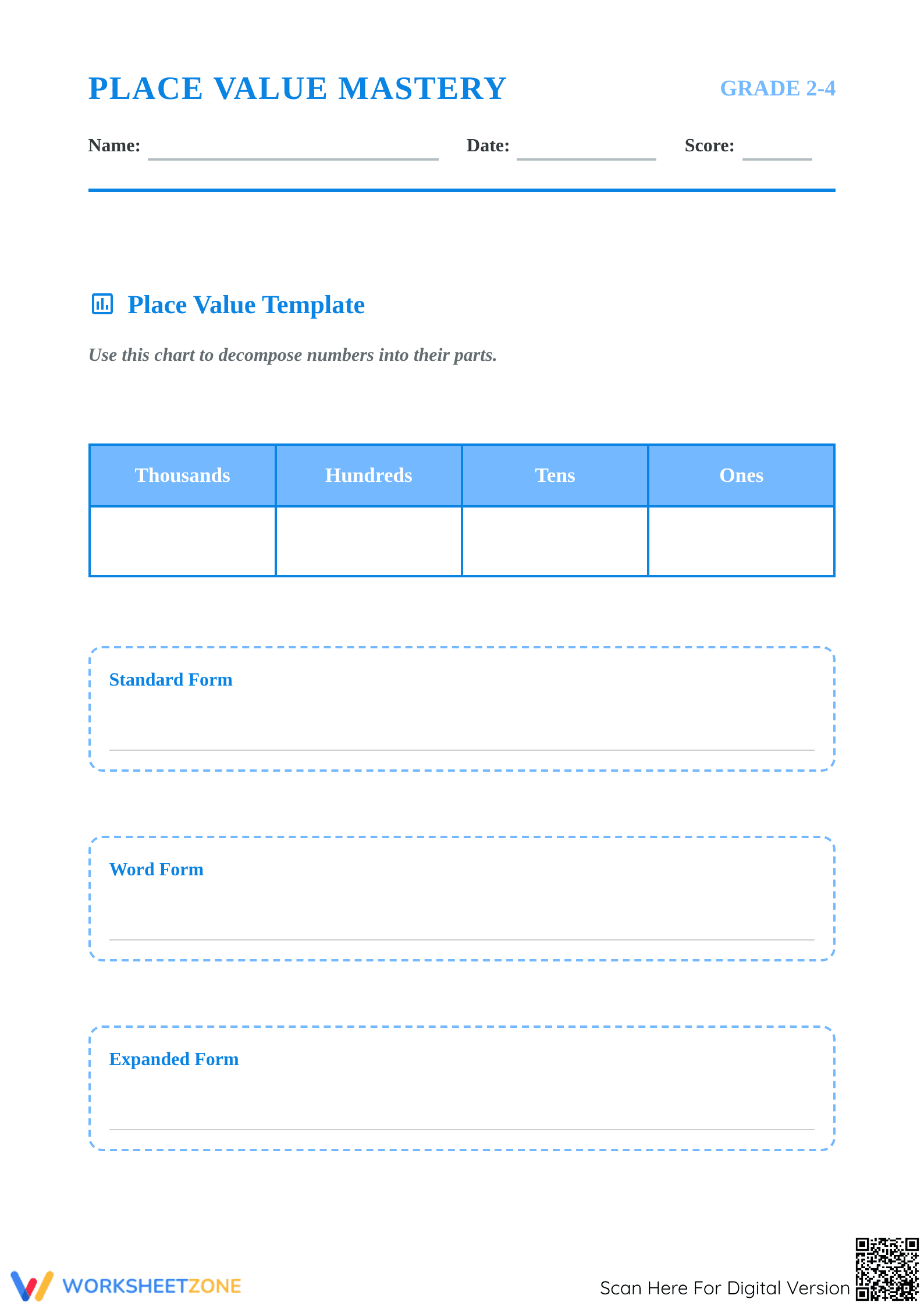
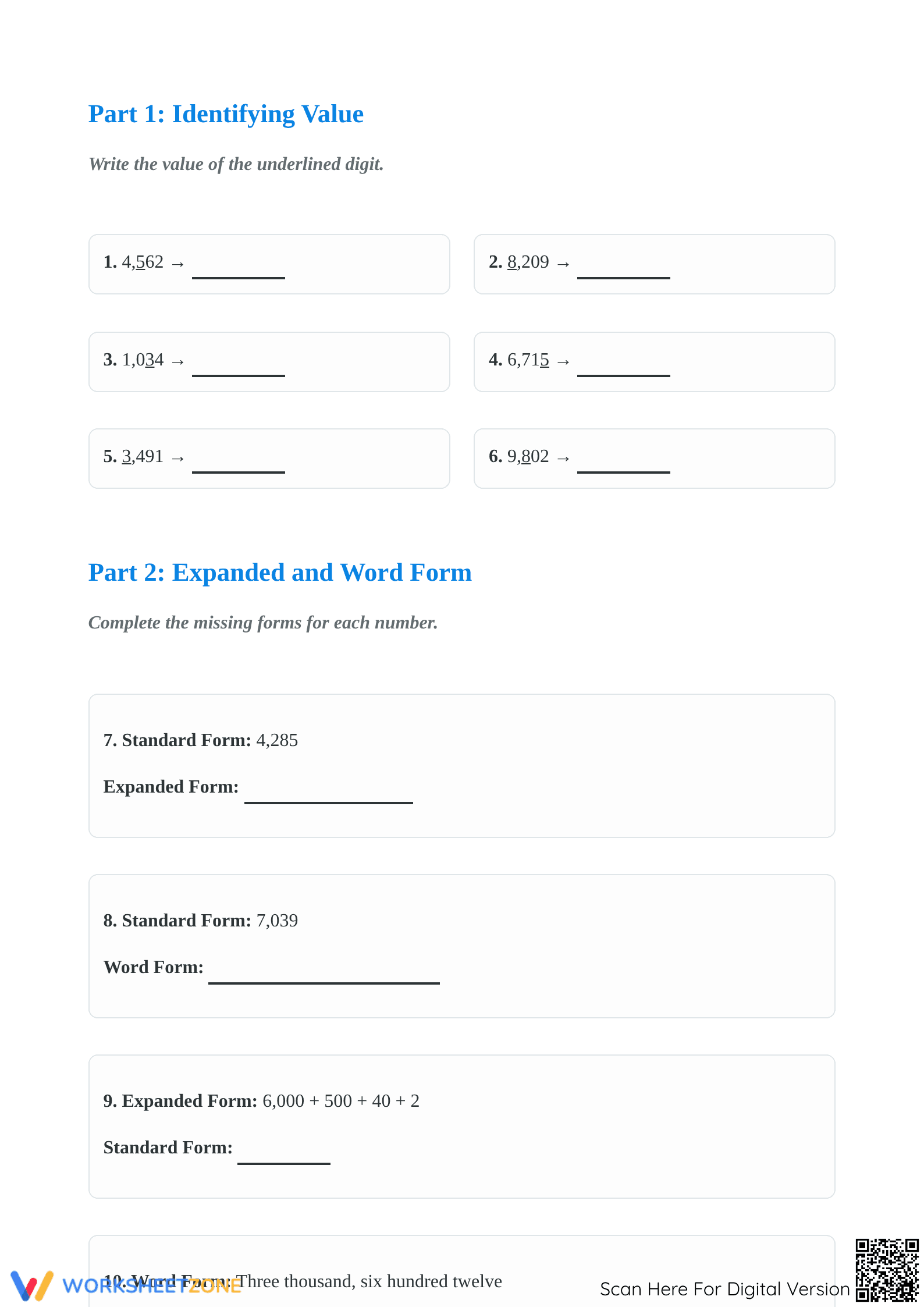
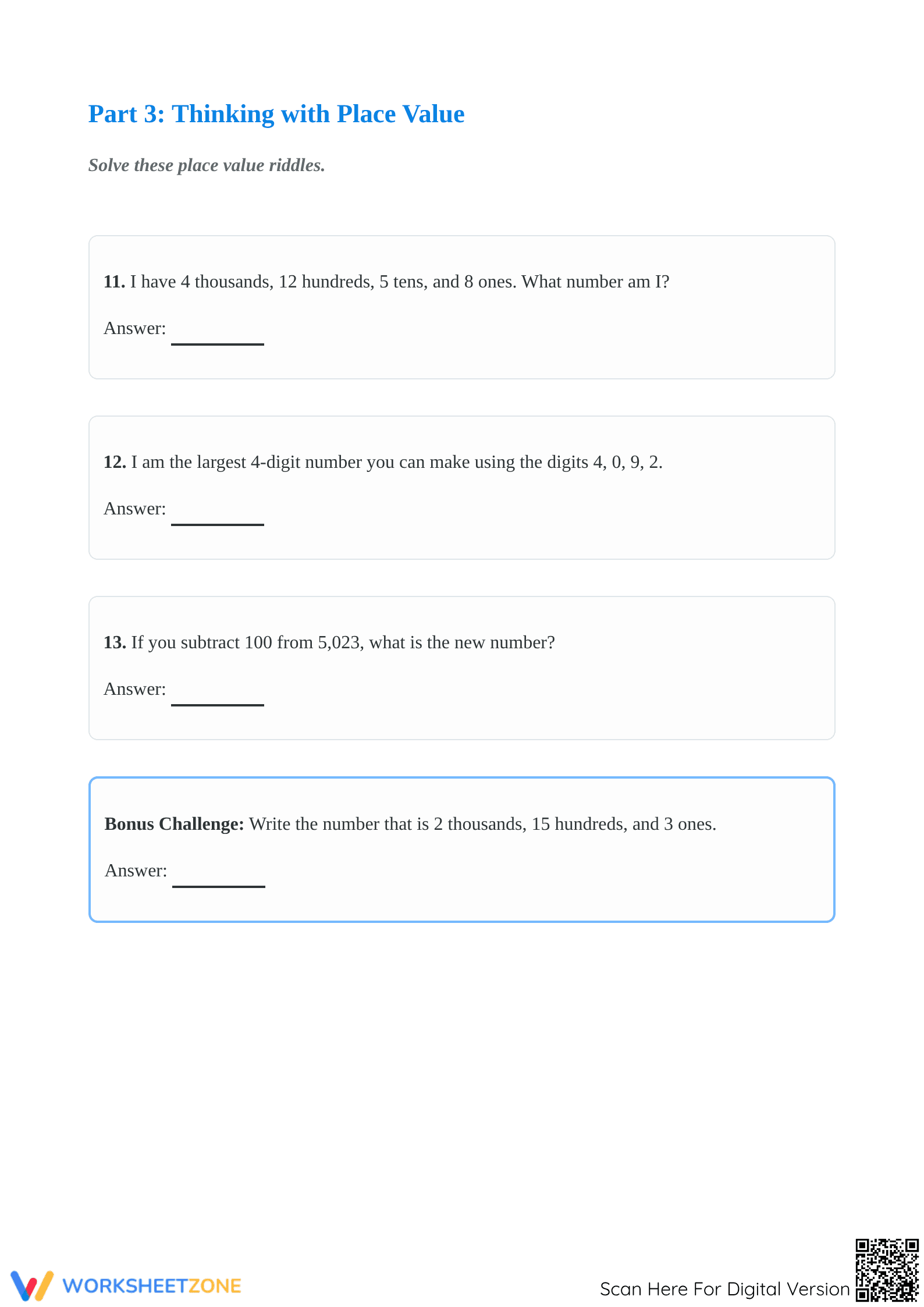
This 3-page PDF features a versatile place value decomposition template on the first page, followed by a 14-problem practice set. Page two includes six digit identification tasks and four conversion problems. The final page presents three place value riddles and a multi-step bonus challenge. A complete answer key is provided to facilitate rapid grading and student self-correction.
Skill Progression
- Guided Practice: The interactive template allows for modeled decomposition of four-digit numbers with visual supports.
- Supported Practice: 10 problems focus on identifying digit values and converting numbers between standard, word, and expanded forms.
- Independent Mastery: 4 higher-order riddles challenge students to apply regrouping logic and problem-solving skills to complex place value scenarios.
This sequence follows the gradual-release model of I Do, We Do, You Do to ensure student confidence and mastery.
Standards Alignment
This resource aligns primarily with CCSS.MATH.CONTENT.4.NBT.A.2, which requires students to read and write multi-digit whole numbers using number names and expanded form. It also supports CCSS.MATH.CONTENT.2.NBT.A.3 by reinforcing the base-ten structure for three-digit and four-digit integers. Both standard codes can be copied directly into lesson plans, IEP goals, or district curriculum mapping tools.
How to Use It
Use the template page during direct instruction as a reusable place value mat inside a dry-erase sleeve. For formative assessment, assign the riddles on page three to observe how students handle regrouping concepts. Expect students to spend roughly 30 minutes completing the entire set. These pages serve as an excellent bridge between concrete manipulatives and abstract numerical representation.
Who It's For
Designed for students in grades 2 through 4, this packet is effective for learners needing targeted intervention in number sense. The structured boxes and clear headers provide essential scaffolding for students with dyscalculia or processing challenges. It pairs naturally with base-ten block manipulatives or a digital place value interactive tool.
High-quality place value instruction is critical for developing the mental number line necessary for higher-level mathematics. According to RAND AIRS 2024, structured templates that explicitly link digit position to value significantly improve student accuracy in multi-digit addition and subtraction. This worksheet addresses CCSS.MATH.CONTENT.4.NBT.A.2 by providing a rigorous path from basic identification to the complex regrouping logic found in standardized assessments. By utilizing both word form and expanded form, the resource ensures students internalize the multiplicative nature of the base-ten system. Research from other cognitive scientists underscores the importance of the gradual release of responsibility, which is mirrored here through the progression from template-aided decomposition to independent riddle-solving. This evidence-based approach ensures that Grade 2-4 learners build a durable mathematical foundation that can be cited in evidence-based teaching portfolios or district-level curriculum reviews and IEP progress monitoring documentation for students receiving specialized math instruction.


