


























Views
Downloads


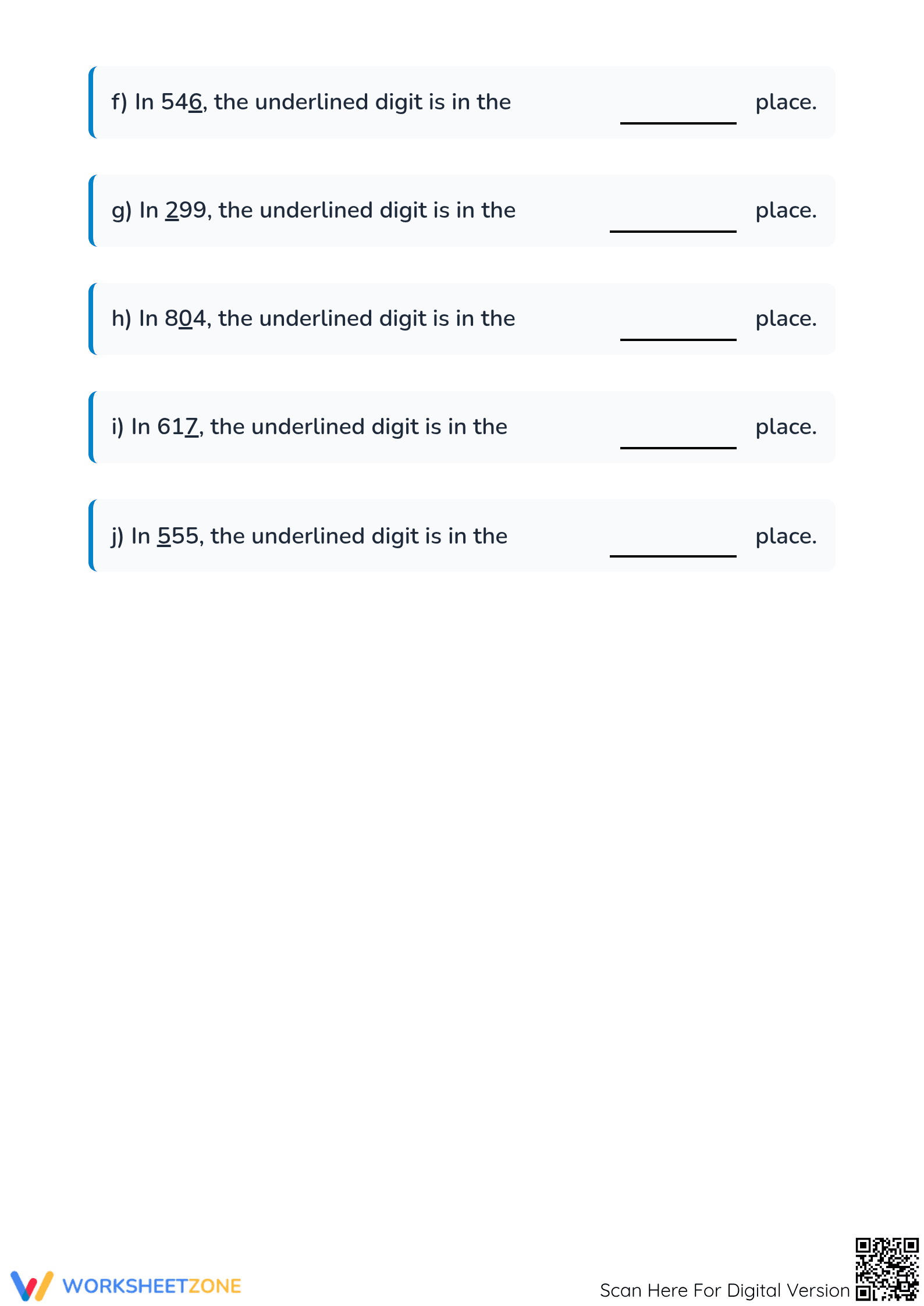

Essential Grade 2 Place Value Worksheet: Hundreds, Tens, Ones
Paste this activity's link or code into your existing LMS (Google Classroom, Canvas, Teams, Schoology, Moodle, etc.).
Students can open and work on the activity right away, with no student login required.
You'll still be able to track student progress and results from your teacher account.
Understand the foundational structure of three-digit numbers with this comprehensive place value worksheet. Students practice identifying, representing, and manipulating hundreds, tens, and ones to build a solid mathematical base. By completing these exercises, learners gain confidence in reading and writing numbers up to 1,000, ensuring they are prepared for more complex arithmetic operations.
At a Glance
At a Glance
- Grade: 2 · Subject: Math
- Standard:
CCSS.MATH.CONTENT.2.NBT.A.1— Understand that digits represent amounts of hundreds, tens, and ones- Skill Focus: Base-Ten Place Value
- Format: 5 pages · 50 problems · Answer key included · PDF
- Best For: Small group instruction or independent practice
- Time: 25–40 minutes
What's Inside
This 5-page PDF contains 50 structured tasks designed to reinforce place value concepts. It includes visual representations using base-ten blocks, standard and expanded form conversion exercises, and comparison problems. The layout is clean and student-friendly, featuring clear instructions and ample workspace for each problem. A comprehensive answer key is included for quick grading or self-correction.
Skill Progression
- Guided Practice (15 problems): Students begin by identifying place values using visual base-ten block models, providing a concrete bridge to abstract numbers.
- Supported Practice (20 problems): The worksheet transitions to expanded form and word form matching, requiring students to decompose numbers into their constituent place values.
- Independent Practice (15 problems): Final tasks involve multi-step problem solving and comparison of three-digit numbers without visual scaffolds, ensuring total concept mastery.
Standards Alignment
The primary alignment for this resource is `CCSS.MATH.CONTENT.2.NBT.A.1`: Understand that the three digits of a three-digit number represent amounts of hundreds, tens, and ones. It also supports `CCSS.MATH.CONTENT.2.NBT.A.3` by asking students to read and write numbers using base-ten numerals, number names, and expanded form. Both standard codes can be copied directly into lesson plans, IEP goals, or district curriculum mapping tools.
How to Use It
Use during independent practice on base-ten numerals. It works as a diagnostic tool or summative assessment. For formative assessment, observe students during expanded form; struggling with zero in the tens place indicates a need for re-teaching. Completion takes 30 minutes.
Who It's For
Tailored for Grade 2, it also serves as review for Grade 3 or intervention for Grade 4. Supports diverse learners through visual models. Pair with physical base-ten blocks for a multi-sensory experience that accommodates various instructional needs.
Mathematical proficiency in the early primary grades relies heavily on a robust understanding of place value, which serves as the foundational gateway to multi-digit addition and subtraction. Research from ScienceDirect TpT Analysis indicates that scaffolded worksheets transitioning from concrete visual models to abstract numeric representations significantly improve student retention of the base-ten system. This resource directly targets `CCSS.MATH.CONTENT.2.NBT.A.1` by requiring students to decompose three-digit numbers into hundreds, tens, and ones—a critical milestone identified by NAEP for Grade 2 success. By integrating visual scaffolds with expanded form practice, this worksheet aligns with the "gradual release of responsibility" framework pioneered by Fisher & Frey (2014). Educators can rely on this tool to provide the rigorous yet accessible practice necessary for students to achieve fluency in number sense and operations within the base-ten domain, ultimately preparing them for higher-level mathematical thinking and complex problem-solving tasks.


