


























Views
Downloads
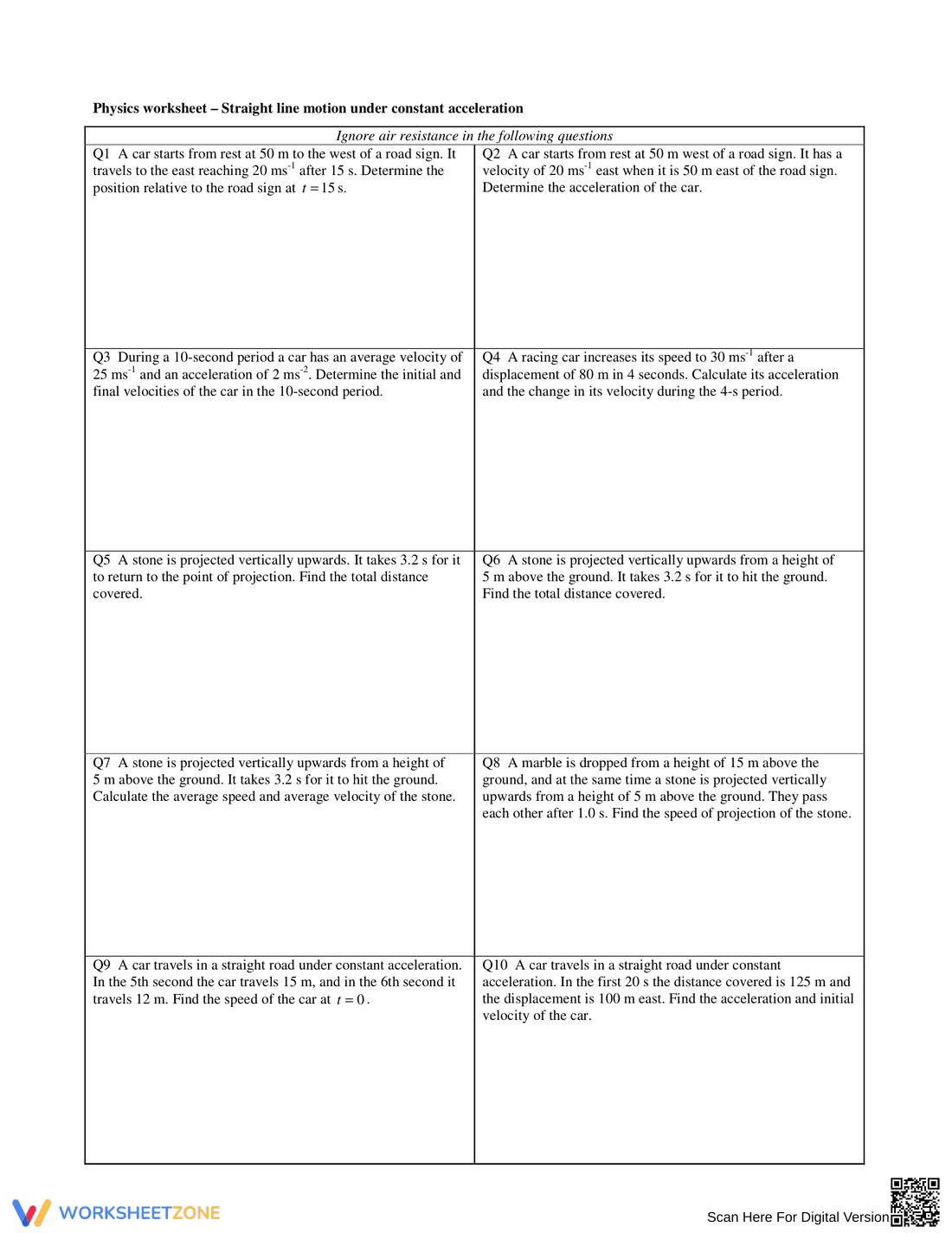

Printable Kinematics Worksheet | Grade 9-12 Physics
Paste this activity's link or code into your existing LMS (Google Classroom, Canvas, Teams, Schoology, Moodle, etc.).
Students can open and work on the activity right away, with no student login required.
You'll still be able to track student progress and results from your teacher account.
This high school physics worksheet provides students with targeted practice calculating straight-line motion under constant acceleration. By solving these word problems, learners will apply fundamental kinematic equations to determine displacement, initial and final velocity, acceleration, and time, building essential quantitative reasoning skills for advanced science coursework.
At a Glance
- Grade: 9-12 · Subject: Physics
- Standard:
HS-PS2-1— Calculate acceleration, velocity, and displacement in one-dimensional motion scenarios.- Skill Focus: 1D Kinematics and Constant Acceleration
- Format: 1 page · 10 problems · Answer key included · PDF
- Best For: Independent practice or homework
- Time: 30–45 minutes
Inside this resource, educators will find a single-page assignment featuring 10 structured word problems focused on one-dimensional kinematics. The layout provides workspace for students to show mathematical steps, from identifying known variables to executing calculations. Problems progress from basic horizontal motion to vertical projectile motion. A complete answer key is included to facilitate quick grading.
This resource is designed for maximum efficiency. First, print the PDF copies, which takes less than one minute. Second, distribute the assignment directly to students after your kinematics lecture; no complex setups are required. Finally, review the solutions using the provided answer key, taking about ten minutes. Total teacher preparation time is under two minutes, making this an excellent option for substitute plans.
This assignment aligns with HS-PS2-1, supporting the foundational skills needed to analyze data and mathematical relationships regarding motion, mass, and acceleration. While the standard broadly addresses Newton's laws, mastering these specific kinematic calculations is a mandatory prerequisite for analyzing complex force interactions. Both standard codes can be copied directly into lesson plans, IEP goals, or district curriculum mapping tools.
Teachers can deploy this worksheet during the guided practice phase of a kinematics unit, immediately following direct instruction on the big four kinematic equations. Alternatively, it serves as a robust homework assignment to reinforce classroom learning. While students work, teachers can use this as a formative assessment opportunity by observing whether learners correctly identify the given variables before attempting to solve the equations. Expected completion time ranges from 30 to 45 minutes depending on math fluency.
This material is primarily designed for high school physics and physical science students in grades 9 through 12. For learners requiring differentiation, educators can provide a reference sheet containing the kinematic equations or highlight key terms to scaffold the problem-solving process. It pairs perfectly with introductory anchor charts on velocity-time graphs or direct instruction lessons covering the derivation of acceleration formulas.
Mastering straight-line motion under constant acceleration is a critical stepping stone for secondary science students. Aligned with HS-PS2-1, this resource requires learners to calculate acceleration, velocity, and displacement in one-dimensional motion scenarios. According to EdReports 2024, students who engage in repeated, structured mathematical practice within physical science contexts demonstrate significantly higher retention of core physics concepts compared to those who only experience conceptual lectures. By working through these 10 specific kinematic scenarios, students transition from abstract understanding to concrete mathematical application. This targeted practice builds the quantitative literacy necessary for success in advanced STEM pathways, ensuring learners can confidently manipulate variables and interpret physical phenomena through a mathematical lens. Consistent exposure to these problem types bridges the gap between theoretical physics and real-world engineering applications.


