




























Views
Downloads
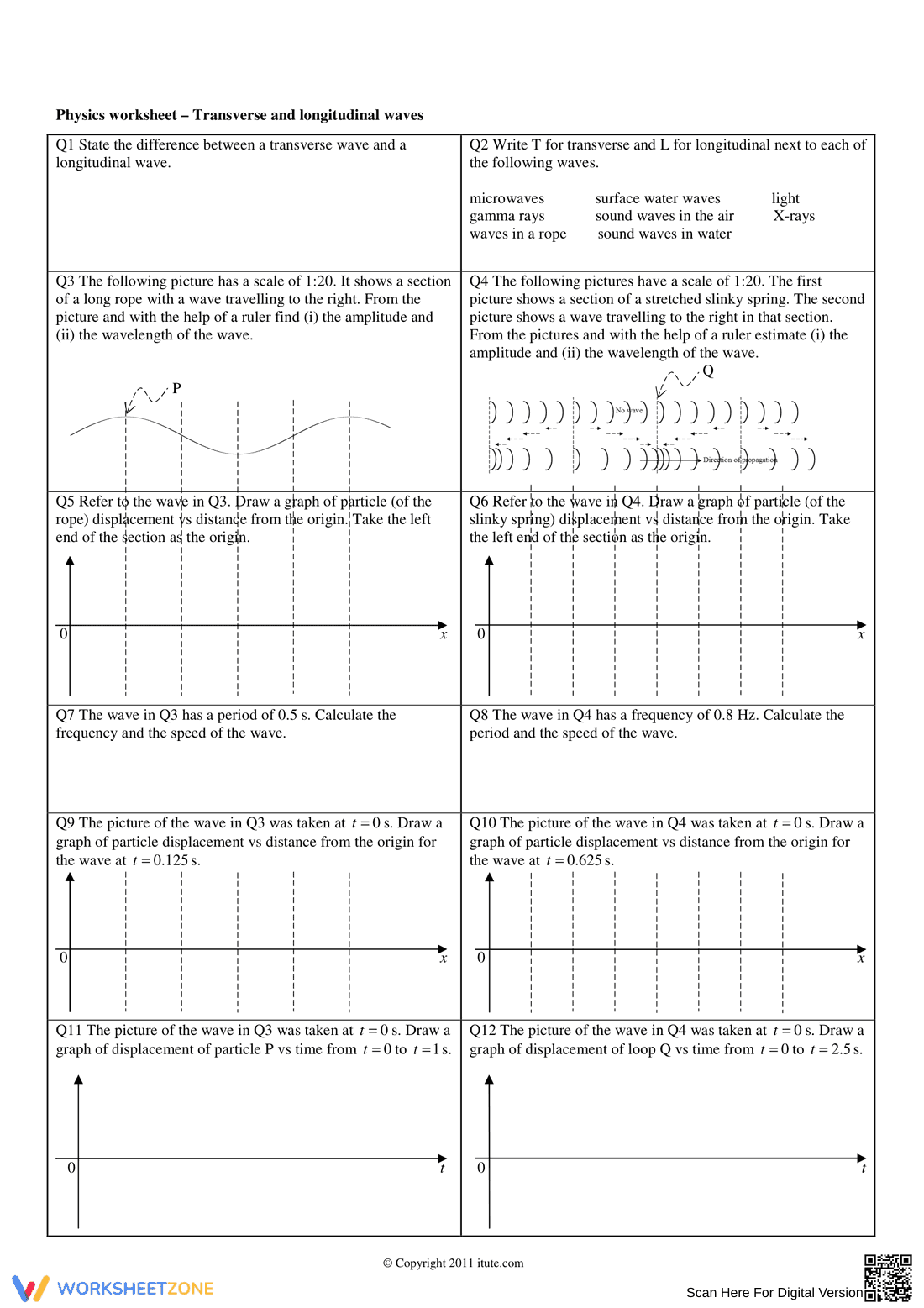

Essential Physics: Transverse & Longitudinal Waves Worksheet

Paste this activity's link or code into your existing LMS (Google Classroom, Canvas, Teams, Schoology, Moodle, etc.).
Students can open and work on the activity right away, with no student login required.
You'll still be able to track student progress and results from your teacher account.
Physics students must master the distinction between wave types and their mathematical representations to succeed in advanced science. This worksheet provides 12 rigorous problems designed to help learners visualize and calculate wave properties such as amplitude, wavelength, and speed. Students transition from conceptual definitions to complex graphing tasks that mirror real-world physical modeling.
At a Glance
- Grade: 9–12 · Subject: Physics
- Standard:
HS-PS4-1— Use mathematical representations to describe relationships between frequency, wavelength, and wave speed- Skill Focus: Transverse vs. longitudinal wave properties
- Format: 1 page · 12 problems · Answer key included · PDF
- Best For: Independent practice or formative assessment
- Time: 30–45 minutes
This comprehensive one-page resource contains 12 structured tasks that challenge students to apply their knowledge of wave mechanics. The worksheet includes scale diagrams (1:20) for manual measurement of amplitude and wavelength, requiring the use of a ruler. It also features multiple coordinate planes for drawing displacement-distance and displacement-time graphs, ensuring students can represent wave motion both spatially and temporally.
Zero-Prep Workflow
- Print: Generate copies for your class in approximately 30 seconds.
- Distribute: Hand out the single-page sheet to students in under a minute.
- Review: Grade or review the 12 problems in 10 minutes using the included key.
With a total teacher prep time of under 2 minutes, this resource is an ideal solution for unexpected sub plans or high-impact homework assignments.
Standards Alignment
The primary alignment is `HS-PS4-1`, which requires students to use mathematical representations to support claims regarding the relationships among frequency, wavelength, and speed of waves. The worksheet also supports `MS-PS4-1` for advanced middle schoolers. Both standard codes can be copied directly into lesson plans, IEP goals, or district curriculum mapping tools.
How to Use It
Use this worksheet as a mid-unit formative assessment after direct instruction on wave types. It is particularly effective for identifying misconceptions regarding particle motion versus wave propagation. Teachers should observe students during the graphing phase to ensure they are correctly identifying the origin and scale. The expected completion time ranges from 30 to 45 minutes depending on student familiarity with wave calculations.
Who It's For
This resource is designed for high school physics students, including those in AP Physics 1 or honors-level courses. It provides the necessary scaffolding for learners who struggle with spatial reasoning while offering enough mathematical depth for advanced students. It pairs naturally with a slinky demonstration or a digital wave simulator to provide a multi-modal learning experience.
According to the Fisher & Frey (2014) framework for gradual release of responsibility, providing structured independent practice with mathematical modeling is essential for long-term retention of physical science concepts. This worksheet aligns with that research by requiring students to translate between visual diagrams, mathematical calculations, and graphical representations. By engaging with the 12 specific tasks, students reinforce their understanding of HS-PS4-1, specifically the relationship between frequency, period, and wave speed. The inclusion of both transverse and longitudinal examples ensures that learners do not over-generalize wave behavior to a single medium. This evidence-based approach to physics instruction supports the development of quantitative literacy and scientific modeling skills necessary for college and career readiness in STEM fields.


