


























Views
Downloads

Personal Finance Vocabulary Worksheet | Grade 4 Essential
Paste this activity's link or code into your existing LMS (Google Classroom, Canvas, Teams, Schoology, Moodle, etc.).
Students can open and work on the activity right away, with no student login required.
You'll still be able to track student progress and results from your teacher account.
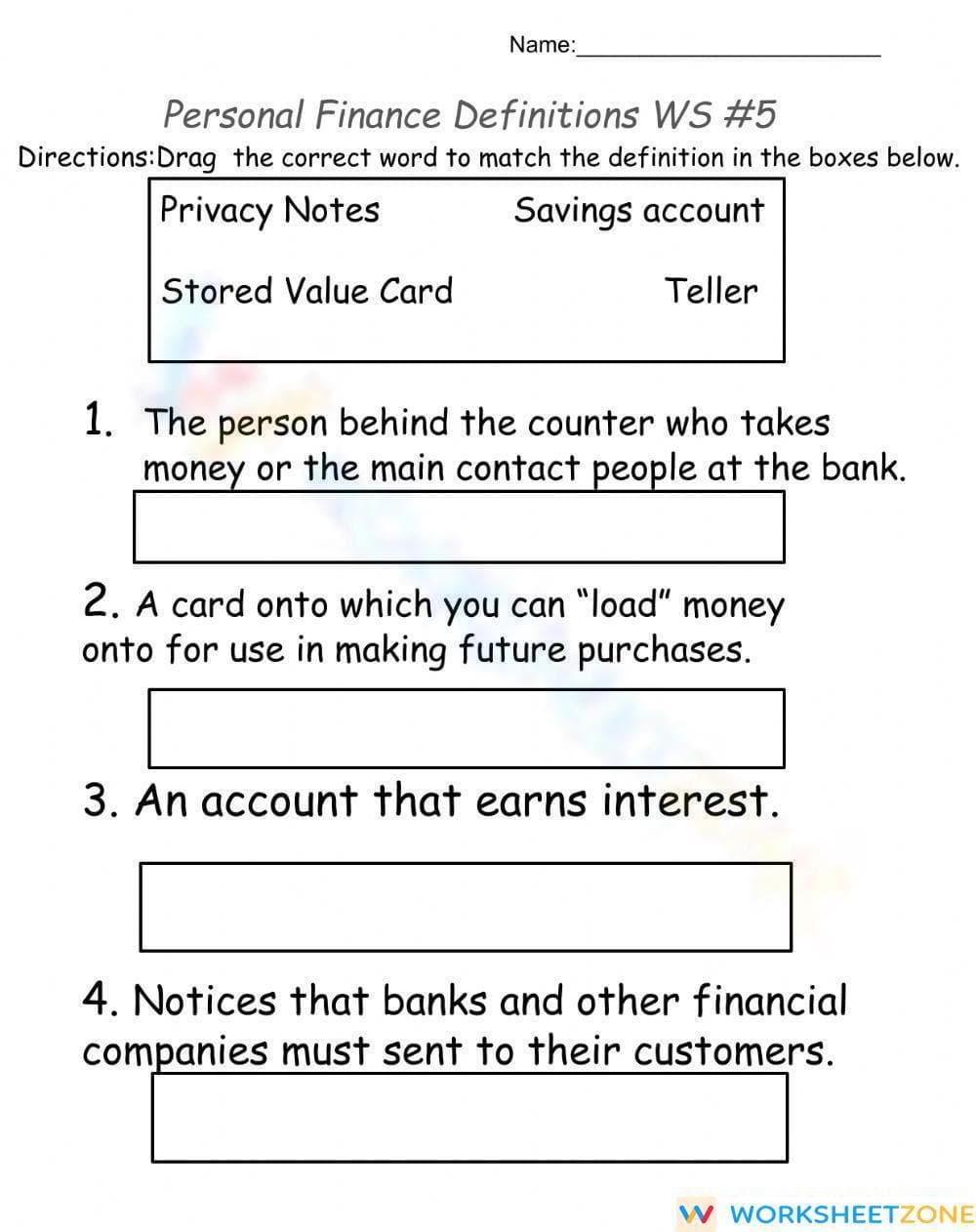
This Essential Personal Finance Definitions worksheet helps students master domain-specific vocabulary related to banking and financial privacy. By matching key terms like "Teller" and "Savings Account" to their accurate definitions, learners build the foundational literacy required for real-world economic participation. It provides immediate practice in identifying financial services and regulatory notices.
At a Glance
- Grade: 4 · Subject: English Language Arts
- Standard:
CCSS.ELA-LITERACY.RI.4.4— Determine the meaning of domain-specific words in a text relevant to grade 4 topics.- Skill Focus: Personal Finance Vocabulary
- Format: 1 page · 4 problems · Answer key included · PDF
- Best For: Individual practice or financial literacy introduction
- Time: 5–10 minutes
What's Inside
This one-page PDF features a word bank containing four critical financial terms: Privacy Notes, Savings account, Stored Value Card, and Teller. Students are tasked with reading four distinct definitions and matching them to the correct term. The layout is clean and focused, including a clear word bank box and numbered matching fields, with a full answer key provided for quick grading.
Zero-Prep Workflow
This classroom-ready resource follows a streamlined three-step workflow: Print (30 seconds), Distribute (30 seconds), and Review (1 minute). With a total teacher preparation time of under two minutes, it serves as an ideal sub-plan filler, warm-up activity, or transition piece. The self-explanatory directions ensure that students can begin working immediately without complex verbal instructions or setup.
Standards Alignment
The primary alignment is CCSS.ELA-LITERACY.RI.4.4, which requires students to determine the meaning of general academic and domain-specific words or phrases in a text. This worksheet specifically targets the "domain-specific" aspect by focusing on technical financial language. The standard code can be copied directly into lesson plans, IEP goals, or district curriculum mapping tools to document evidence of vocabulary instruction.
How to Use It
Use this worksheet during the "Independent Practice" phase of a lesson on financial literacy or economics. It works best after a direct instruction session introducing bank roles and account types. As a formative assessment tip, observe if students confuse "Privacy Notes" with "Savings account" to gauge their understanding of bank-to-customer communications. Expected completion time is approximately 5 to 10 minutes.
Who It's For
Designed for elementary students in Grades 3 through 6, this resource is particularly effective for learners requiring clear, structured vocabulary support. It is a natural pairing for an introductory passage on banking or a classroom anchor chart detailing financial institutions. It also serves as an excellent resource for Special Education students due to its limited task volume and high visual clarity.
Research by Fisher & Frey (2014) highlights that effective domain-specific vocabulary acquisition is most successful when students interact with technical terms in structured, focused contexts. This worksheet applies those principles by isolating four high-frequency financial concepts—Privacy Notes, Savings account, Stored Value Card, and Teller—and requiring students to map them to functional definitions. By targeting CCSS.ELA-LITERACY.RI.4.4, the activity bridges the gap between general reading comprehension and specialized literacy required for economic competence. The inclusion of a clear word bank reduces cognitive load, allowing students to focus on the semantic relationship between the concept and its real-world application. Educators can use the resulting data to identify specific gaps in background knowledge regarding financial systems. This evidence-based approach ensures that learners develop the precise lexicon necessary for subsequent complex texts in social studies and practical life skills curricula.


