


























Views
Downloads

Grade 1 Nouns Worksheet — Printable No-Prep Practice
Paste this activity's link or code into your existing LMS (Google Classroom, Canvas, Teams, Schoology, Moodle, etc.).
Students can open and work on the activity right away, with no student login required.
You'll still be able to track student progress and results from your teacher account.
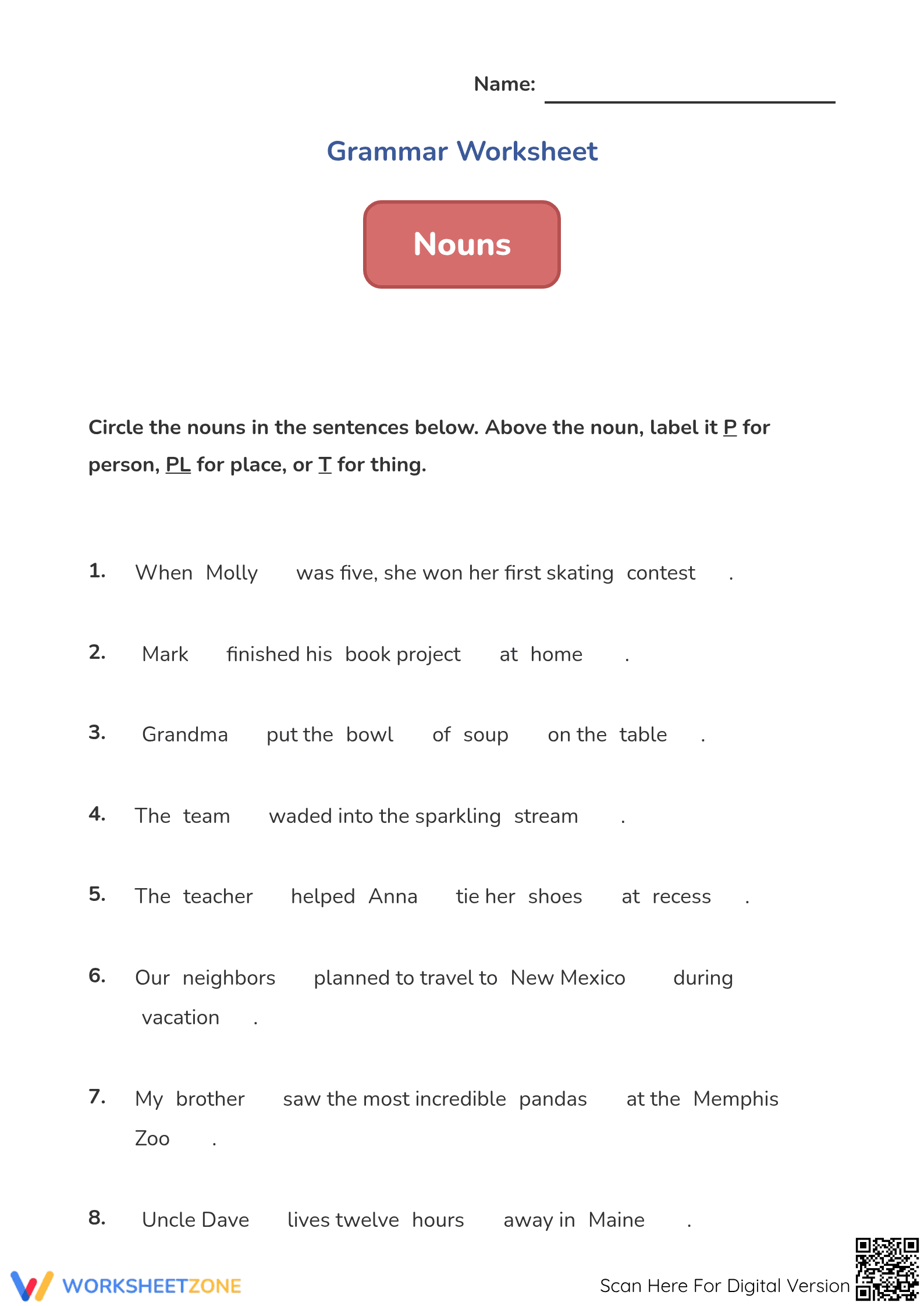
This Grade 1 ELA worksheet provides essential practice in identifying and categorizing nouns as people, places, or things. Students engage with 14 distinct tasks designed to solidify their understanding of lexical word classes. By labeling nouns within sentences and generating their own examples, learners build a strong foundation for sentence structure and grammar mastery.
At a Glance
- Grade: 1 · Subject: ELA
- Standard:
CCSS.ELA-LITERACY.L.1.1.B— Use common, proper, and possessive nouns in sentences- Skill Focus: Noun categorization (Person, Place, Thing)
- Format: 2 pages · 14 problems · Answer key included · PDF
- Best For: Independent practice or morning work
- Time: 15–20 minutes
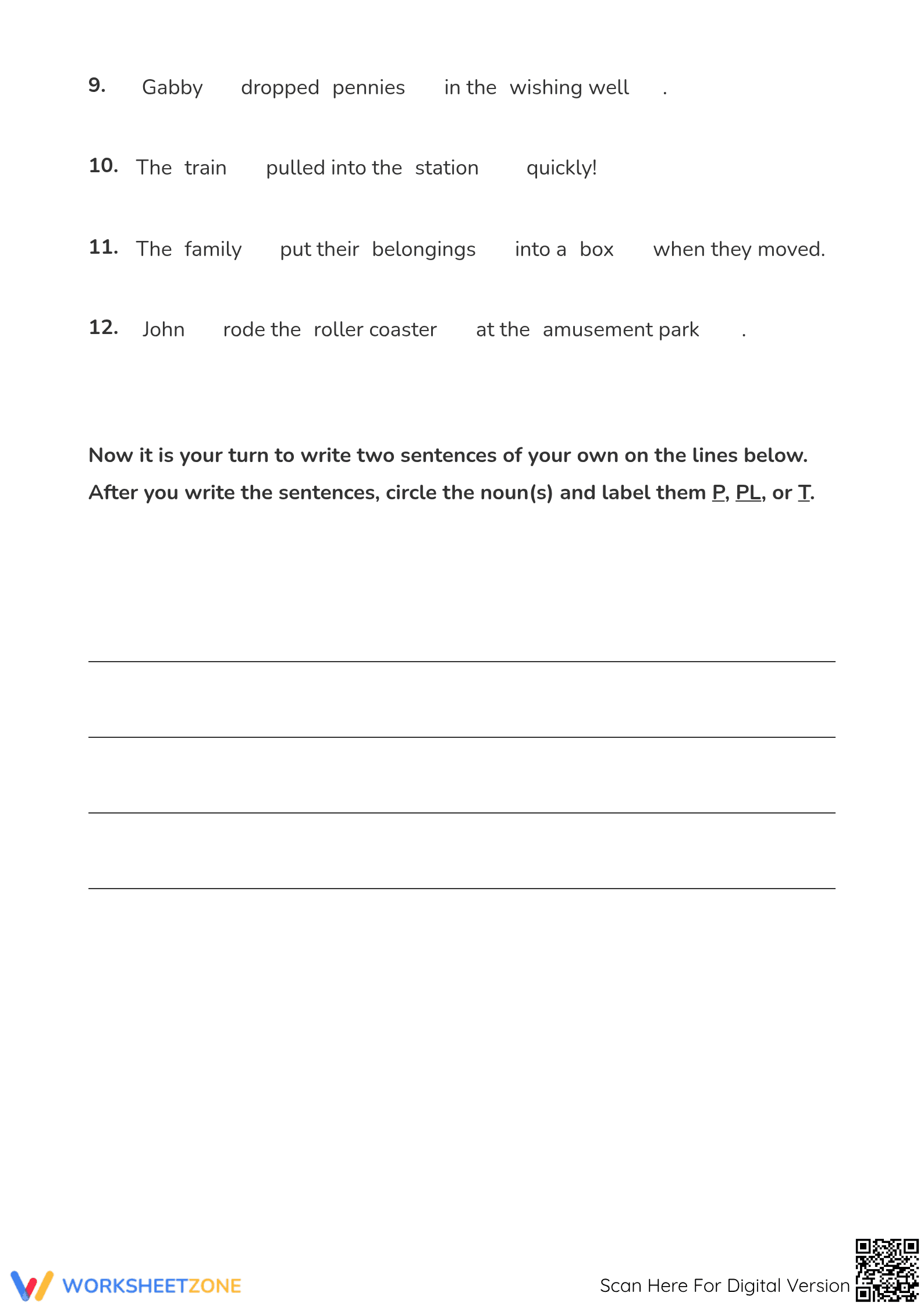
This comprehensive 2-page PDF features 12 sentence-based identification problems and 2 creative writing prompts. Students are required to circle nouns and apply specific labels (P, PL, or T) to demonstrate categorization skills. The second page includes primary-ruled lines for sentence generation, ensuring students apply their knowledge in context. A full answer key is provided for quick grading.
Zero-Prep Workflow
- Print: Select the 2-page PDF and print enough copies for your class (under 30 seconds).
- Distribute: Hand out the worksheets as a quiet bell-ringer or during your grammar block (1 minute).
- Review: Use the included answer key to check student work or project it for a whole-class review (1 minute).
This resource is ideal for emergency sub plans or low-prep literacy centers where teacher time is limited.
Standards Alignment
This resource is aligned to `CCSS.ELA-LITERACY.L.1.1.B`, which focuses on the use of common, proper, and possessive nouns. By distinguishing between people, places, and things, students meet the foundational requirements for identifying parts of speech. Both standard codes can be copied directly into lesson plans, IEP goals, or district curriculum mapping tools.
How to Use It
Use this worksheet during the independent practice phase of a gradual release lesson on parts of speech. It serves as an excellent formative assessment to see if students can distinguish between a person (Molly) and a place (Maine). Expect students to complete the identification portion in 10 minutes and the writing portion in 5-10 minutes. Observe students as they label to catch common misconceptions between things and places.
Who It's For
This worksheet is designed for first-grade students but is also suitable for kindergarten enrichment or second-grade intervention. It pairs naturally with a "Noun Sort" anchor chart or a direct instruction lesson using a mentor text that highlights various settings and characters. It is particularly helpful for English Language Learners who need concrete practice with lexical categories.
According to the RAND AIRS 2024 report, structured grammar practice in early elementary grades is vital for developing syntactic awareness. This Grade 1 worksheet targets `CCSS.ELA-LITERACY.L.1.1.B` by requiring students to identify and categorize nouns as people, places, or things across 14 tasks. Research from Fisher & Frey (2014) emphasizes that moving from identification to generation—as seen in the final writing prompt—supports the transfer of grammatical knowledge to independent writing. By providing a clear labeling system (P, PL, T), the resource scaffolds the cognitive load for young learners. This printable PDF includes a full answer key, making it a reliable tool for measuring student progress toward mastery of lexical word classes. Educators can use these results to inform small-group instruction or to document growth in foundational ELA skills during parent-teacher conferences.


