


























Views
Downloads
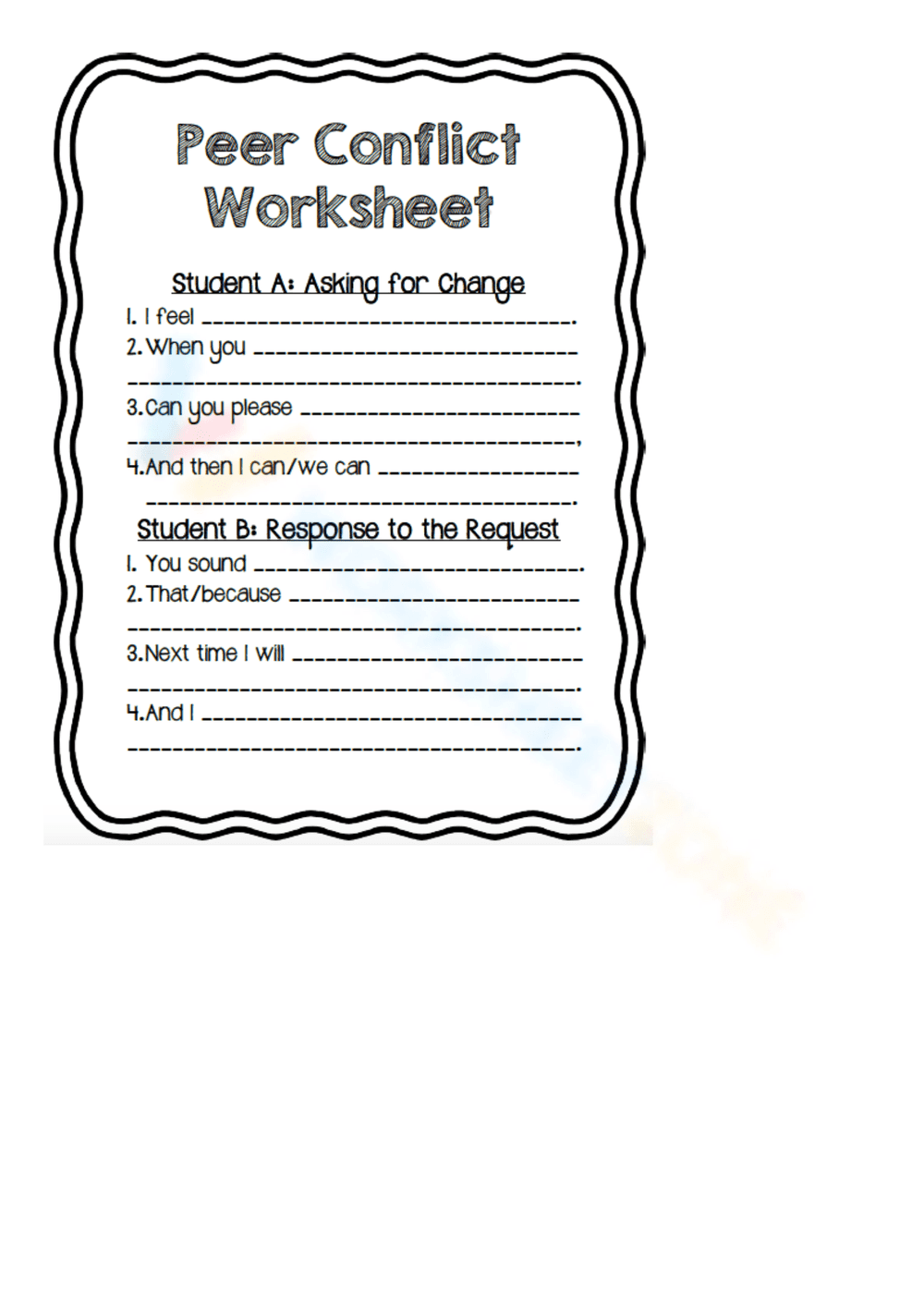

Peer Conflict Worksheet | Essential Grade 6-9 Guide
Paste this activity's link or code into your existing LMS (Google Classroom, Canvas, Teams, Schoology, Moodle, etc.).
Students can open and work on the activity right away, with no student login required.
You'll still be able to track student progress and results from your teacher account.
This Grade 6-9 peer conflict worksheet provides a structured framework for students to resolve interpersonal disputes through effective communication. By utilizing specific sentence starters, students learn to articulate their feelings and needs without escalating tension. This resource transforms abstract social-emotional concepts into concrete, actionable dialogue steps for immediate classroom application.
At a Glance
- Grade: 6-9 · Subject: Behavior & English
- Standard:
CCSS.ELA-LITERACY.SL.6.1— Engage effectively in collaborative discussions and express ideas clearly- Skill Focus: Conflict Resolution & Active Listening
- Format: 1 page · 8 sentence frames · No-prep · PDF
- Best For: Restorative circles and peer mediation
- Time: 10–15 minutes
The worksheet is divided into two distinct roles: Student A (Asking for Change) and Student B (Response to the Request). Each section contains 4 guided sentence frames designed to facilitate a respectful exchange. The layout is clean and distraction-free, featuring a simple border and clear headings that allow students to focus entirely on the communication task at hand.
This resource is designed for immediate implementation during high-stress moments. First, print the single-page PDF (30 seconds). Second, distribute the sheet to the two students involved in a disagreement (30 seconds). Third, facilitate the 8-step dialogue as students read their completed frames aloud (5-10 minutes). Total teacher preparation time is under 2 minutes, making it an ideal tool for unexpected behavioral incidents or as a planned sub-plan activity.
The primary alignment is `CCSS.ELA-LITERACY.SL.6.1`, which requires students to come to discussions prepared and explicitly draw on that preparation to reflect on ideas under discussion. By providing the preparation in the form of sentence frames, this worksheet scaffolds the ability to reflect on interpersonal issues. Both standard codes can be copied directly into lesson plans, IEP goals, or district curriculum mapping tools.
Use this worksheet as a formative assessment tool during small-group role-play activities. Observe whether students can maintain eye contact and appropriate tone while delivering their "I feel" statements. Alternatively, keep a stack of these in a "calm down corner" or restorative justice station for students to use independently when a conflict arises during independent work time. Completion typically takes 10 to 15 minutes depending on the complexity of the conflict.
This resource is tailored for middle school students in grades 6 through 9 who are developing social-emotional maturity. It is particularly effective for students with IEP goals related to social skills or emotional regulation. It pairs naturally with a direct instruction lesson on "I" statements or an anchor chart detailing the differences between assertive and aggressive communication styles.
Effective conflict resolution in middle school requires explicit scaffolding of oral language to move students from reactive emotional responses to proactive problem-solving. According to Fisher & Frey (2014), the use of sentence frames in collaborative settings allows students to internalize the linguistic structures necessary for academic and social success. This worksheet addresses CCSS.ELA-LITERACY.SL.6.1 by providing the necessary support for students to engage in civil discourse during peer disagreements. Research from the RAND AIRS 2024 report suggests that social-emotional learning tools that focus on specific student actions—such as the 8 tasks provided here—lead to higher rates of self-regulation and a decrease in classroom disruptions. By standardizing the response to conflict, educators provide a predictable environment that fosters empathy and reduces the cognitive load associated with interpersonal stress, ensuring that students remain focused on their learning objectives.


