


























Views
Downloads

Printable Fraction Addition Worksheet | Grade 4 Aligned
Paste this activity's link or code into your existing LMS (Google Classroom, Canvas, Teams, Schoology, Moodle, etc.).
Students can open and work on the activity right away, with no student login required.
You'll still be able to track student progress and results from your teacher account.
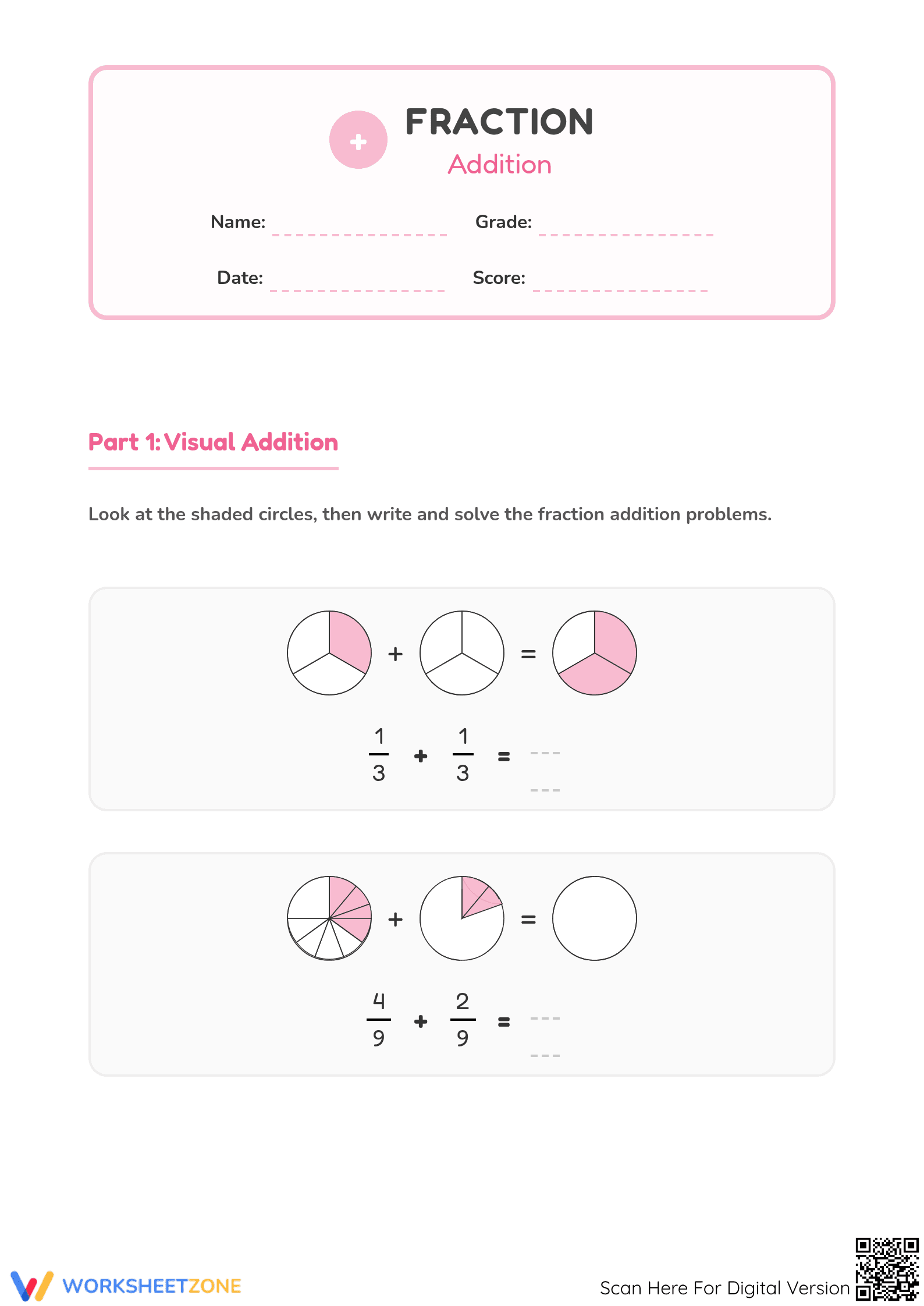
Help students master adding fractions with like denominators through a structured progression from visual models to real-world applications. This three-page worksheet ensures learners understand that adding fractions involves joining parts of a single whole, leading to greater conceptual clarity and procedural fluency in fourth-grade mathematics.
At a Glance
- Grade: 4 · Subject: Math
- Standard:
4.NF.B.3.a— Understand addition of fractions as joining parts referring to the same whole- Skill Focus: Adding fractions with like denominators
- Format: 3 pages · 12 problems · Answer key included · PDF
- Best For: Independent practice or small group instruction
- Time: 20–30 minutes
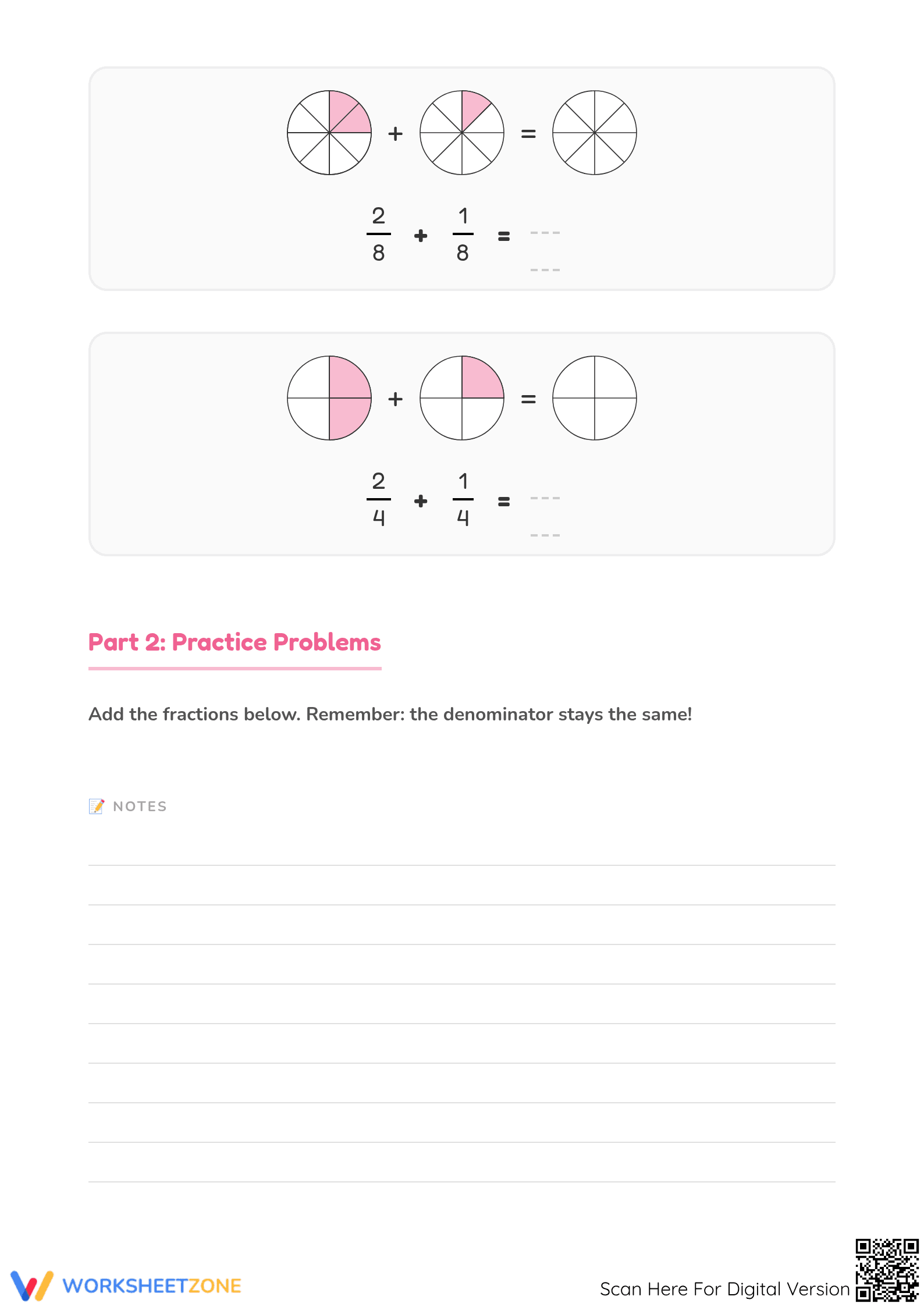
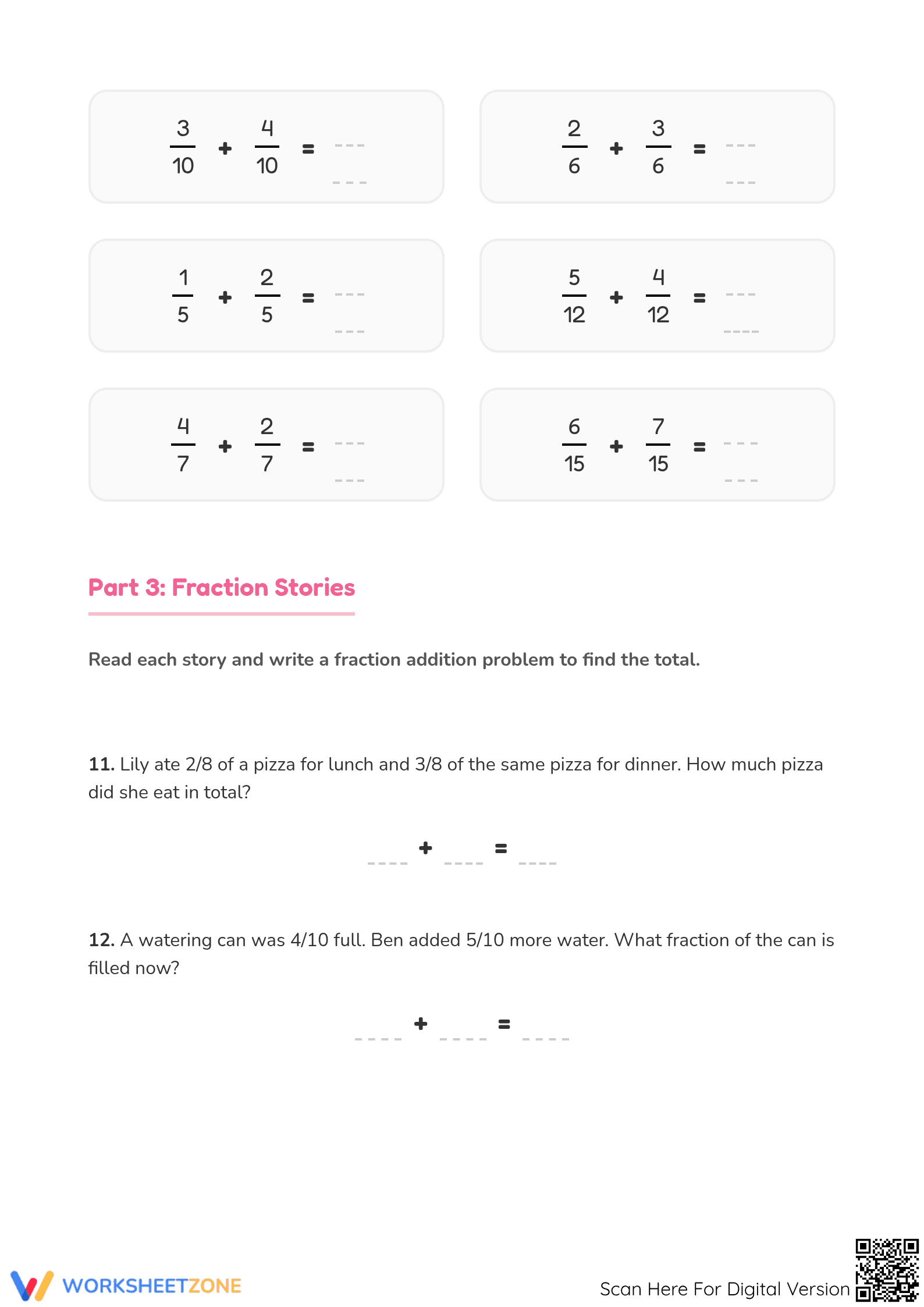
This comprehensive resource features three distinct sections designed to scaffold student learning. It begins with four visual addition problems using shaded circles, transitions to six abstract practice problems, and concludes with two "Fraction Stories" word problems. The set includes a notes section for student calculations and a full answer key for rapid grading and immediate feedback.
Zero-Prep Workflow
Implementation is designed for maximum teacher efficiency with a three-step workflow. First, print the three-page PDF (30 seconds). Second, distribute to students for independent work or as a reliable sub plan (30 seconds). Finally, use the provided answer key for immediate feedback or peer-grading sessions (60 seconds). Total preparation time is under two minutes.
Standards Alignment
The primary alignment is `4.NF.B.3.a`, which requires students to understand addition and subtraction of fractions as joining and separating parts referring to the same whole. By starting with visual models in Part 1 and moving to story problems in Part 3, students demonstrate a complete grasp of the standard. This standard code can be copied directly into lesson plans, IEP goals, or district curriculum mapping tools.
How to Use It
Use this worksheet during the "You Do" phase of a gradual release lesson to assess individual student mastery of like-denominator addition. For a formative assessment, observe students during Part 1 to ensure they are correctly identifying the shaded regions before they move to abstract problems. Expected completion time is approximately 25 minutes for the full set.
Who It's For
This resource is ideal for fourth-grade general education students, fifth-grade students needing remedial support, or as a challenge for advanced third-graders. It pairs naturally with an anchor chart showing circular fraction models or a short introductory passage about "parts of a whole" to reinforce the conceptual underpinnings of fraction arithmetic.
Research by Fisher & Frey (2014) emphasizes the importance of scaffolding math instruction from concrete visual representations to abstract numerical procedures. This Grade 4 worksheet follows that evidence-based trajectory, ensuring students first "see" the math through shaded circle models before solving symbolic equations and complex word problems. By grounding `4.NF.B.3.a` in multiple modalities, the resource supports long-term retention and the ability to transfer skills to real-world contexts, such as the "Fraction Stories" included in Part 3. The inclusion of a clear answer key allows for immediate corrective feedback, a critical factor in preventing the solidification of misconceptions during the early stages of fraction mastery. This document serves as a reliable artifact for measuring student progress against state and national standards, providing clear evidence of a student's ability to join parts referring to the same whole.


