




























0
Views
0
Downloads

0.0
0
Save
0 Likes
Share
Explore Past vs Present
0 Views
0 Downloads

Paste this activity's link or code into your existing LMS (Google Classroom, Canvas, Teams, Schoology, Moodle, etc.).
Students can open and work on the activity right away, with no student login required.
You'll still be able to track student progress and results from your teacher account.
Information
Description
What It Is:
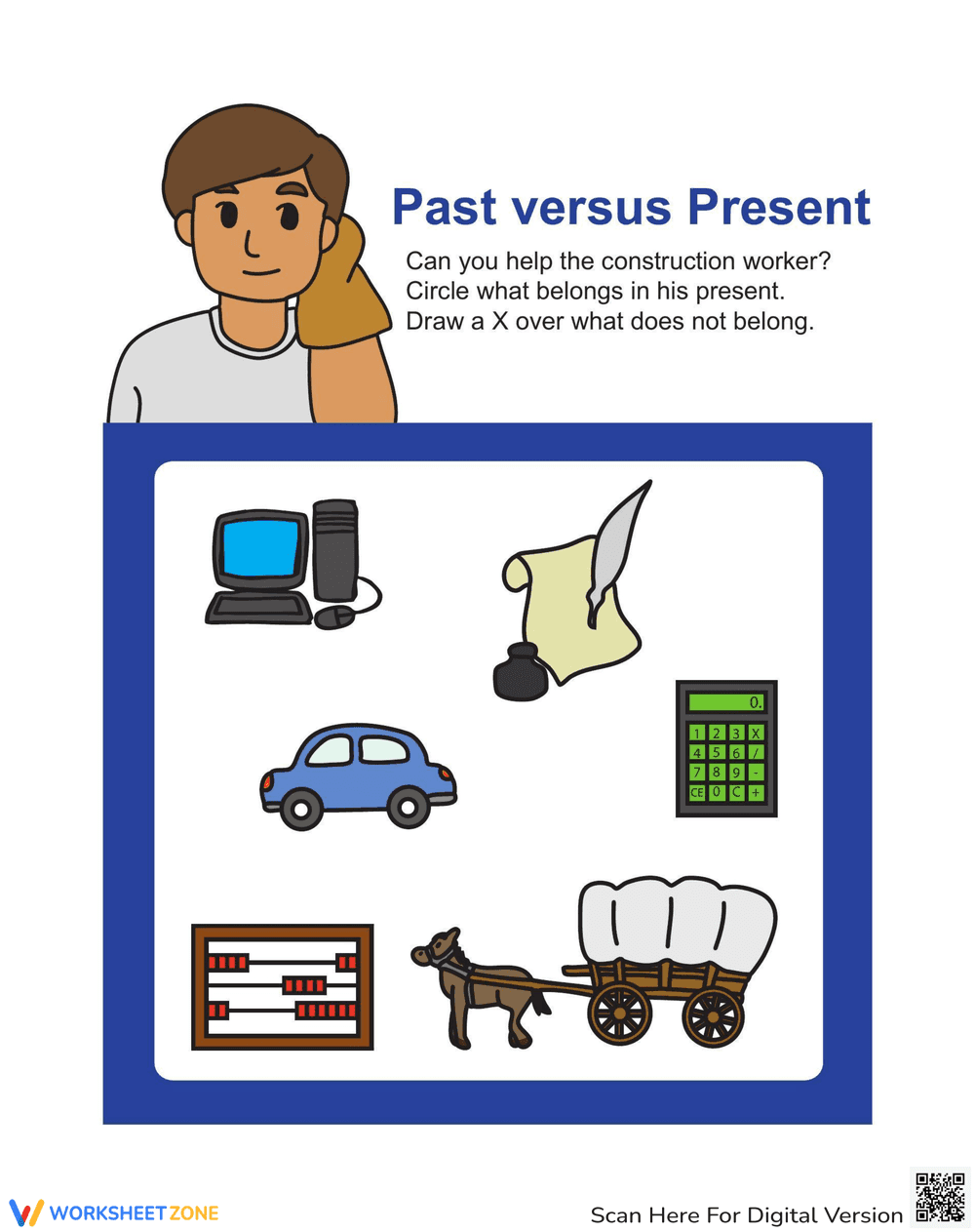
This is a worksheet titled 'Past versus Present' featuring a construction worker illustration. The activity requires students to differentiate between items that belong in the present and those that do not. Students are instructed to circle items that belong in the construction worker's present and draw an 'X' over items that do not. The worksheet includes images of a computer, a car, an abacus, a quill and ink, a calculator, and a horse-drawn covered wagon.
Grade Level Suitability:
This worksheet is suitable for Kindergarten to 2nd grade. The concepts of past and present are introduced at this level, and the activity involves simple identification and marking, making it appropriate for young learners.
Why Use It:
This worksheet helps students develop their understanding of time concepts, specifically the difference between past and present. It encourages critical thinking and observation skills as students analyze the images and determine their historical context. The activity also reinforces fine motor skills through circling and drawing.
How to Use It:
Explain the concept of 'past' and 'present' to the students. Review each image and discuss whether it belongs in the present day or the past. Instruct students to circle the items that belong in the present and draw an 'X' over the items that belong in the past.
Target Users:
This worksheet is designed for elementary school students, particularly those in Kindergarten, 1st, and 2nd grade, who are learning about history and the concept of time. It is also beneficial for students who need to practice their fine motor and critical thinking skills.
This is a worksheet titled 'Past versus Present' featuring a construction worker illustration. The activity requires students to differentiate between items that belong in the present and those that do not. Students are instructed to circle items that belong in the construction worker's present and draw an 'X' over items that do not. The worksheet includes images of a computer, a car, an abacus, a quill and ink, a calculator, and a horse-drawn covered wagon.
Grade Level Suitability:
This worksheet is suitable for Kindergarten to 2nd grade. The concepts of past and present are introduced at this level, and the activity involves simple identification and marking, making it appropriate for young learners.
Why Use It:
This worksheet helps students develop their understanding of time concepts, specifically the difference between past and present. It encourages critical thinking and observation skills as students analyze the images and determine their historical context. The activity also reinforces fine motor skills through circling and drawing.
How to Use It:
Explain the concept of 'past' and 'present' to the students. Review each image and discuss whether it belongs in the present day or the past. Instruct students to circle the items that belong in the present and draw an 'X' over the items that belong in the past.
Target Users:
This worksheet is designed for elementary school students, particularly those in Kindergarten, 1st, and 2nd grade, who are learning about history and the concept of time. It is also beneficial for students who need to practice their fine motor and critical thinking skills.


