


























Views
Downloads




Printable Past Present or Future Tense Worksheet | Grade 1
Paste this activity's link or code into your existing LMS (Google Classroom, Canvas, Teams, Schoology, Moodle, etc.).
Students can open and work on the activity right away, with no student login required.
You'll still be able to track student progress and results from your teacher account.
Mastering verb tenses is a foundational step in Grade 1 literacy, allowing students to communicate exactly when actions occur. This worksheet provides direct practice in identifying past, present, and future tenses within clear, age-appropriate sentences. By the end of these activities, learners will confidently distinguish between completed, ongoing, and upcoming events in written English.
At a Glance
- Grade: 1 · Subject: English Language Arts
- Standard:
CCSS.ELA-LITERACY.L.1.1.E— Use verbs to convey a sense of past, present, and future- Skill Focus: Verb Tense Identification
- Format: 4 pages · 16 problems · Answer key included · PDF
- Best For: Literacy centers and independent grammar practice
- Time: 15–20 minutes
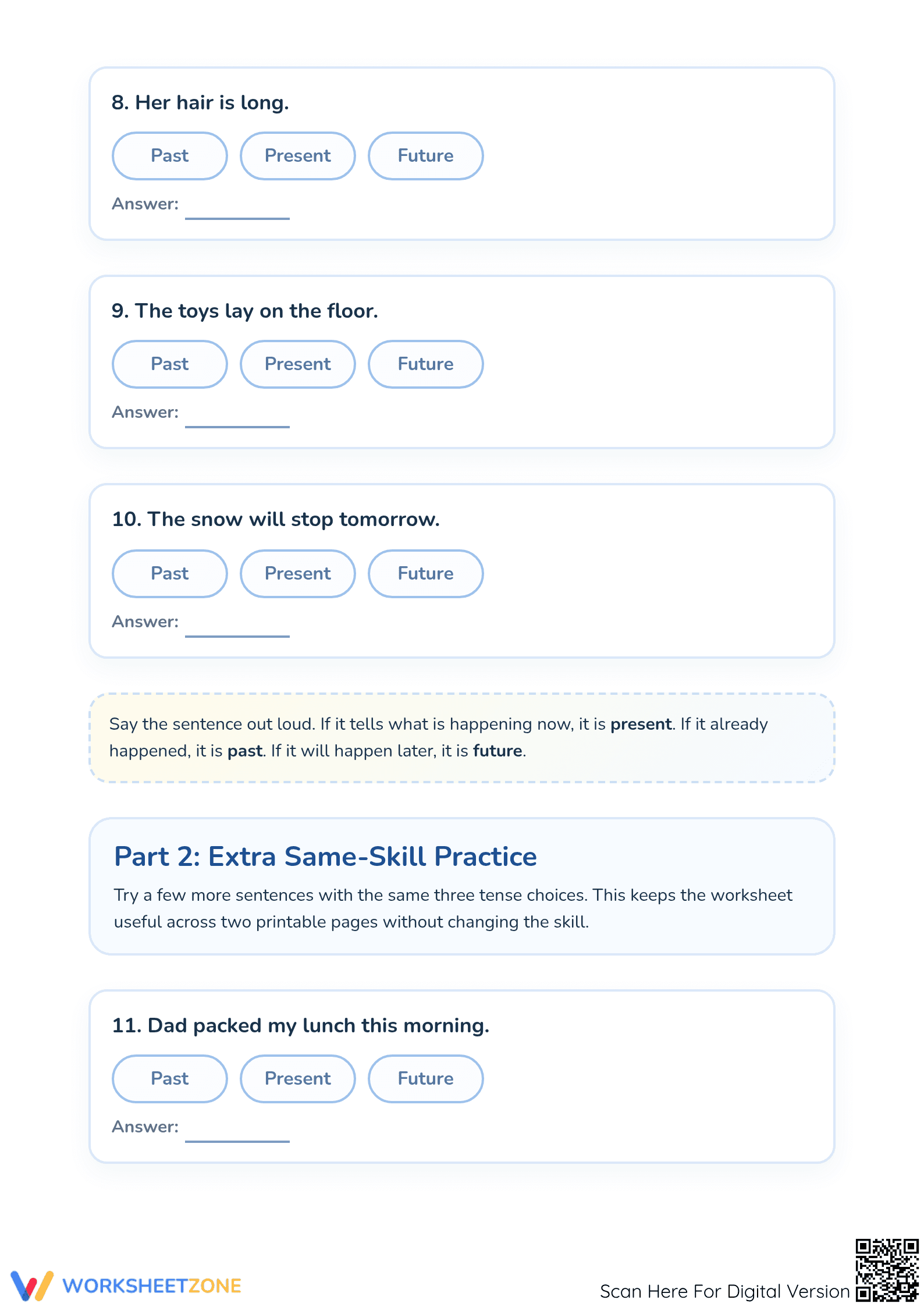
This comprehensive 4-page PDF contains 16 unique sentences designed to test a student's grasp of temporal indicators. The layout features two distinct parts: "Original Practice" and "Extra Same-Skill Practice," ensuring students have ample opportunities to verify their understanding. Each problem includes three large, easy-to-circle buttons for "Past," "Present," and "Future," along with a dedicated space for writing the final answer.
Getting this activity into your students' hands is remarkably simple and takes less than two minutes of teacher preparation. First, print the four-page document directly from the PDF file. Second, distribute the sheets to your students during your grammar or ELA block. Third, review the answers using the included answer key, which can be projected on a screen for a whole-class check or used for quick individual grading.
This resource is specifically aligned to `CCSS.ELA-LITERACY.L.1.1.E`: "Use verbs to convey a sense of past, present, and future (e.g., Yesterday I walked; Today I walk; Tomorrow I will walk)." It focuses on the recognition phase of this standard, helping students identify how time is signaled by verb forms. This standard code can be copied directly into lesson plans, IEP goals, or district curriculum mapping tools.
Use this worksheet as a formative assessment after a direct instruction lesson on verb tenses to check for immediate understanding. Alternatively, assign it as a "must-do" activity during literacy rotations to provide independent practice. While students work, observe if they are using the included "clue words" like yesterday or tomorrow to help them decide the correct tense, which takes about 15 minutes.
This resource is ideal for Grade 1 students who are beginning to explore sentence structure and grammar. It also serves as an excellent intervention tool for Grade 2 learners who need a refresher on basic tense identification. For a complete lesson, pair this worksheet with a short reading passage and ask students to underline verbs in different tenses to see the grammar in a broader context.
According to the RAND AIRS 2024 report on foundational literacy, explicit instruction in grammatical structures like verb tenses is critical for early reading comprehension. This worksheet aligns with CCSS.ELA-LITERACY.L.1.1.E by providing structured practice in identifying past, present, and future verb forms. By isolating the temporal markers in sentences—such as 'yesterday', 'every day', and 'tomorrow'—students develop a concrete understanding of how verbs signal time. Research from the NAEP highlights that students who master basic sentence mechanics in Grade 1 are significantly more likely to meet literacy benchmarks in subsequent years. This resource supports the gradual release of responsibility model, moving from guided identification to independent verification of tense usage. Educators can utilize the 16 unique practice items to assess student mastery of regular verb inflections. The inclusion of an answer key facilitates immediate feedback, which is a proven driver of student engagement and retention in early elementary ELA settings.


