


























Views
Downloads
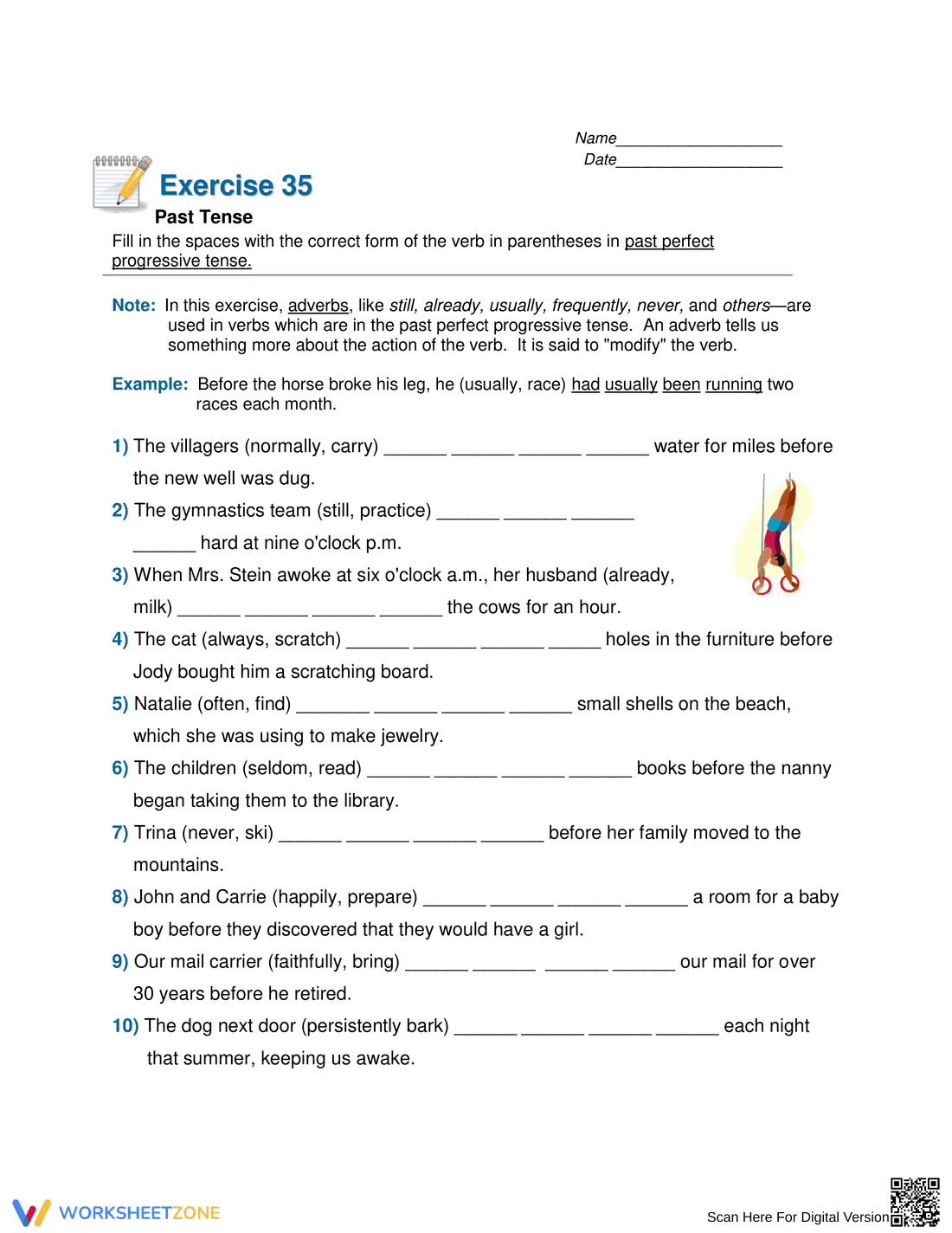

Essential Past Perfect Progressive Tense Worksheet | Grade 5
Paste this activity's link or code into your existing LMS (Google Classroom, Canvas, Teams, Schoology, Moodle, etc.).
Students can open and work on the activity right away, with no student login required.
You'll still be able to track student progress and results from your teacher account.
Master the complexities of English grammar with this focused practice on the past perfect progressive tense. Designed for Grade 5 students, this resource helps learners understand how to describe ongoing actions that were completed before another point in the past. By integrating adverbs, students develop the sophisticated linguistic skills necessary for advanced narrative and informational writing.
At a Glance
- Grade: 5 · Subject: English Language Arts
- Standard:
CCSS.ELA-LITERACY.L.5.1.C— Use verb tenses to convey various times, sequences, and states- Skill Focus: Past Perfect Progressive with Adverbs
- Format: 1 page · 10 problems · Answer key included · PDF
- Best For: Independent grammar practice or sub plans
- Time: 15–20 minutes
Inside this exercise, students will find 10 structured fill-in-the-blank sentences that challenge them to combine "had been" with the present participle while correctly placing adverbs like "normally," "still," and "already." The worksheet includes a concise instructional note and a clear worked example, ensuring that learners have a model to follow as they work through the problems. The single-page layout is designed for maximum clarity and ease of use.
Implementing this resource is a three-step process. Print the copies in under one minute, distribute them for independent work, and review the answers using the key. This zero-prep workflow makes it ideal for emergency sub plans or bell-ringers, requiring less than two minutes of teacher preparation time. This efficiency ensures that instructional time is maximized while administrative burden is minimized.
This resource is aligned to the CCSS.ELA-LITERACY.L.5.1.C standard, which requires students to use verb tense to convey various times, sequences, states, and conditions. It specifically addresses the nuance of the progressive form within the perfect aspect. This standard code can be copied directly into lesson plans, IEP goals, or district curriculum mapping tools to ensure instructional alignment with state and national expectations.
Use this during the independent practice phase of a grammar lesson. It serves as an excellent formative assessment; observe student adverb placement as they work. If a student misses the word order, provide a quick, targeted intervention. Most learners complete the 10 tasks in 15 to 20 minutes, making it a perfect fit for a standard English block or tutorial session.
This is ideal for Grade 5 students or English Language Learners (ELLs) struggling with complex verb phrases. For best results, pair this activity with a short mentor text that uses the past perfect progressive tense so students can see the grammar in a natural literary context. It provides the necessary scaffolding for students to move from rote conjugation to meaningful communication.
According to the RAND AIRS 2024 report on literacy instruction, the explicit teaching of complex verb structures like the past perfect progressive is essential for developing syntactical fluency in upper elementary students. This worksheet targets the CCSS.ELA-LITERACY.L.5.1.C standard, requiring learners to use verb tenses to convey specific sequences and states of being. By focusing on the interaction between adverbs and progressive forms, the 10 tasks provided here move beyond simple conjugation into functional grammar application. Fisher & Frey (2014) emphasize that such guided practice facilitates the gradual release of responsibility, allowing students to internalize the logic of temporal shifts before applying them to their own narrative or expository writing. Educators can use this resource to pinpoint specific gaps in understanding related to auxiliary verbs and participle usage, ensuring that students meet grade-level expectations for language mastery and complex sentence construction.


