


























Views
Downloads
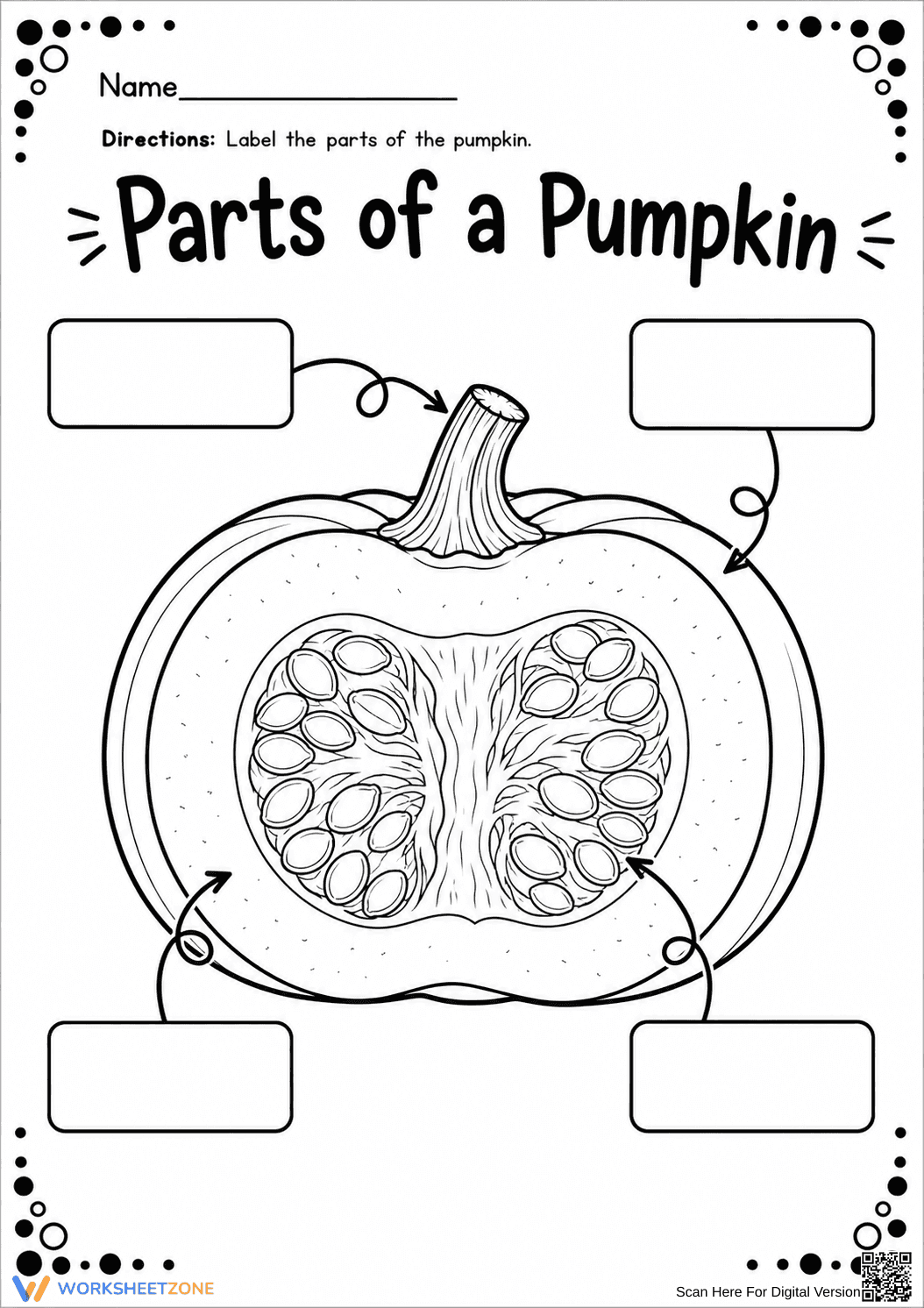

Parts of the Pumpkin Worksheet | Grade 1 Essential
Paste this activity's link or code into your existing LMS (Google Classroom, Canvas, Teams, Schoology, Moodle, etc.).
Students can open and work on the activity right away, with no student login required.
You'll still be able to track student progress and results from your teacher account.
This Grade 1 science worksheet helps students identify and label the internal and external structures of a pumpkin. By engaging with a clear cross-section diagram, learners develop foundational biological vocabulary and observation skills. Students will successfully name key components like the stem, seeds, and pulp, reinforcing their understanding of plant anatomy during seasonal science units.
At a Glance
- Grade: Grade 1 · Subject: Science
- Standard:
1-LS1-1— Use materials to design a solution to a human problem by mimicking how plants/animals use their external parts- Skill Focus: Plant Anatomy & Labeling
- Format: 1 page · 4 problems · Answer key included · PDF
- Best For: Fall science units and vocabulary building
- Time: 10–15 minutes
The resource features a high-quality, black-and-white illustration of a pumpkin sliced in half. It includes 4 distinct labeling boxes with directional arrows pointing to the stem, the outer skin, the fibrous pulp, and the seeds. The single-page PDF format is designed for easy duplication, and the line-art style allows students to color the diagram after completing the linguistic task.
This worksheet is designed for a zero-prep classroom environment. Teachers can print the single-page PDF in less than 30 seconds. Distribution takes approximately 1 minute during a transition period. Students typically complete the labeling and coloring within 10 to 15 minutes, allowing for a quick whole-group review of the correct terms. Total teacher preparation time is under 2 minutes.
This activity aligns with 1-LS1-1, which focuses on how the external parts of plants help them survive and grow. By identifying the rind for protection and seeds for reproduction, students connect physical structures to biological functions. This standard code can be copied directly into lesson plans, IEP goals, or district curriculum mapping tools.
Use this worksheet as a formative assessment following a hands-on pumpkin investigation where students touch real pumpkin guts. It also serves as an excellent quiet-work activity for science centers. Observe if students can differentiate between the pulp and seeds to gauge their attention to detail and vocabulary retention.
This resource is ideal for Kindergarten and Grade 1 students, including English Language Learners who benefit from visual-to-text associations. It pairs naturally with a read-aloud about plant life cycles or an anchor chart displaying common autumn harvest vocabulary.
According to research by Fisher & Frey (2014) on the gradual release of responsibility, visual labeling tasks serve as a critical bridge between direct instruction and independent mastery of technical vocabulary. This worksheet specifically targets the 1-LS1-1 standard by requiring students to observe and categorize the physical structures of a plant. By isolating four primary components—the stem, rind, pulp, and seeds—the activity reduces cognitive load for early elementary learners while reinforcing the scientific method of observation. Data from NAEP science frameworks suggest that early exposure to anatomical diagrams improves long-term retention of biological concepts. This printable resource provides a structured environment for students to practice these skills without the distraction of complex text, making it an essential tool for inclusive science classrooms. The clear spatial arrangement of the labeling boxes supports fine motor development and spatial reasoning, which are foundational for later success in more complex STEM disciplines.


