




























Views
Downloads

Grade K Body Parts — Printable No-Prep Worksheet

Paste this activity's link or code into your existing LMS (Google Classroom, Canvas, Teams, Schoology, Moodle, etc.).
Students can open and work on the activity right away, with no student login required.
You'll still be able to track student progress and results from your teacher account.
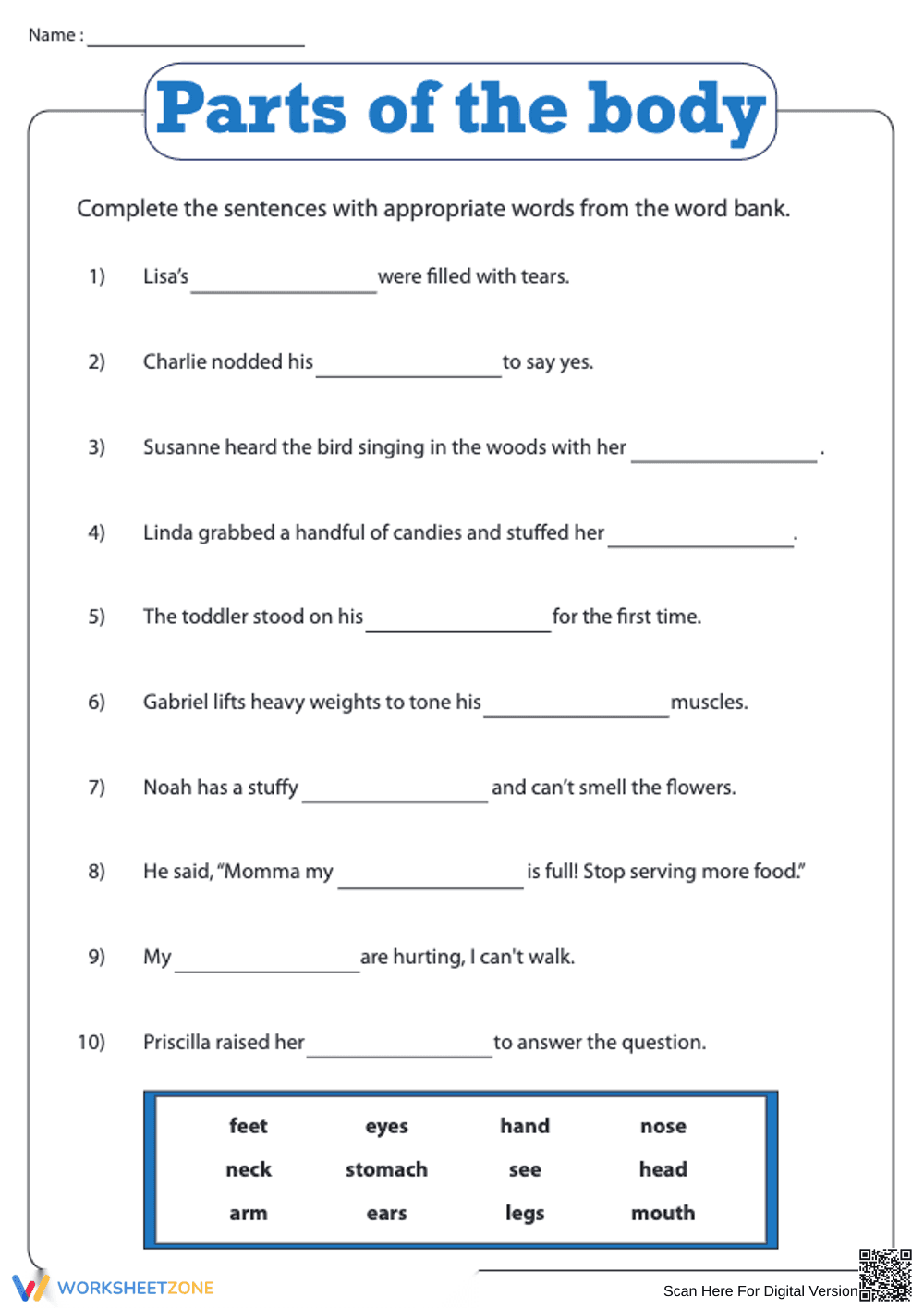
This Kindergarten science worksheet helps students identify and understand basic human body parts by using context clues to complete sentences. By reading simple scenarios and selecting the correct anatomical term from a word bank, young learners build foundational biology vocabulary and reading comprehension skills simultaneously.
At a Glance
- Grade: Kindergarten · Subject: Science
- Standard:
K-LS1-1— Identify external human body parts and their basic functions- Skill Focus: Body Parts Vocabulary
- Format: 2 pages · 10 problems · Answer key included · PDF
- Best For: Independent practice or morning work
- Time: 10–15 minutes
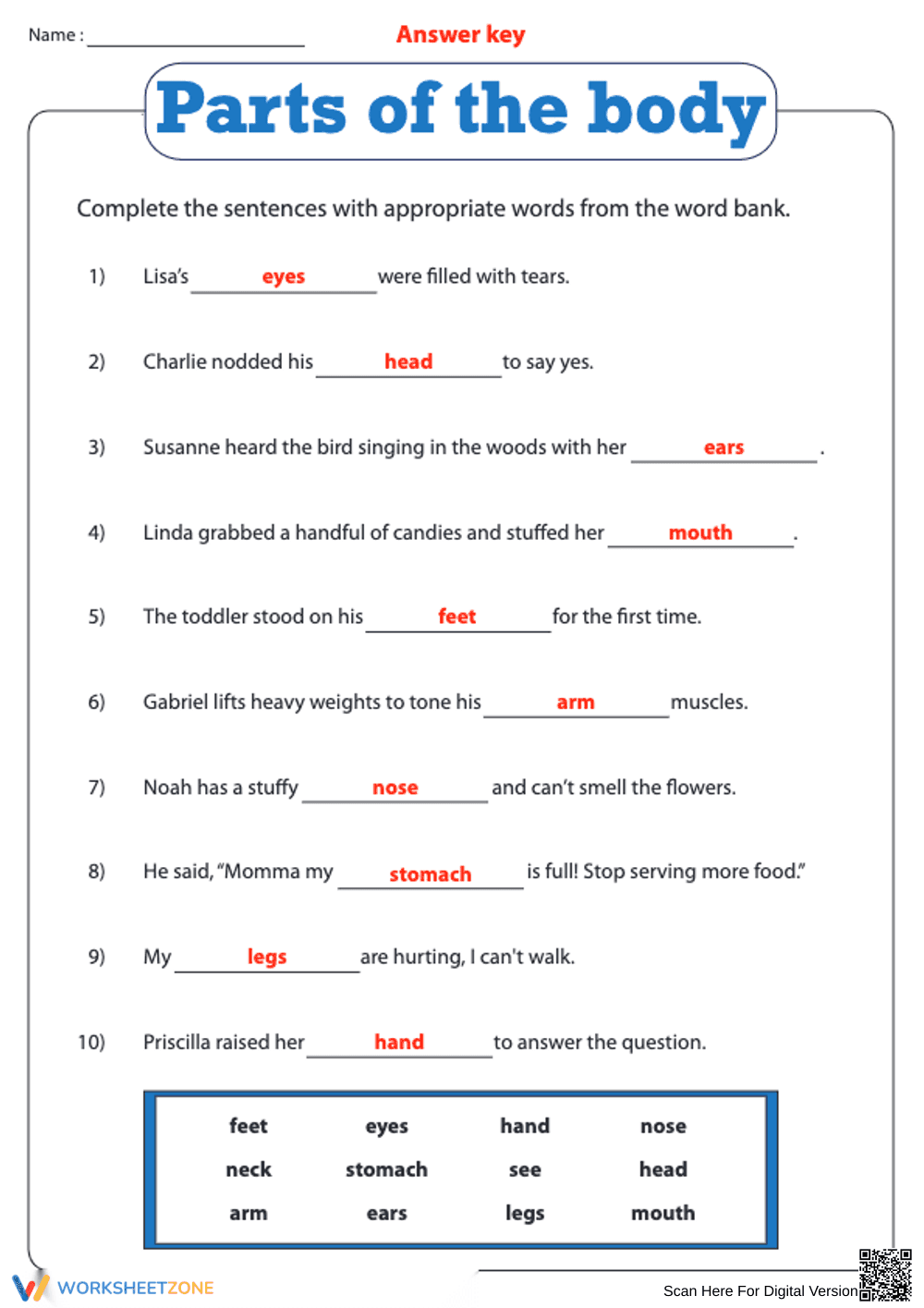
This resource features a single-page fill-in-the-blank activity containing 10 distinct sentences. Students read each sentence and choose the appropriate body part from a 12-word bank. The worksheet includes clear text suitable for early readers and comes with a complete, color-coded answer key on the second page for rapid grading.
- Print (1 minute): Simply print the PDF. The black-and-white design is ink-friendly and requires no special formatting.
- Distribute (1 minute): Hand out the single-page activity to students. The included word bank means no additional reference materials are needed.
- Review (3 minutes): Use the provided answer key to quickly check student work or project it on the board for self-correction.
With under two minutes of total teacher prep time, this worksheet is an ideal solution for busy mornings, quick science centers, or emergency substitute plans.
Aligned to K-LS1-1, this activity supports students as they observe and describe patterns of what humans need to survive, which begins with identifying external body parts and their functions. It also reinforces early literacy standards by requiring students to use context clues to determine missing vocabulary words. Both standard codes can be copied directly into lesson plans, IEP goals, or district curriculum mapping tools.
Deploy this worksheet during a science center rotation after a whole-class lesson on the human body. Students can work independently to read the sentences and fill in the blanks. Alternatively, use it as a formative assessment tool at the end of a health unit. As students work, observe whether they rely heavily on the word bank or identify the missing body part based solely on context. Expect completion in 10 to 15 minutes.
This activity is designed for Kindergarten students developing their science vocabulary and early reading skills. It is highly effective for English Language Learners (ELLs) who benefit from the structured word bank and contextual sentences. Pair this worksheet with a visual anchor chart of the human body or a read-aloud book about anatomy to provide additional scaffolding for emerging readers.
Integrating vocabulary practice with foundational science concepts, such as identifying external human body parts and their basic functions, is critical for early childhood cognitive development. According to a RAND AIRS 2024 report, cross-curricular activities that combine literacy skills with core science content significantly improve both reading comprehension and scientific knowledge retention in early elementary students. The research emphasizes that when young learners encounter scientific vocabulary within meaningful, context-rich sentences, their ability to recall and apply those terms increases dramatically. By aligning to standards such as K-LS1-1, educators ensure that students are not merely memorizing isolated terms, but are actively understanding how these body parts function in everyday, real-world contexts. This dual-focus instructional approach maximizes valuable classroom time and provides a much more cohesive, engaging learning experience for young students.


