




























0
Views
0
Downloads

0.0
0
Save
0 Likes
Share
Labeling the Parts of a Tree Science Activity
0 Views
0 Downloads

Paste this activity's link or code into your existing LMS (Google Classroom, Canvas, Teams, Schoology, Moodle, etc.).
Students can open and work on the activity right away, with no student login required.
You'll still be able to track student progress and results from your teacher account.
Information
Description
What It Is:
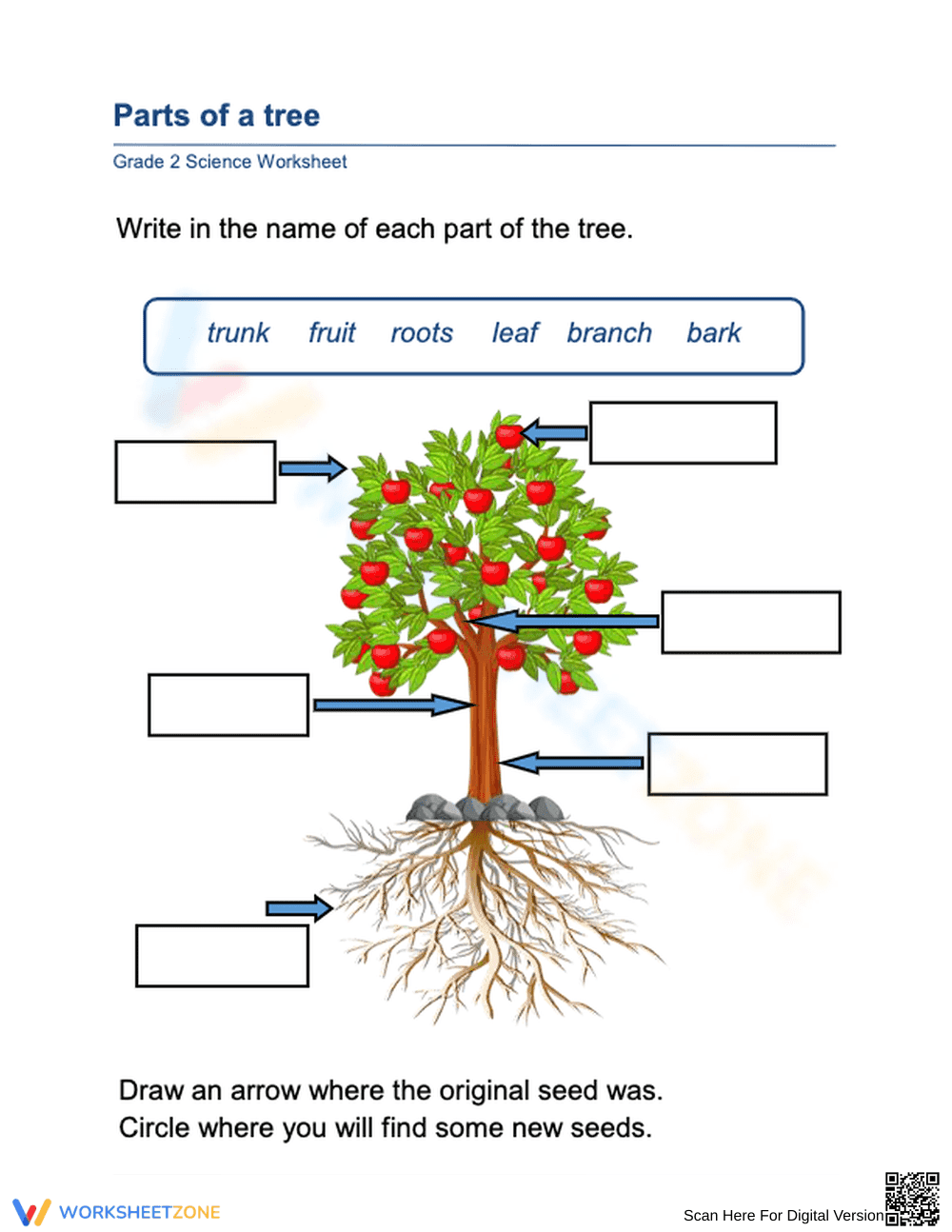
This educational worksheet features a vibrant illustration of a fruit-bearing tree alongside a helpful word bank. Students are tasked with labeling six key components: trunk, fruit, roots, leaf, branch, and bark. It also includes critical thinking prompts regarding the location of seeds.
Why Use It:
It strengthens scientific vocabulary and helps children visualize the anatomy of plants. This activity supports observational skills and introduces the basic life cycle of trees in an easy-to-follow format.
How to Use It:
• Review the word bank terms together to ensure students understand each part's function.
• Ask students to trace the blue arrows and write the matching name in the corresponding boxes.
• Encourage students to think about plant growth by completing the seed-finding tasks at the bottom of the page.
Grade Suitability:
Best for Grade 1 and Grade 2.
• Younger kids focus on identifying visible parts like the leaf and fruit.
• Older students focus on complex structures like the root system and bark protection.
Target Users:
Elementary school teachers, homeschooling parents, and curious young learners.
This educational worksheet features a vibrant illustration of a fruit-bearing tree alongside a helpful word bank. Students are tasked with labeling six key components: trunk, fruit, roots, leaf, branch, and bark. It also includes critical thinking prompts regarding the location of seeds.
Why Use It:
It strengthens scientific vocabulary and helps children visualize the anatomy of plants. This activity supports observational skills and introduces the basic life cycle of trees in an easy-to-follow format.
How to Use It:
• Review the word bank terms together to ensure students understand each part's function.
• Ask students to trace the blue arrows and write the matching name in the corresponding boxes.
• Encourage students to think about plant growth by completing the seed-finding tasks at the bottom of the page.
Grade Suitability:
Best for Grade 1 and Grade 2.
• Younger kids focus on identifying visible parts like the leaf and fruit.
• Older students focus on complex structures like the root system and bark protection.
Target Users:
Elementary school teachers, homeschooling parents, and curious young learners.


