


























Views
Downloads

Parts of a Plant Worksheet | Essential Grade 7 Science
Paste this activity's link or code into your existing LMS (Google Classroom, Canvas, Teams, Schoology, Moodle, etc.).
Students can open and work on the activity right away, with no student login required.
You'll still be able to track student progress and results from your teacher account.
This Grade 7 science worksheet provides a clear visual guide for students to identify and label the primary anatomical structures of a flowering plant. By connecting visual diagrams to biological terminology, learners reinforce their understanding of how specialized plant structures support growth and reproduction. This resource serves as a foundational tool for middle school biology units.
At a Glance
- Grade: 7 · Subject: Science / Biology
- Standard:
MS-LS1-4— Identify specialized plant structures that affect the probability of successful reproduction- Skill Focus: Anatomical labeling and identification
- Format: 1 page · 5 problems · Answer key included · PDF
- Best For: Bell-ringers, exit tickets, or sub plans
- Time: 10–15 minutes
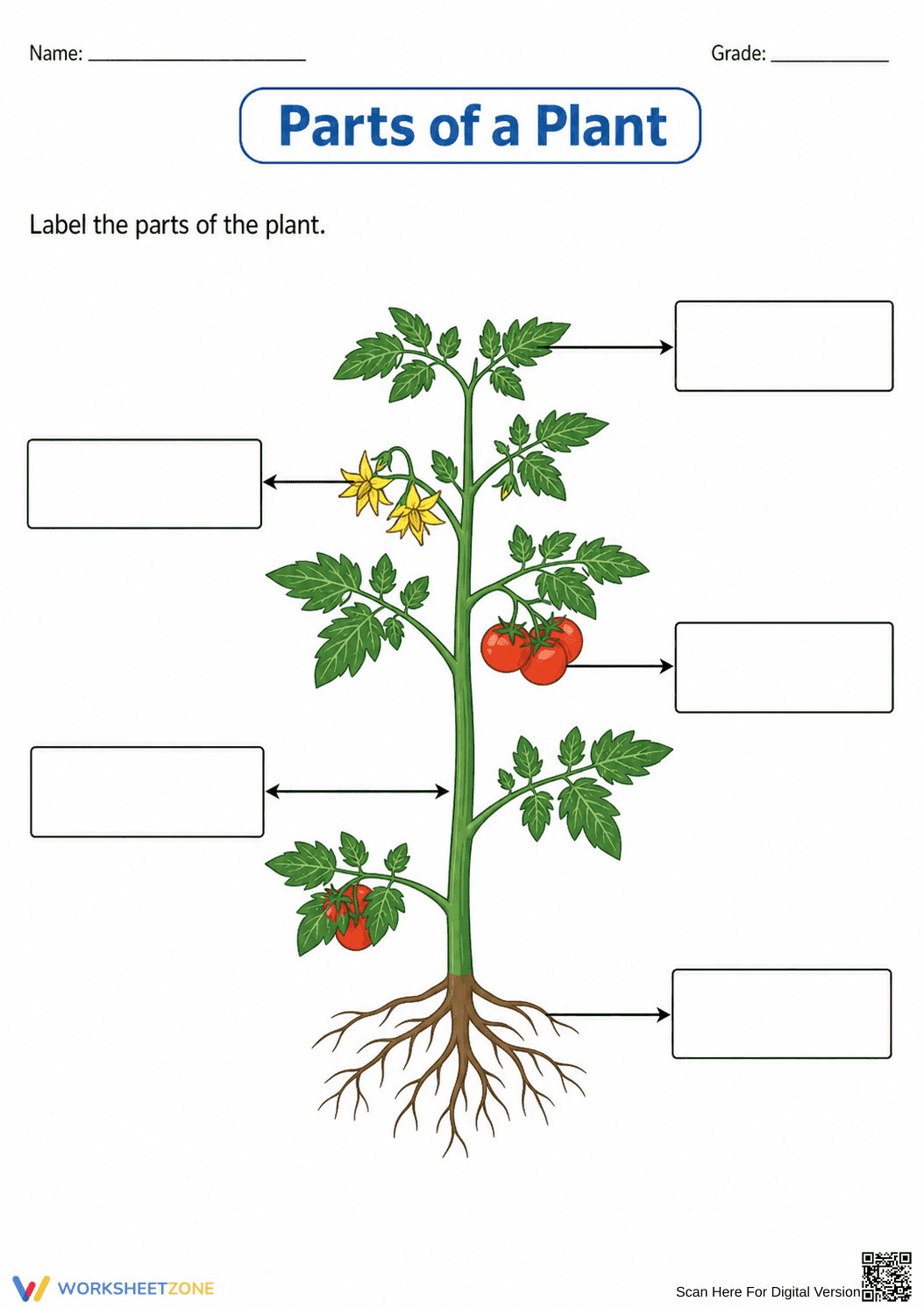
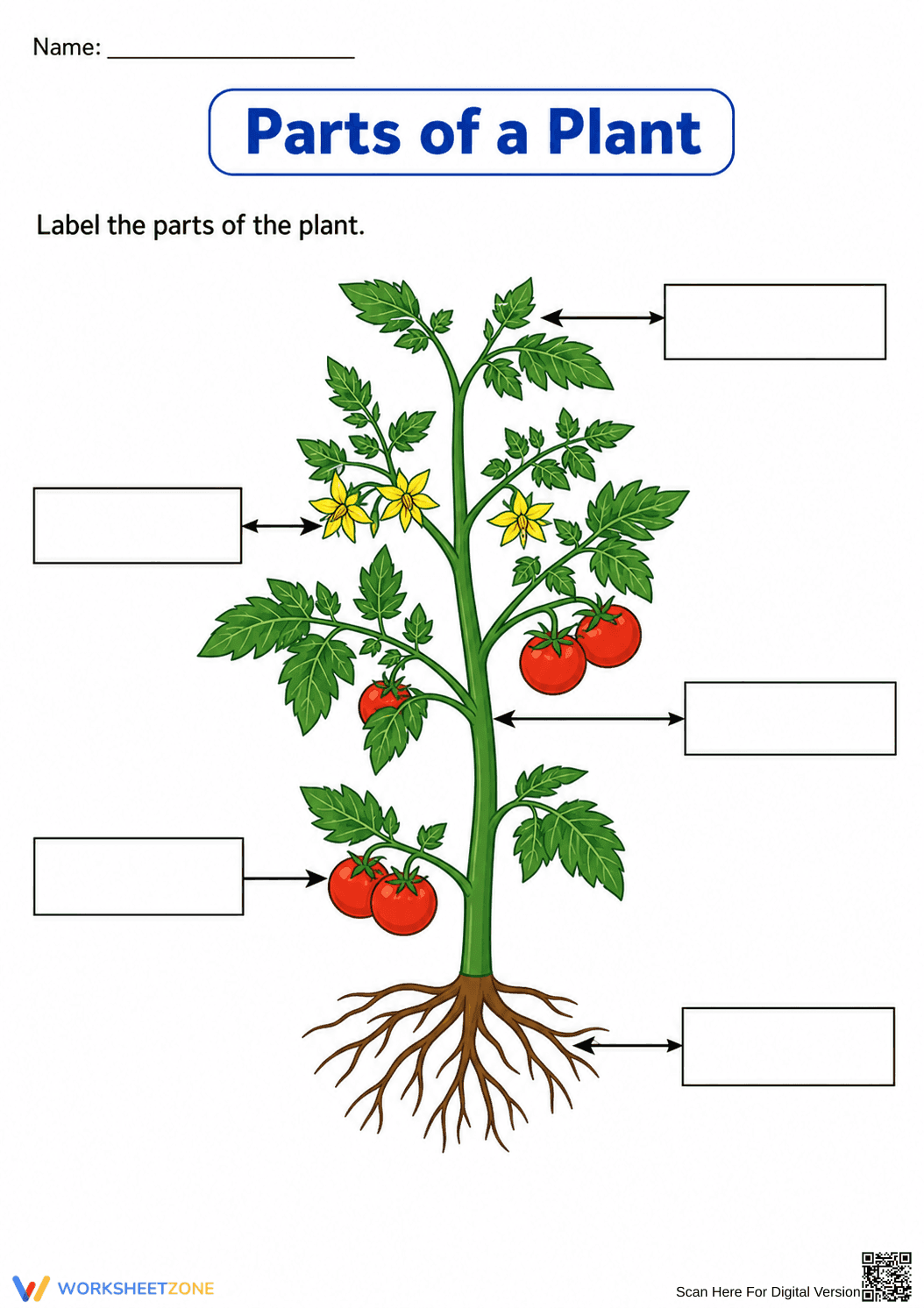
Inside this resource, you will find a high-quality botanical illustration of a tomato plant. The diagram features 5 distinct call-out boxes pointing to the roots, stem, leaves, flowers, and fruit. The clean layout ensures that students can focus on the spatial relationship between different plant organs without visual clutter. A second page provides a complete answer key, allowing for immediate student feedback or efficient teacher grading.
Zero-Prep Workflow: This worksheet is designed for maximum efficiency in the classroom. First, print the single-page PDF (30 seconds). Second, distribute the sheets to students as they enter the room or as a transition between activities (1 minute). Third, review the answers using the included key to project the correct labels and discuss the biological function of each part (5 minutes). Total teacher prep time is under 2 minutes, making it an ideal choice for busy schedules.
Standards Alignment: This activity aligns with MS-LS1-4: "Use argument based on empirical evidence and scientific reasoning to support an explanation for how characteristic animal behaviors and specialized plant structures affect the probability of successful reproduction of animals and plants respectively." By identifying the flower and fruit, students begin to categorize structures specifically involved in the reproductive cycle. This standard code can be copied directly into lesson plans, IEP goals, or district curriculum mapping tools.
How to Use It: Use this as a formative assessment before a botany unit to gauge prior knowledge or as a quick check for understanding after a lecture on plant life cycles. Teachers can observe students as they work to identify which structures (like the stem versus the root) might cause confusion. The expected completion time is 10 to 15 minutes, fitting perfectly into a standard instructional block.
Who It's For: This resource is designed for Grade 7 through Grade 12 students, particularly those needing visual reinforcement or English Language Learners (ELL) building scientific vocabulary. It pairs naturally with a live plant dissection or an anchor chart detailing the functions of each organ.
According to the RAND AIRS 2024 analysis of instructional materials, high-quality visual aids significantly improve the retention of biological terminology in middle school learners. This worksheet utilizes a clear, realistic diagram to bridge the gap between abstract concepts and physical structures. By focusing on the MS-LS1-4 standard, the activity ensures that students are not just memorizing names but are preparing to analyze how these parts contribute to the survival and reproduction of the organism. Research from Fisher & Frey (2014) suggests that such scaffolded labeling tasks are essential for developing the academic language required for higher-level scientific inquiry. This printable resource provides a reliable, evidence-based method for reinforcing plant anatomy.


