


























Views
Downloads

Grade 7-12 Parts of a Plant — Printable No-Prep Worksheet
Paste this activity's link or code into your existing LMS (Google Classroom, Canvas, Teams, Schoology, Moodle, etc.).
Students can open and work on the activity right away, with no student login required.
You'll still be able to track student progress and results from your teacher account.
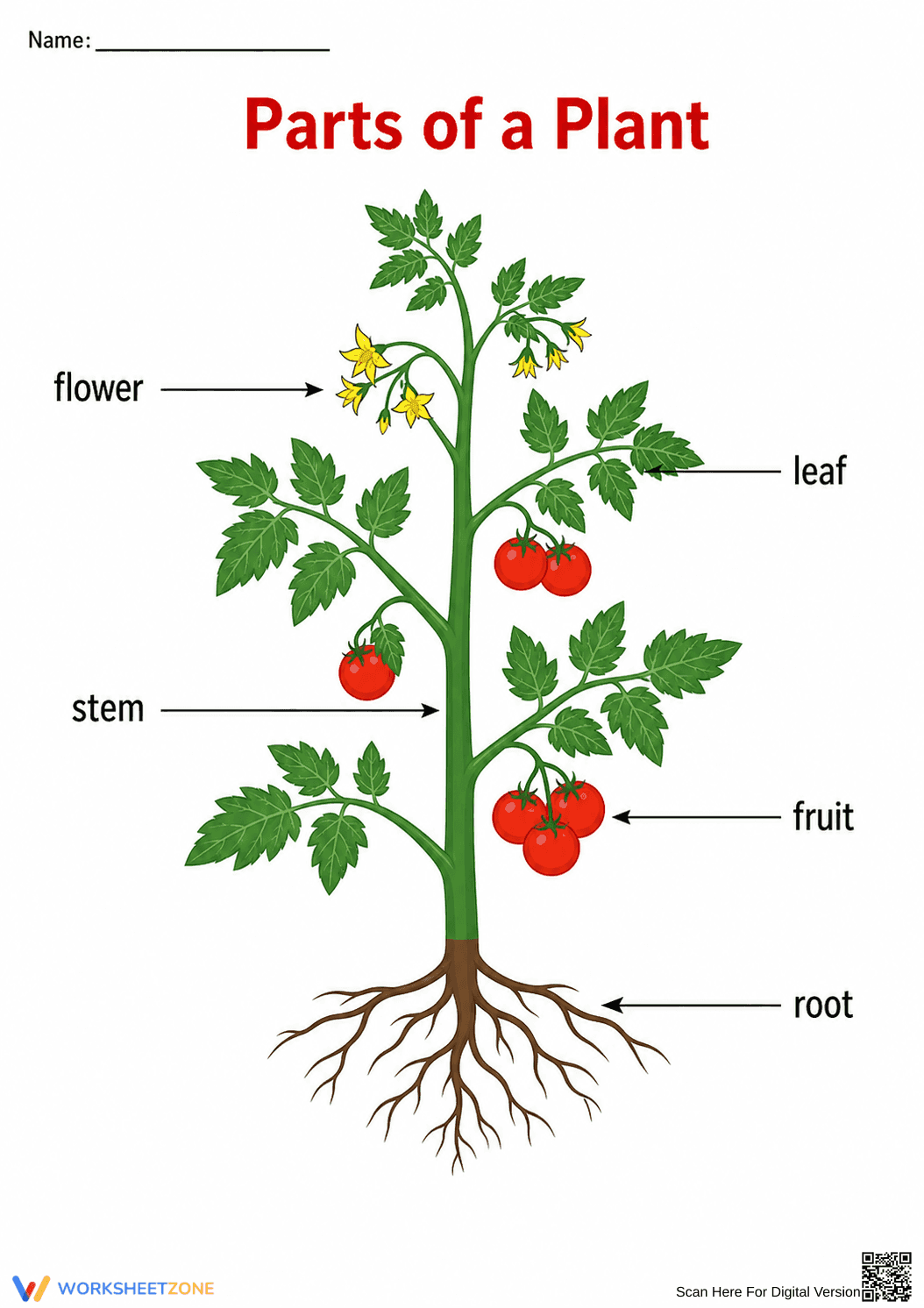
This Grade 7-12 biology reference worksheet provides students with a clear, labeled diagram of essential botanical structures. By studying this visual guide, learners will easily identify the root, stem, leaf, flower, and fruit, building a strong foundation for advanced life science concepts and plant anatomy identification.
At a Glance
- Grade: 7–12 · Subject: Biology
- Standard:
MS-LS1-4— Identify specialized plant structures and their functions- Skill Focus: Plant anatomy identification
- Format: 1 page · 5 labeled parts · Answer key included · PDF
- Best For: Visual reference and study guide
- Time: 5–10 minutes
Inside this single-page resource, educators will find a fully colored, accurately labeled diagram of a tomato plant. The visual clearly points out five primary anatomical features: the flower, leaf, stem, fruit, and root system. It serves perfectly as a student study guide, a classroom anchor chart, or a self-contained answer key for related activities. The clean layout ensures students can quickly locate each specific structure without visual clutter.
This resource is designed for immediate classroom implementation with a highly efficient zero-prep workflow:
- Print (1 minute): Download the PDF and print copies or project it directly onto your smartboard.
- Distribute (1 minute): Hand out the reference sheets for inclusion in student science notebooks.
- Review (3 minutes): Walk through the five labeled structures, explaining how each part contributes to plant survival.
With under two minutes of total teacher prep time, this material is an excellent addition to emergency sub plans or quick review sessions.
This visual guide aligns with MS-LS1-4, supporting students as they learn to identify specialized plant structures that affect the probability of successful reproduction. It also provides foundational knowledge for high school biology standards regarding hierarchical organization in multicellular organisms. Both standard codes can be copied directly into lesson plans, IEP goals, or district curriculum mapping tools.
Teachers can utilize this diagram in multiple instructional moments. Before direct instruction, distribute the sheet to activate prior knowledge about plant anatomy. During a lab activity, students can keep this guide on their desks to identify corresponding parts on real specimens. For a quick formative assessment, ask students to cover the labels and verbally name each part to a partner. Expected review time is five to ten minutes.
This resource is primarily designed for middle and high school biology students who benefit from clear visual aids. The straightforward labeling makes it an excellent differentiation tool for English Language Learners (ELLs), as it removes complex text and focuses purely on vocabulary acquisition. It pairs perfectly with hands-on dissection labs or direct instruction lessons on photosynthesis.
Understanding foundational botanical anatomy is a critical step in mastering broader life science concepts. This resource directly supports MS-LS1-4 by helping students identify specialized plant structures and their functions. According to a 2024 report by EdReports, providing students with accurate, high-quality visual models significantly improves their ability to retain complex scientific vocabulary and understand systemic biological processes. When learners can visually map terms like stem, root, and flower to a concrete image, their cognitive load decreases, allowing for deeper engagement with subsequent topics like cellular respiration and reproductive strategies. By integrating this labeled diagram into regular instruction, educators ensure that all students have the necessary scaffolding to succeed in rigorous science curricula. This evidence-based approach to visual learning fosters greater academic confidence and promotes long-term retention of essential biological frameworks.


