


























Views
Downloads

Parts of a Flower Worksheet | Essential Grade 1-2 Science
Paste this activity's link or code into your existing LMS (Google Classroom, Canvas, Teams, Schoology, Moodle, etc.).
Students can open and work on the activity right away, with no student login required.
You'll still be able to track student progress and results from your teacher account.
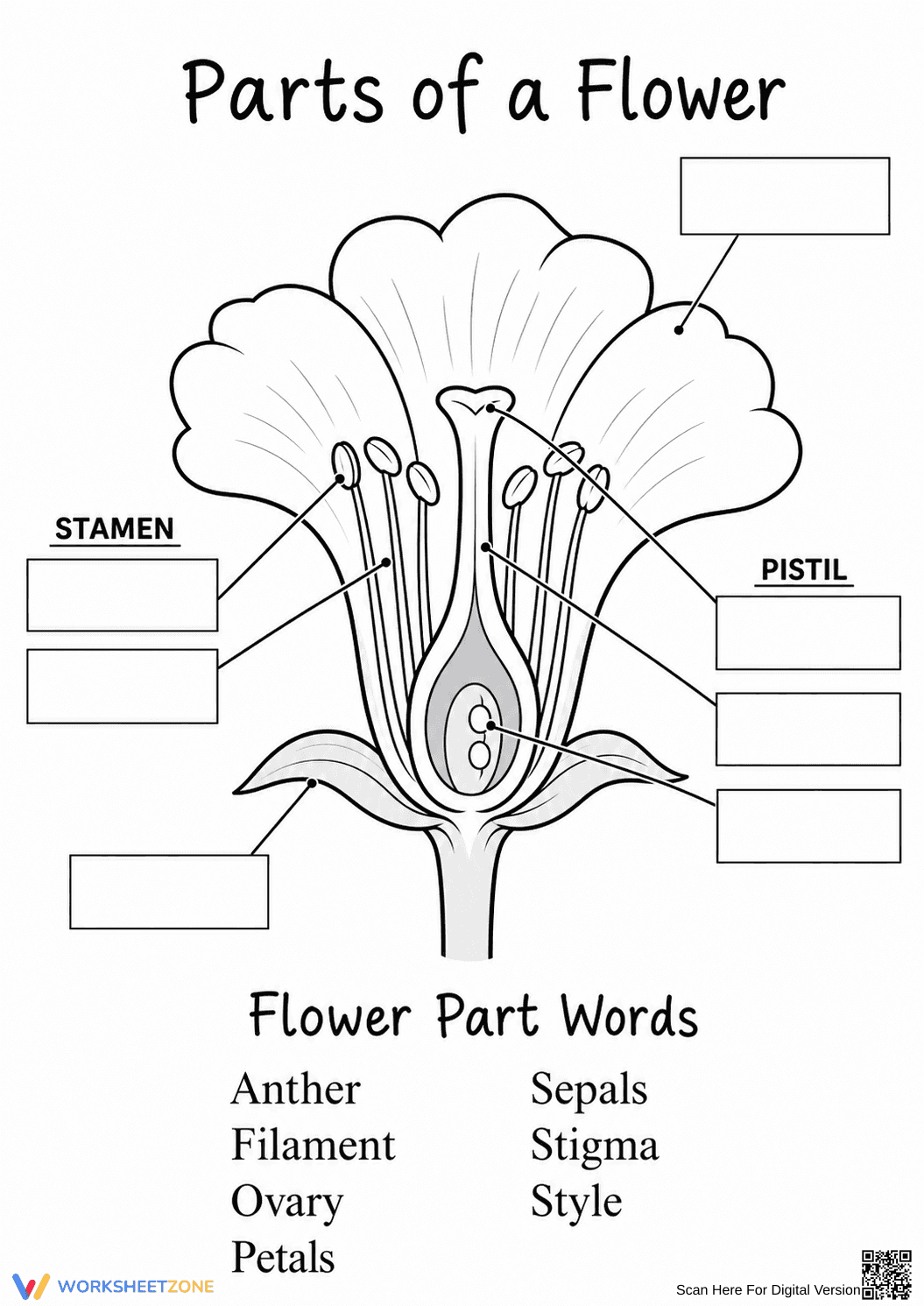
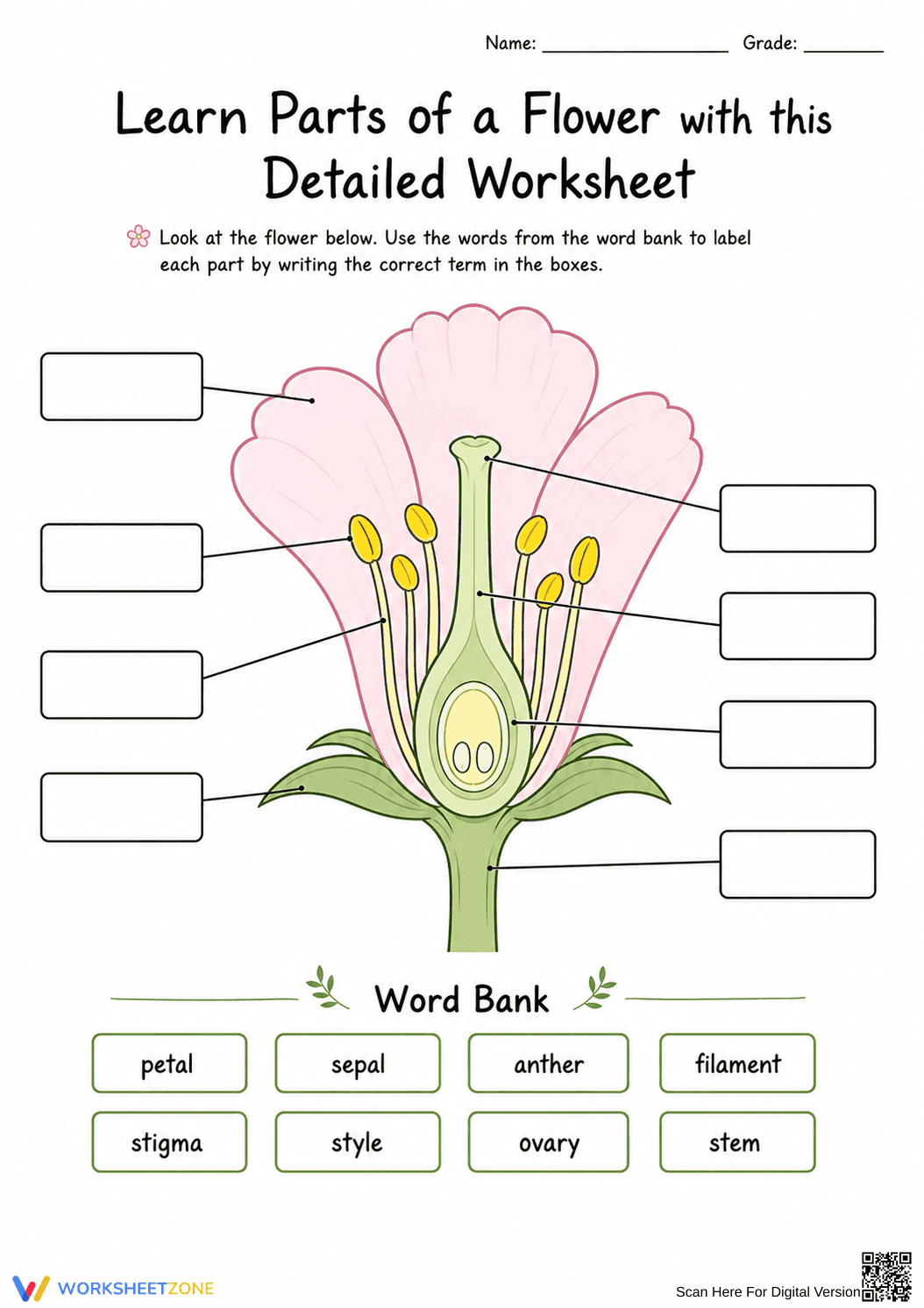
Students identify and label the primary reproductive and structural components of a flowering plant using this clear, visual guide. This activity bridges the gap between observation and scientific terminology, ensuring learners understand how specific structures like the stamen and pistil contribute to the plant's life cycle and survival.
At a Glance
- Grade: 1-2 · Subject: Science
- Standard:
1-LS1-1— Use materials to design a solution to a human problem by mimicking plant/animal structures- Skill Focus: Flower Anatomy & Labeling
- Format: 1 page · 8 problems · Answer key included · PDF
- Best For: Introduction to botany and plant life cycles
- Time: 15–20 minutes
This single-page PDF features a high-resolution botanical diagram of a flower. It includes 8 clear leader lines pointing to specific anatomical parts, paired with a structured word bank at the bottom. The layout is designed for high-contrast printing, ensuring that students can easily distinguish between the filament, anther, and style. The inclusion of both the male and female reproductive parts allows for a comprehensive overview of plant biology.
Zero-Prep Workflow
- Print: Select the "Fit to Page" setting and print enough copies for your class in under 30 seconds.
- Distribute: Hand out the sheets as a transition activity or a follow-up to a garden observation; students will need approximately 10 minutes to complete the labeling.
- Review: Use the included answer key for a 2-minute whole-class check or peer-grading session to reinforce correct terminology.
This resource aligns with `1-LS1-1`, which requires students to understand that all organisms have external parts that help them survive and grow. By identifying the reproductive organs and protective sepals, students gain foundational knowledge of plant survival and reproduction. Both standard codes can be copied directly into lesson plans, IEP goals, or district curriculum mapping tools.
Use this as a formative assessment after a direct instruction lesson on pollination. It works exceptionally well as a "check for understanding" exit ticket or a quiet-time activity during science rotations. Expected completion time is 15 to 20 minutes depending on prior vocabulary exposure and reading level. Teachers can observe student progress by checking for the correct placement of the "stigma" versus the "style."
This worksheet is ideal for first and second-grade general education classrooms, ESL students requiring visual aids, and homeschoolers exploring botany. It provides the necessary scaffolding for young learners who are just beginning to engage with technical scientific diagrams. Pair this with a real lily or tulip dissection for a comprehensive multi-sensory learning experience that connects the paper model to the natural world.
According to Fisher & Frey (2014), the use of visual non-linguistic representations, such as labeled diagrams, significantly enhances the retention of complex scientific vocabulary in early elementary learners. This worksheet targets the 1-LS1-1 standard by requiring students to map specific terms like "stigma" and "ovary" to their physical locations, a critical step in developing mental models of biological systems. Research from the NAEP suggests that early exposure to technical diagrams prepares students for the increased informational text complexity found in higher grade levels. By providing a scaffolded word bank, this resource reduces cognitive load while maintaining high academic rigor for Grade 1 and Grade 2 students. The 8 specific tasks ensure that students engage with every major part of the flower's anatomy, providing a robust foundation for future life science units.


