




























Views
Downloads

HS-LS1-2 Worksheet: Parasitología — Grade 12 Aligned

Paste this activity's link or code into your existing LMS (Google Classroom, Canvas, Teams, Schoology, Moodle, etc.).
Students can open and work on the activity right away, with no student login required.
You'll still be able to track student progress and results from your teacher account.
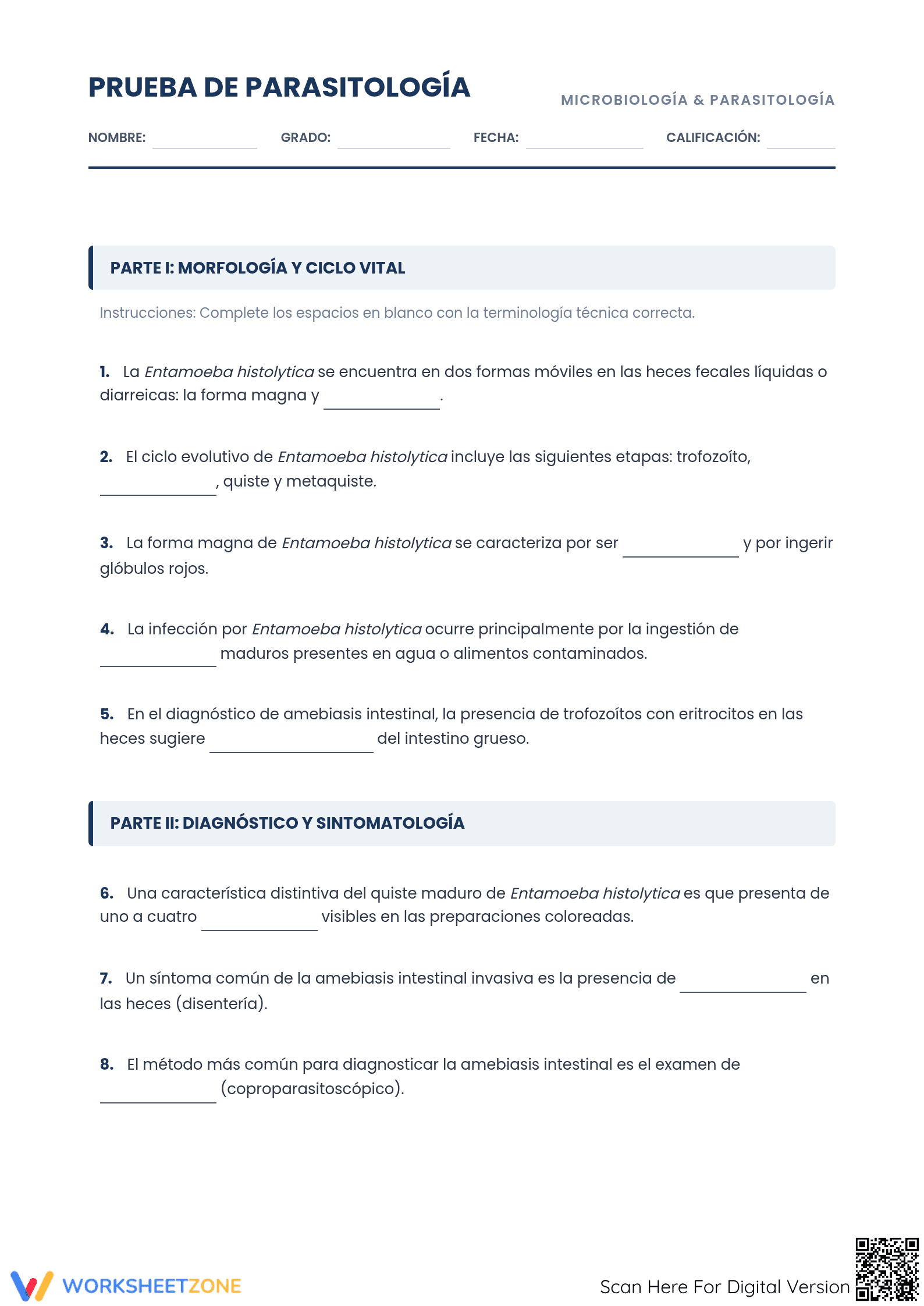
This Grade 12 microbiology assessment provides a comprehensive evaluation of student understanding regarding Entamoeba histolytica. Students demonstrate mastery by identifying morphological characteristics, explaining life cycle stages, and illustrating biological structures. This resource ensures learners can distinguish between trophozoite and cyst forms while understanding clinical implications and diagnostic procedures.
At a Glance
- Grade: 12 · Subject: Science
- Standard:
HS-LS1-2— Illustrate the hierarchical organization of interacting systems within multicellular organisms- Skill Focus: Parasitology & Microbiology
- Format: 2 pages · 12 problems · Answer key included · PDF
- Best For: Summative assessment of parasitic life cycles
- Time: 30–45 minutes
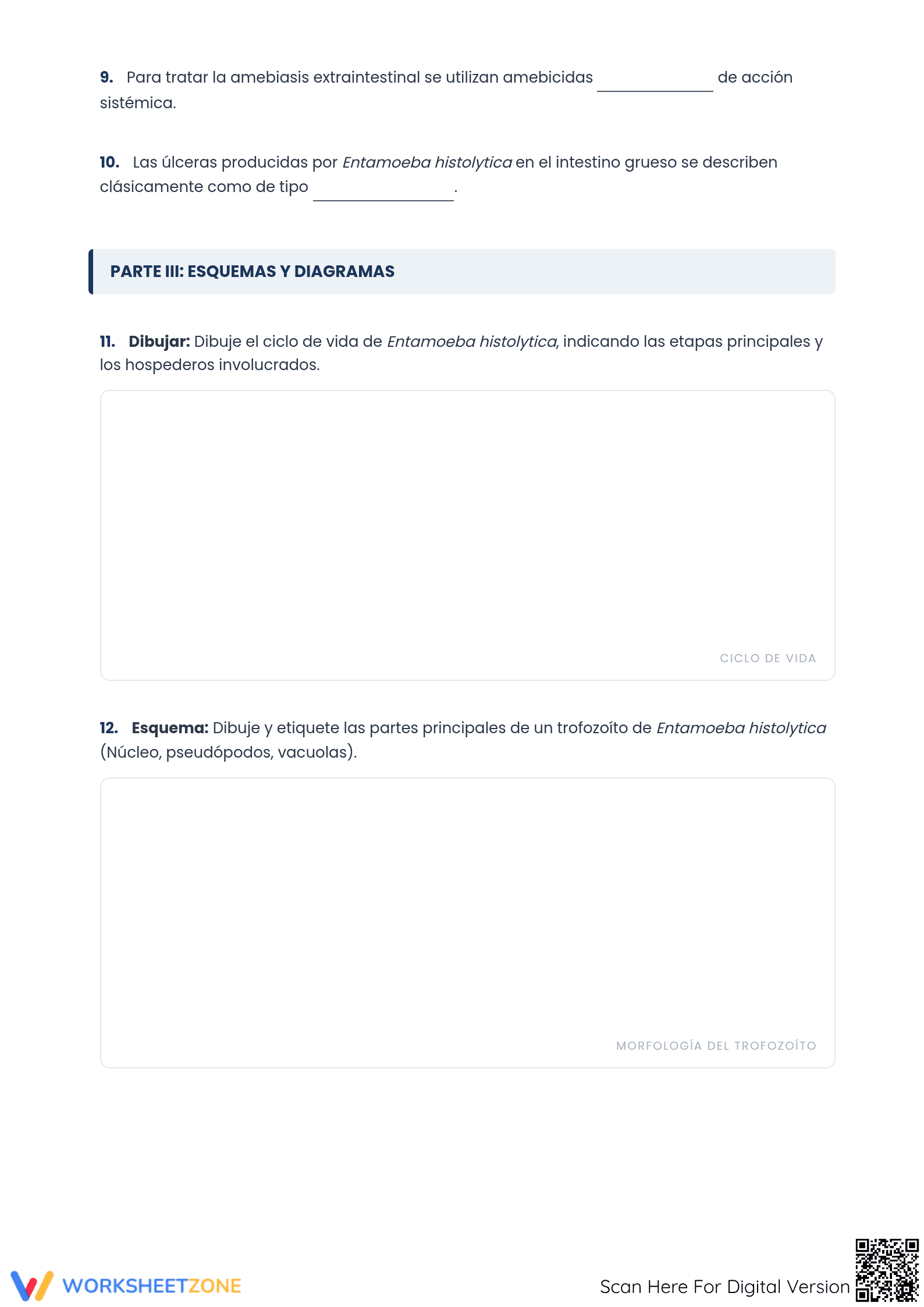
What's Inside: This 2-page PDF contains three distinct sections designed to test various cognitive levels. Part I and II feature 10 technical fill-in-the-blank questions focusing on morphology, symptoms, and diagnostic methods. Part III requires students to synthesize information through two detailed drawing tasks: a complete life cycle diagram and a labeled morphological sketch of a trophozoite. A full answer key is provided for efficient grading.
Mastery Evidence: The assessment is structured to provide clear evidence of student proficiency. The fill-in-the-blank sections map directly to foundational knowledge of biological systems, while the diagrammatic tasks evaluate higher-order synthesis. Teachers can use the included answer key to categorize student performance into tiers: Approaching (identifying terms), Meeting (explaining cycles), or Exceeding (accurate anatomical labeling). Scores can be entered directly into gradebooks or used for IEP progress monitoring.
Standards Alignment: This resource aligns with `HS-LS1-2`, requiring students to explain how systems of cells and tissues work together. By analyzing the life cycle of Entamoeba histolytica, students explore how specialized structures facilitate survival and reproduction within a host. Both standard codes can be copied directly into lesson plans, IEP goals, or district curriculum mapping tools.
How to Use It: Assign this worksheet as a summative quiz following a unit on microbiology or infectious diseases. It serves as an excellent formative check during direct instruction to ensure students grasp the distinction between different parasitic stages. Expect completion within 40 minutes. Teachers should observe students during the diagramming phase to identify misconceptions regarding cellular organelles like pseudopods or vacuoles.
Who It's For: This material is tailored for Grade 12 students in advanced Biology, Microbiology, or Health Science pathways. It is particularly effective for students preparing for medical or laboratory technician certifications. Pair this with a microscopic slide observation lab or a digital pathology database for a complete instructional sequence.
Research from EdReports (2024) emphasizes that high-quality instructional materials must bridge the gap between theoretical biological concepts and practical diagnostic applications. This `HS-LS1-2` aligned worksheet achieves this by requiring students to translate technical descriptions into visual models of Entamoeba histolytica. By focusing on the specific morphology and life cycle of human parasites, the resource supports the development of scientific literacy and clinical reasoning skills essential for post-secondary success in health sciences. The inclusion of 12 distinct tasks ensures a broad sampling of the standard's requirements, providing a reliable measure of student achievement. According to the NAEP framework, the ability to represent complex biological processes through diagrams is a key indicator of advanced scientific proficiency. This assessment provides the necessary scaffolding to move students from rote memorization to conceptual mastery of microbiology.


