


























Views
Downloads

Printable Parallel or Perpendicular Lines Worksheet
Paste this activity's link or code into your existing LMS (Google Classroom, Canvas, Teams, Schoology, Moodle, etc.).
Students can open and work on the activity right away, with no student login required.
You'll still be able to track student progress and results from your teacher account.
This comprehensive linear equations analysis worksheet helps students master the geometric relationship between lines by calculating and comparing slopes. Students will determine if pairs of equations represent parallel or perpendicular paths, fostering a deep understanding of coordinate geometry. By the end of these exercises, learners will fluently navigate slope conversions to prove line relationships.
At a Glance
- Grade: 8–10 · Subject: Mathematics
- Standard: `CCSS.MATH.CONTENT.HSG.GPE.B.5` — Prove and use slope criteria for parallel and perpendicular lines in coordinate geometry.
- Skill Focus: Slope Analysis and Linear Relationships
- Format: 3 pages · 10 problems · Answer key included · PDF
- Best For: High school Algebra 1 and Geometry students
- Time: 25–35 minutes
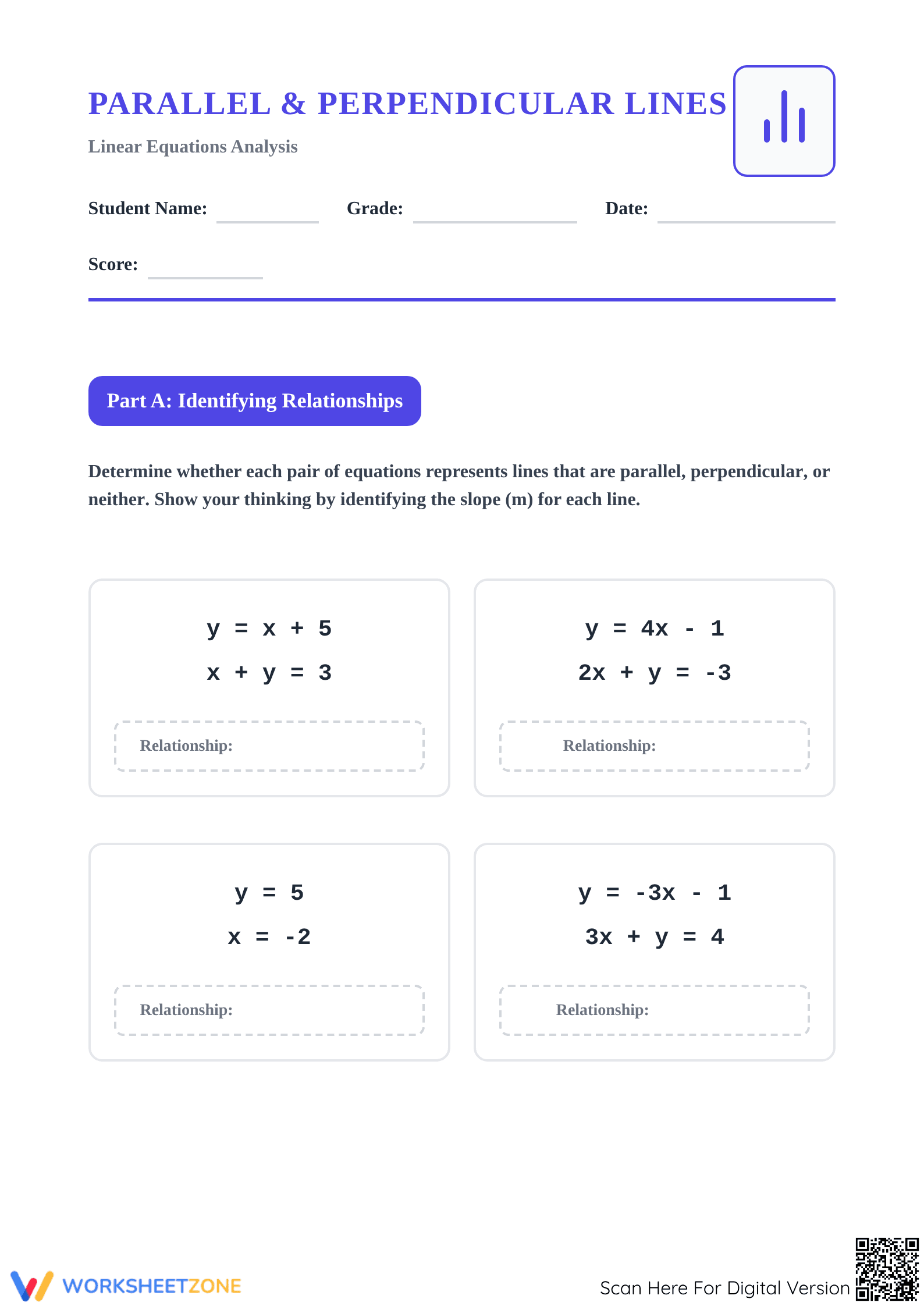
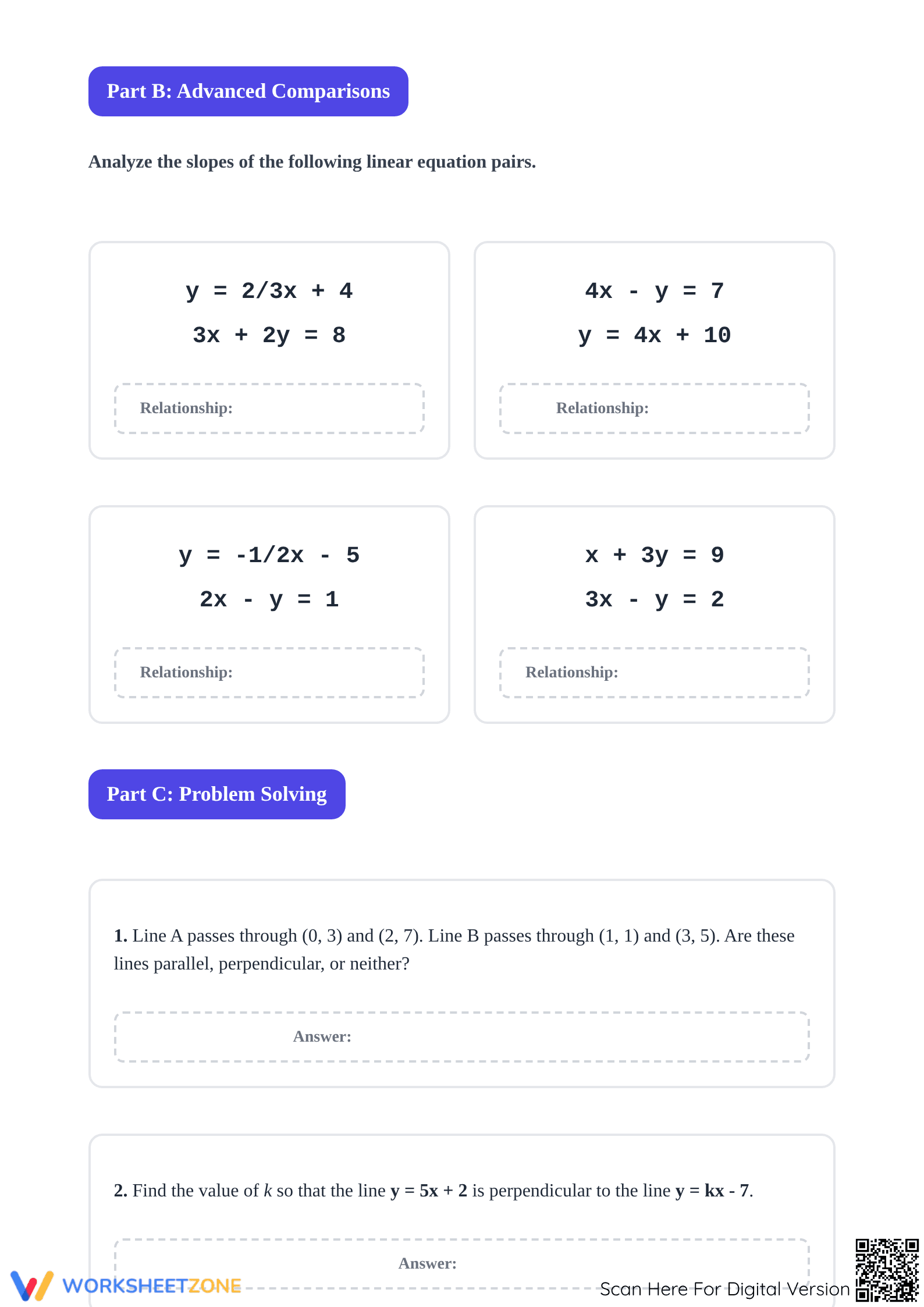
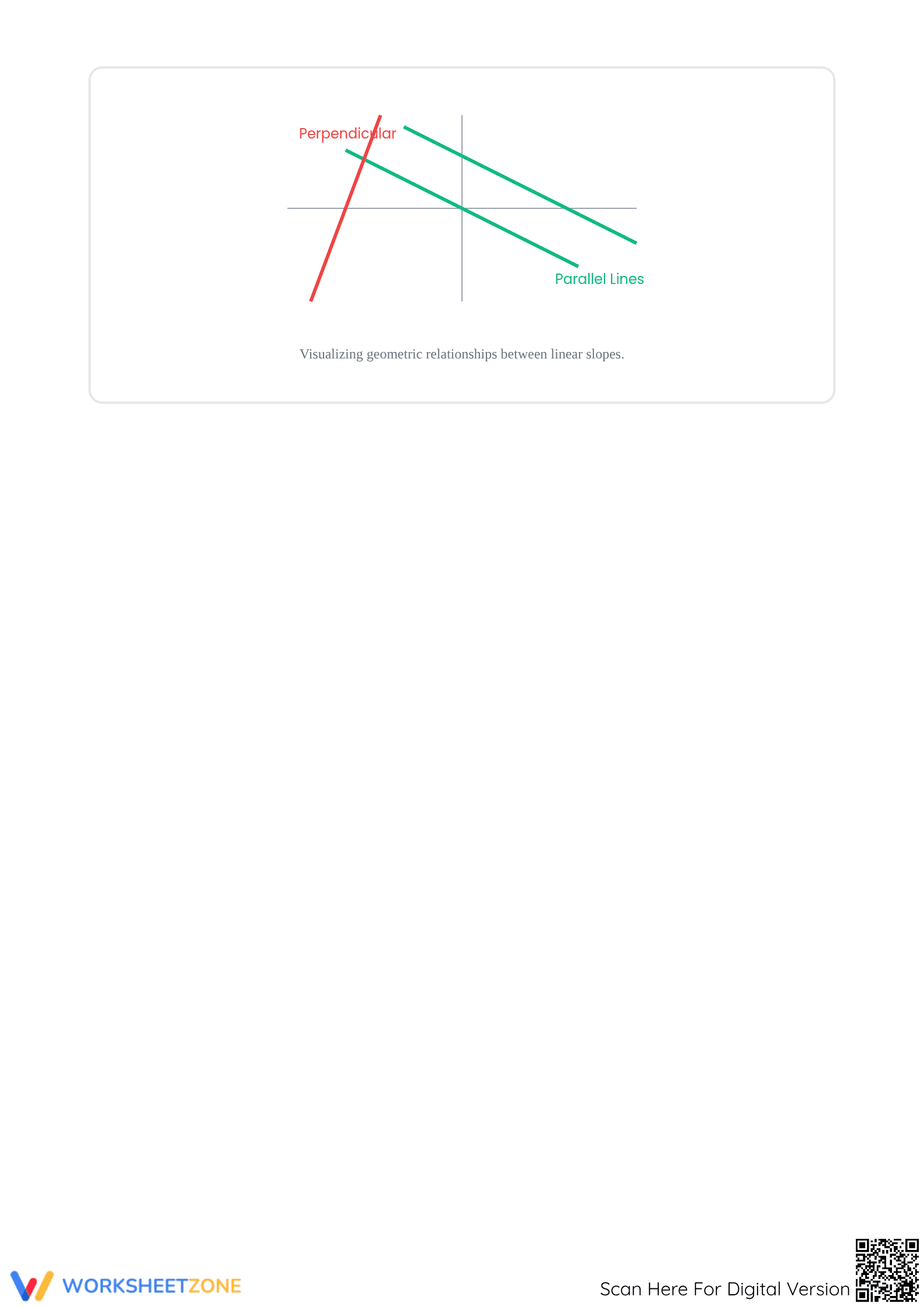
This three-page PDF resource provides 10 rigorous problems divided into three distinct sections. Students analyze eight pairs of linear equations, ranging from simple slope-intercept forms to more complex standard form variations requiring algebraic manipulation. The worksheet also features two coordinate geometry word problems and a visual reference page that illustrates geometric relationships, connecting algebraic results with visual outcomes.
- Guided Practice: The initial four problems in Part A provide structured boxes for identifying the slope (m) for each line. This scaffolding ensures students isolate the correct coefficient before making a comparative judgment on line relationships.
- Supported Practice: Part B transitions to advanced comparisons where equations are presented in mixed formats, including standard form. This requires students to perform conversions to slope-intercept form with decreasing support.
- Independent Practice: The final section presents two complex word problems requiring students to calculate slopes from coordinate points or find missing coefficients to satisfy specific geometric conditions.
The primary focus is `CCSS.MATH.CONTENT.HSG.GPE.B.5`, which requires students to prove the slope criteria for parallel and perpendicular lines and use them to solve problems. Students must recognize that parallel lines share identical slopes while perpendicular lines possess slopes that are negative reciprocals. Both standard codes can be copied directly into lesson plans, IEP goals, or district curriculum mapping tools.
Deploy this worksheet as a formative assessment after introducing the concept of slope in Algebra 1 or as a targeted review in a Geometry unit. During the activity, observe students as they convert standard form equations to identify if they are correctly handling sign changes. Expected completion time is roughly 30 minutes, making it an ideal check for understanding or homework assignment.
This resource is designed for Grade 8 through Grade 10 students enrolled in Algebra 1 or Geometry. It supports diverse learners through clear visual aids and a gradual release of responsibility. Pair this worksheet with a coordinate plane anchor chart or a graphing calculator activity to help students visualize the lines they are analyzing algebraically.
Research by Fisher & Frey (2014) emphasizes the importance of the gradual release of responsibility in mathematical instruction, particularly when moving from computational tasks to abstract problem-solving. This worksheet adheres to that framework by transitioning students from simple slope identification to complex coordinate geometry proofs involving standard code `CCSS.MATH.CONTENT.HSG.GPE.B.5`. By requiring students to calculate slopes and prove relationships like negative reciprocity for perpendicular lines, the resource builds procedural fluency and conceptual depth. The inclusion of visual representations alongside algebraic analysis is supported by the RAND AIRS 2024 report on effective math pedagogy, which highlights dual-coding as a primary driver of retention for high school learners. This balanced approach ensures that students develop the analytical skills necessary for advanced geometric modeling and SAT-level coordinate geometry challenges.


