


























Views
Downloads
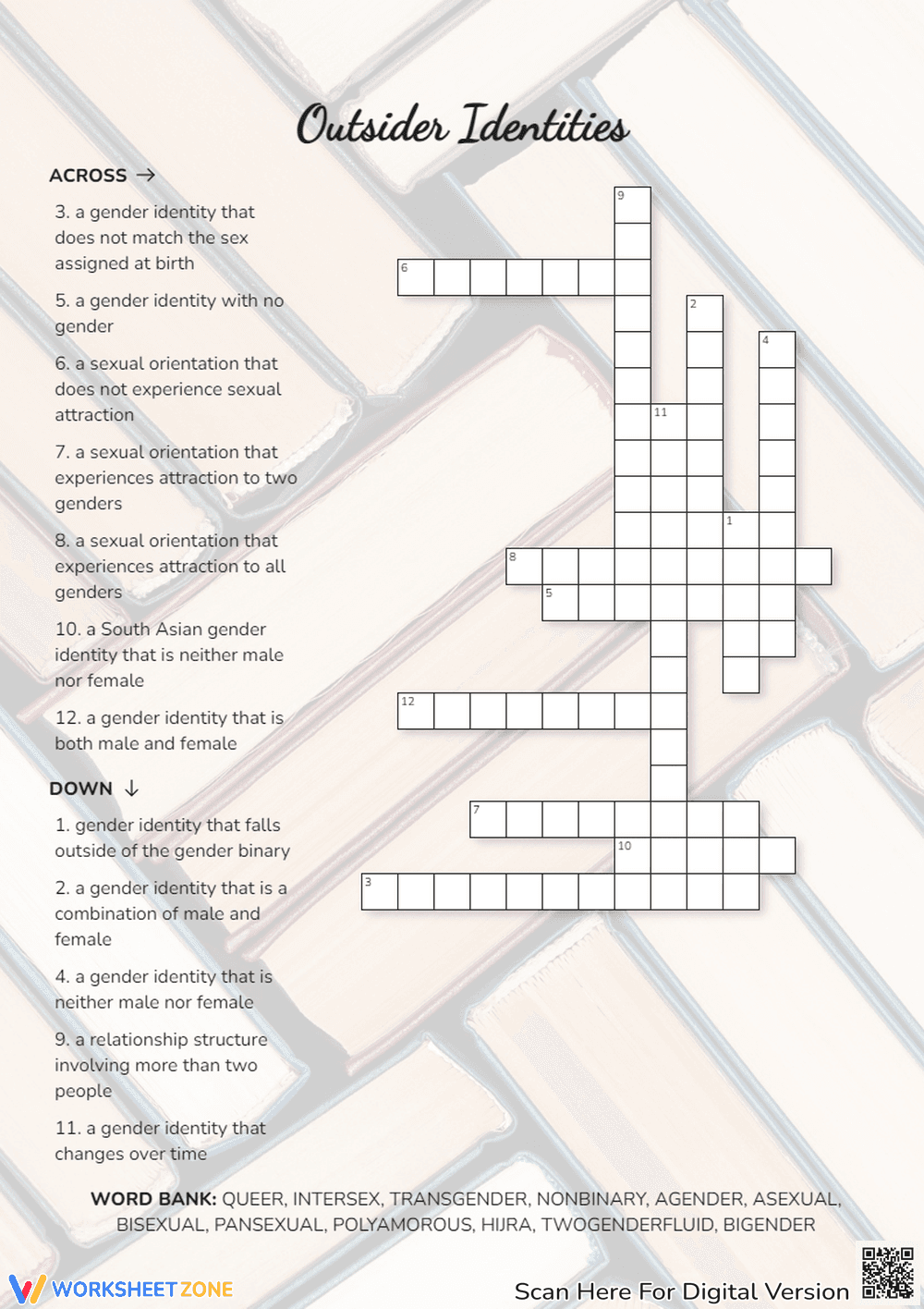

Identity Vocabulary Crossword | Grade 4 Printable
Paste this activity's link or code into your existing LMS (Google Classroom, Canvas, Teams, Schoology, Moodle, etc.).
Students can open and work on the activity right away, with no student login required.
You'll still be able to track student progress and results from your teacher account.
This Grade 4 vocabulary worksheet provides students with a structured crossword puzzle to learn and reinforce domain-specific terminology related to diverse identities. By matching definitions to terms in the provided word bank, learners build essential social awareness and reading comprehension skills in a highly engaging format.
At a Glance
- Grade: 4 · Subject: ELA
- Standard:
CCSS.ELA-LITERACY.L.4.6— Acquire and use domain-specific words- Skill Focus: Identity Vocabulary
- Format: 1 page · 12 problems · Answer key included · PDF
- Best For: Independent practice
- Time: 15–20 minutes
This single-page resource features a 12-clue crossword puzzle focused on identity and orientation terminology. Students read clear, age-appropriate definitions and select the correct matching term from a comprehensive word bank at the bottom of the page. The word bank includes terms like transgender, nonbinary, and asexual to support accurate spelling and vocabulary acquisition. A complete answer key is provided for quick grading.
This resource is designed for immediate classroom implementation with a streamlined zero-prep workflow:
- Print (1 minute): Simply print the puzzle and the accompanying answer key.
- Distribute (1 minute): Hand out the worksheets to students during morning work or vocabulary blocks.
- Review (3 minutes): Use the answer key to quickly check student responses or facilitate a whole-class review.
With under two minutes of total teacher prep time, this activity is highly suitable for emergency sub plans or independent learning stations.
This worksheet is directly aligned to CCSS.ELA-LITERACY.L.4.6, requiring students to acquire and use accurately grade-appropriate general academic and domain-specific words and phrases. By engaging with specialized vocabulary, students expand their linguistic toolkit and cultural literacy. Both standard codes can be copied directly into lesson plans, IEP goals, or district curriculum mapping tools.
Teachers can deploy this crossword puzzle during independent practice after a direct instruction lesson on social awareness or diverse communities. It also serves as an excellent anchor activity for early finishers who need meaningful vocabulary enrichment. As students work through the 12 clues, teachers can use this as a formative assessment by observing which terms require more context or discussion. The expected completion time ranges from 15 to 20 minutes, making it a flexible addition to any ELA or SEL block.
This activity is primarily designed for fourth-grade students expanding their domain-specific vocabulary. The inclusion of a word bank provides built-in differentiation, supporting English Language Learners and students who struggle with spelling recall. It pairs naturally with introductory reading passages about diverse communities, inclusive anchor charts, or direct instruction lessons focused on social-emotional learning and respect for all identities.
Mastering domain-specific vocabulary is a critical component of reading comprehension and social awareness. This resource targets CCSS.ELA-LITERACY.L.4.6, helping students acquire and use domain-specific words accurately in context. According to a recent EdReports 2024 analysis, integrating specialized vocabulary practice into engaging formats like crossword puzzles significantly improves retention and student motivation. When learners actively match definitions to terms, they build stronger cognitive connections than through rote memorization alone. This targeted practice ensures students can confidently comprehend complex texts and discussions involving diverse identities. By providing clear definitions and a supportive word bank, the worksheet reduces cognitive overload while maximizing vocabulary acquisition. Educators can rely on this structured approach to foster both linguistic competence and inclusive classroom environments, ensuring all students have the language tools necessary for academic and social success.


