


























Views
Downloads
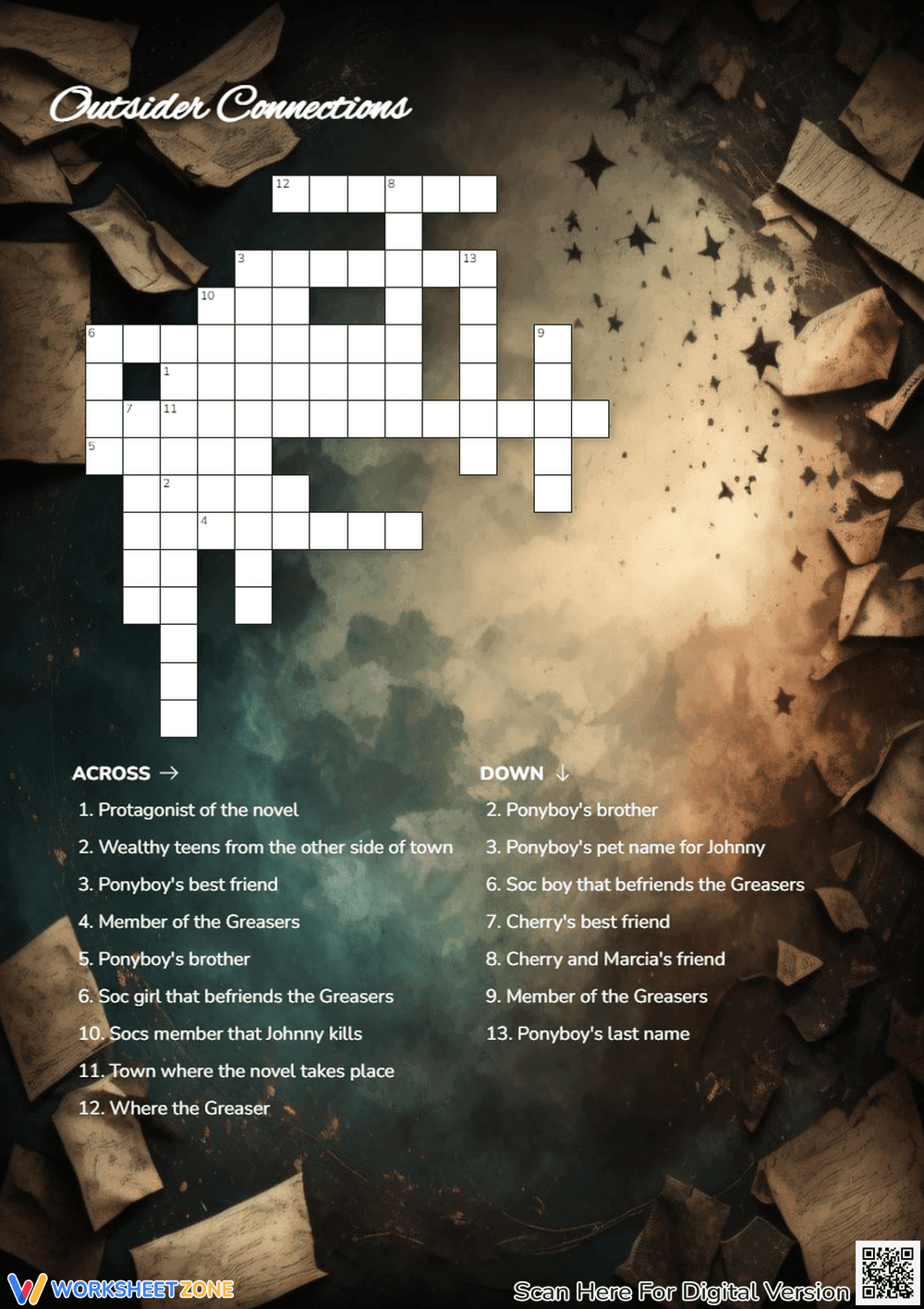

The Outsiders Crossword | Printable Grade 4 ELA
Paste this activity's link or code into your existing LMS (Google Classroom, Canvas, Teams, Schoology, Moodle, etc.).
Students can open and work on the activity right away, with no student login required.
You'll still be able to track student progress and results from your teacher account.
This Grade 4 reading comprehension worksheet gives students a fun, engaging way to review character relationships and key plot points from The Outsiders. By solving this crossword puzzle, learners reinforce their understanding of the novel's core dynamics and settings while practicing essential text-recall skills.
At a Glance
- Grade: 4 · Subject: ELA
- Standard:
CCSS.ELA-LITERACY.RL.4.3— Describe characters and settings using specific text details- Skill Focus: Reading Comprehension
- Format: 1 page · 16 problems · Answer key included · PDF
- Best For: Novel study review
- Time: 15–20 minutes
This resource features a single-page crossword puzzle containing 16 distinct clues based on The Outsiders. Students will read descriptions of characters, locations, and group affiliations to fill in the corresponding grid. The layout includes a clear "Across" and "Down" clue section alongside an atmospheric, thematic background. A complete answer key is provided to ensure accurate grading and easy review.
Zero-Prep Workflow
This worksheet is designed for immediate classroom use with minimal teacher setup:
- Print (1 minute): Simply download the PDF and print a class set.
- Distribute (1 minute): Hand out the puzzle as a bell-ringer, early finisher activity, or novel study review station.
- Review (3 minutes): Use the included answer key to quickly check student responses or project it for self-correction.
With under two minutes of total prep time, this activity is an excellent option for emergency sub plans or independent work periods.
Standards Alignment
This activity aligns with CCSS.ELA-LITERACY.RL.4.3, requiring students to describe in depth a character, setting, or event in a story or drama, drawing on specific details in the text. By identifying characters like Ponyboy and Cherry based on specific relational clues, students demonstrate explicit text comprehension. Both standard codes can be copied directly into lesson plans, IEP goals, or district curriculum mapping tools.
How to Use It
Post-Reading Review: Assign this puzzle after students finish reading the first half of the novel. It serves as a quick formative assessment to verify they can distinguish between the Greasers and the Socs. Watch if students struggle with specific character names, indicating a need to review key chapters.
Early Finisher Station: Keep a stack of these puzzles in a folder. When students complete primary literature assignments early, they can quietly reinforce their novel knowledge. Expected completion time ranges from 15 to 20 minutes.
Who It's For
This worksheet is primarily designed for Grade 4 students engaging in a modified novel study or introductory literature circle. It provides a low-stakes, highly structured format that benefits students who need clear, direct recall tasks. For differentiation, teachers can pair this puzzle with a character anchor chart or allow students to keep their books open while solving.
Effective literature instruction relies on consistent, low-stakes retrieval practice to solidify students' understanding of complex narratives. Aligning with CCSS.ELA-LITERACY.RL.4.3, this activity prompts learners to describe characters and settings using specific text details. According to Fisher & Frey (2014), integrating structured vocabulary and comprehension tasks directly into novel studies significantly improves long-term retention of character dynamics and thematic elements. Crossword puzzles specifically reduce cognitive overload by providing letter-count constraints, allowing students to focus on recalling the exact textual evidence needed to identify protagonists, antagonists, and settings. By embedding these targeted recall opportunities within a thematic format, educators can accurately gauge reading comprehension without the anxiety often associated with formal testing. This approach ensures that foundational knowledge is secure before moving on to higher-order analytical tasks, ultimately supporting more robust classroom discussions.


