


























Views
Downloads

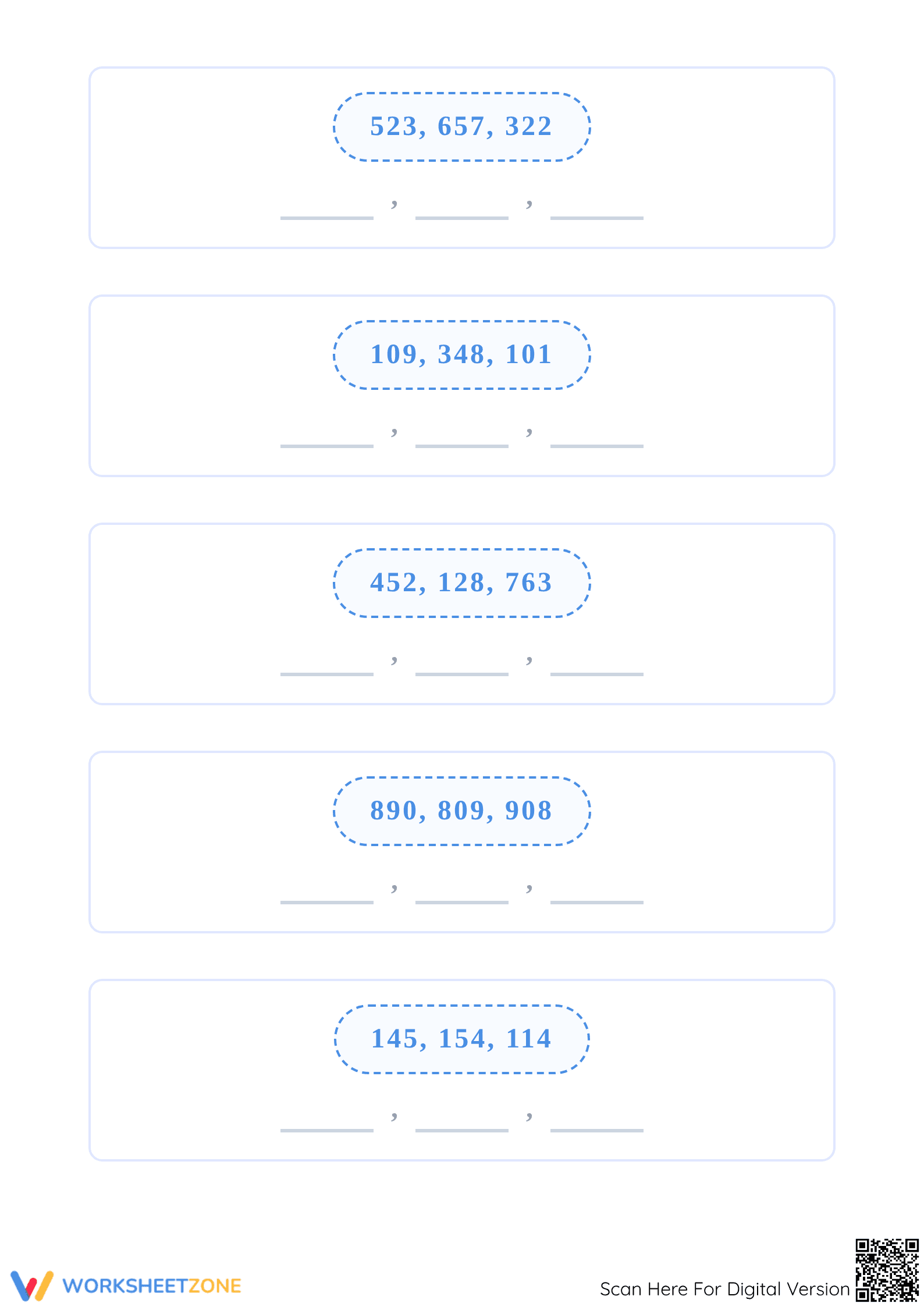


Printable Ordering Numbers Worksheet | Grade 1 Math
Paste this activity's link or code into your existing LMS (Google Classroom, Canvas, Teams, Schoology, Moodle, etc.).
Students can open and work on the activity right away, with no student login required.
You'll still be able to track student progress and results from your teacher account.
This Grade 1 Math worksheet provides comprehensive practice for ordering three-digit numbers. Students will master the ability to sequence numerical sets from least to greatest and greatest to least. By engaging with 18 distinct problems across three specialized parts, learners develop a deep understanding of place value and numerical magnitude through structured, repetitive practice.
At a Glance
- Grade: Grade 1 · Subject: Math
- Standard:
CCSS.MATH.CONTENT.2.NBT.A.4— Compare three-digit numbers based on hundreds, tens, and ones place value.- Skill Focus: Ordering 3-digit numbers
- Format: 5 pages · 18 problems · Answer key included · PDF
- Best For: Independent practice and homework reinforcement
- Time: 20–30 minutes
What's Inside
This high-quality 5-page PDF contains 18 carefully constructed tasks divided into three logical sections. Part 1 focuses on sequencing 8 sets from least to greatest. Part 2 reverses the challenge with 8 sets ordered from greatest to least. The final section, "Find the Star," requires students to identify the smallest value in a group. A full answer key is included for rapid grading.
Zero-Prep Workflow
Teachers can implement this resource in under two minutes. First, print the 5-page set (1 minute). Second, distribute the worksheets to students during independent work time (30 seconds). Finally, use the included answer key to review student work or allow for self-correction at the end of the period (30 seconds). This streamlined process makes it an ideal choice for substitute lesson plans.
Standards Alignment
The primary focus is CCSS.MATH.CONTENT.2.NBT.A.4, which requires students to compare two three-digit numbers based on meanings of the hundreds, tens, and ones digits. While designed for advanced first graders or second-grade review, it perfectly supports building number sense. This standard code can be copied directly into lesson plans, IEP goals, or district curriculum mapping tools.
How to Use It
Deploy this worksheet during the "You Do" phase of a gradual release model. It serves as an excellent formative assessment tool after a lesson on place value comparison. Teachers should observe if students are correctly identifying the hundreds digit first when ordering. Expect most students to complete the 18 problems within 25 minutes during a standard math block.
Who It's For
This resource is tailored for first-grade students ready for extension or second-graders needing foundational review. It is particularly effective for English Language Learners due to its clear visual layout and minimal text. Pair this with a 3-digit number line or hundreds chart anchor chart to provide additional scaffolding for students struggling with magnitude.
Standard CCSS.MATH.CONTENT.2.NBT.A.4 is critical for developing the numerical fluency required for higher-order mathematical operations. According to EdReports 2024, high-quality instructional materials must provide sufficient practice for students to internalize place value concepts through varied problem types. This worksheet addresses that need by requiring students to order numbers in both ascending and descending sequences, a task that reinforces the relationship between digit position and value. Research from Fisher & Frey (2014) emphasizes that independent practice with immediate feedback—supported here by the included answer key—is essential for moving skills into long-term memory. By engaging with 18 problems that specifically target three-digit magnitude, students build the cognitive scaffolds necessary for comparing larger numbers and performing multi-digit addition or subtraction. This zero-prep resource ensures that students spend their maximum cognitive energy on the math itself rather than complex instructions.


