


























Views
Downloads


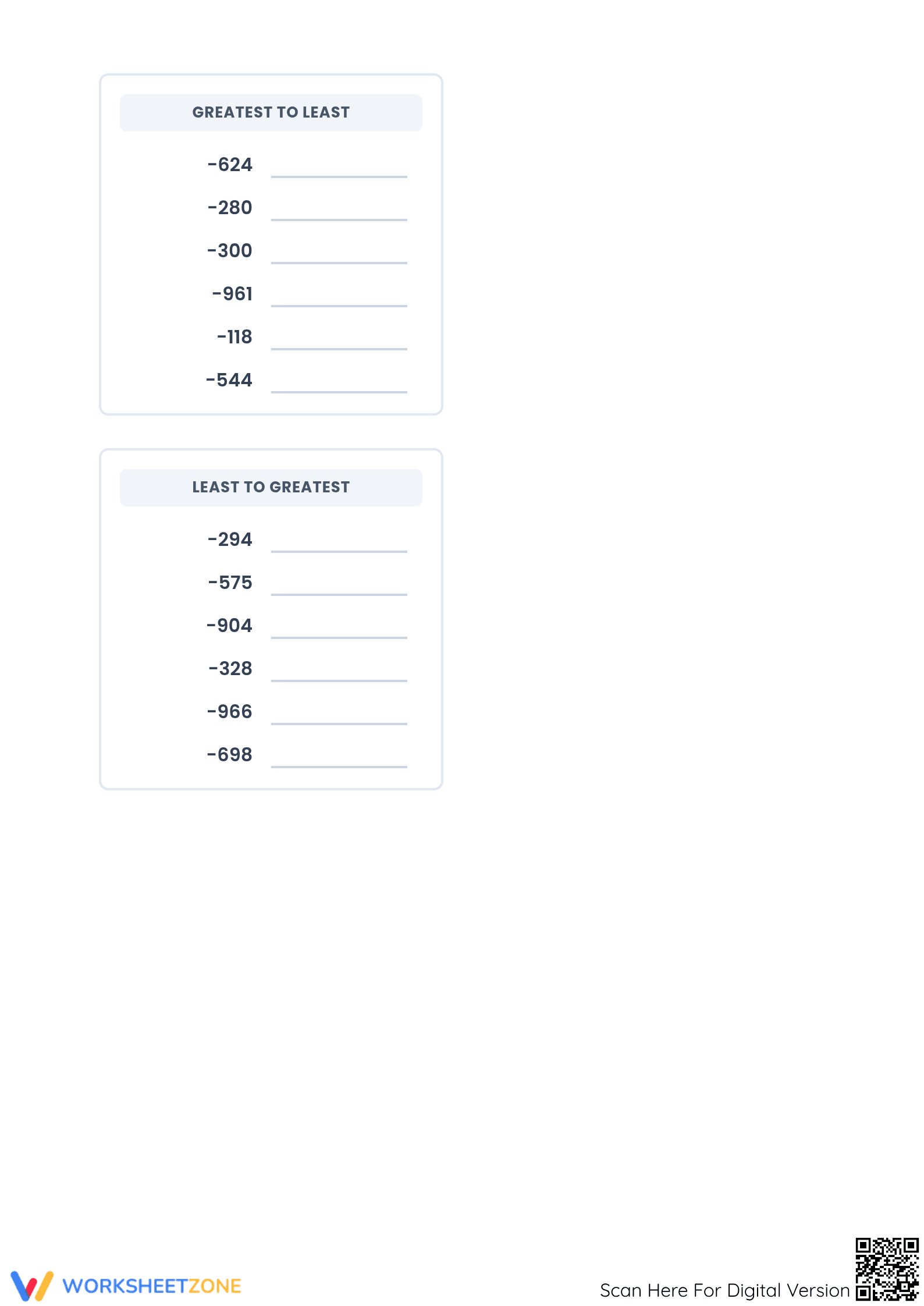


Essential Grade 6 Ordering Negative Integers Worksheet
Paste this activity's link or code into your existing LMS (Google Classroom, Canvas, Teams, Schoology, Moodle, etc.).
Students can open and work on the activity right away, with no student login required.
You'll still be able to track student progress and results from your teacher account.
This comprehensive math resource helps middle school students master ordering negative three-digit integers. By comparing values across multiple sets, students develop a deep understanding of number line placement. This printable set provides intensive practice to ensure students can accurately sequence numbers in both ascending and descending order.
At a Glance
- Grade: 6 · Subject: Math
- Standard:
6.NS.C.7— Interpret statements of inequality as statements about the relative position of two numbers- Skill Focus: Ordering negative 3-digit integers
- Format: 5 pages · 54 problems · Answer key included · PDF
- Best For: Independent practice and skills reinforcement
- Time: 25–40 minutes
This 5-page PDF contains nine exercise boxes, each presenting six negative three-digit integers. Students rewrite these sets from greatest to least or least to greatest. The layout includes a "Notes" section for recording strategies for comparing negative values. A full answer key follows the student pages for rapid grading.
Zero-Prep Workflow
Integration requires less than two minutes of prep. Simply select pages and print. Because instructions are self-explanatory, you can distribute these without a lengthy introduction. After completion, use the included answer key to review results or for individual grading. This format is ideal for substitute plans or homework assignments.
Standards Alignment
The primary focus is `6.NS.C.7`, specifically requiring students to "understand ordering and absolute value of rational numbers." By ordering negative integers, students demonstrate they can "interpret statements of inequality as statements about the relative position of two numbers on a number line diagram." Both standard codes can be copied directly into lesson plans, IEP goals, or district curriculum mapping tools.
How to Use It
Use this during "Independent Practice" on the number system to solidify understanding of integer magnitude. It serves as an excellent formative assessment tool; observe if students confuse absolute value with actual value. Expect students to spend roughly 5 minutes per page, totaling 25-30 minutes for the collection. This provides immediate data on student mastery of negative value sequencing.
Who It's For
This is designed for sixth-grade students, though it remains a valuable review for seventh and eighth graders. It is effective for students struggling with the logic of negative ordering. Pair this with a number line anchor chart to provide a visual reference for the 54 comparison tasks, ensuring all learners can access the material.
This worksheet aligns with the instructional shift toward deep conceptual understanding of the number system as defined by `6.NS.C.7`. Mastery of negative integer ordering is a critical prerequisite for success in pre-algebra and coordinate geometry. Research from Fisher & Frey (2014) emphasizes that "gradual release of responsibility" is enhanced when students engage in high-volume, focused practice that isolates a single skill—in this case, the relative positioning of negative 3-digit values. Without this foundational fluency, students often struggle with later concepts involving absolute value and multi-step inequalities. The RAND AIRS 2024 analysis highlights that consistent exposure to varied integer sets reduces common misconceptions regarding "larger" looking numbers actually having smaller values in the negative domain. This resource provides the necessary repetition to move students from procedural hesitation to conceptual mastery within the middle school mathematics curriculum.


