


























Views
Downloads


Printable Worksheet: Ordering Negative Integers | Grade 6 Math
Paste this activity's link or code into your existing LMS (Google Classroom, Canvas, Teams, Schoology, Moodle, etc.).
Students can open and work on the activity right away, with no student login required.
You'll still be able to track student progress and results from your teacher account.
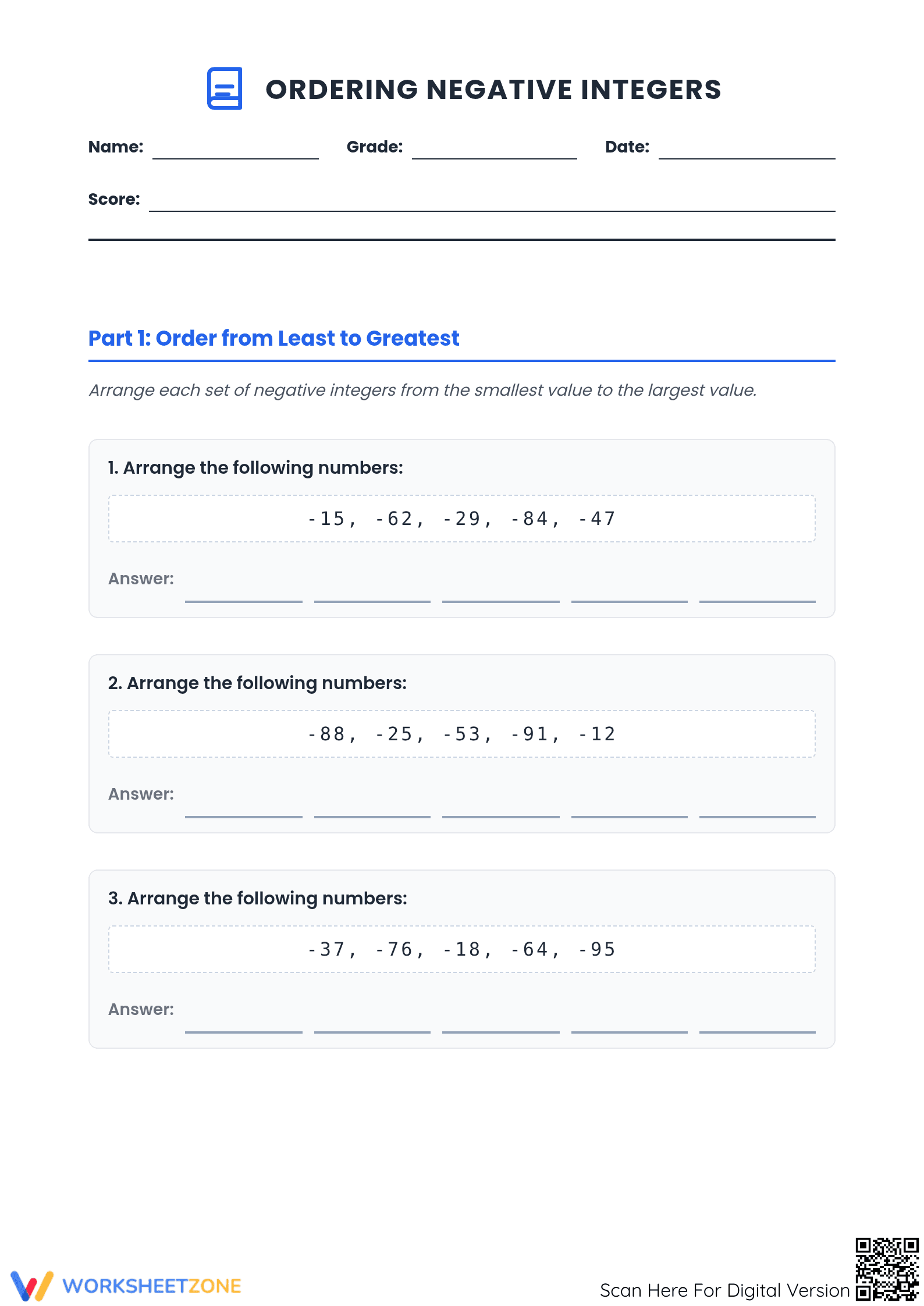
This Grade 6 math worksheet provides essential practice for students learning to compare and order negative two-digit integers. By arranging sets of numbers from least to greatest and greatest to least, learners develop a deep conceptual understanding of number line placement and the inverse relationship between absolute value and negative magnitude.
At a Glance
- Grade: 6 · Subject: Math
- Standard:
6.NS.C.7— Understand ordering and absolute value of rational numbers- Skill Focus: Ordering negative two-digit integers
- Format: 4 pages · 17 problems · Answer key included · PDF
- Best For: Small group practice or independent review
- Time: 20–30 minutes
What's Inside
The packet contains four structured pages focusing exclusively on negative two-digit integers. Part 1 presents 12 sets of five numbers each, requiring students to arrange them from the smallest value to the largest. Part 2 shifts the cognitive demand, challenging students to order five sets of integers from the largest value to the smallest. A comprehensive answer key is included for immediate feedback and grading.
Skill Progression
- Guided Practice: The initial problems feature integers with widely varying tens digits, allowing students to use basic number sense to determine relative value with 17 unique tasks.
- Supported Practice: Mid-worksheet sets include integers with the same tens digit (e.g., -43 and -49), forcing students to attend to the ones place while maintaining the negative orientation.
- Independent Practice: The final sections mix magnitudes and include both least-to-greatest and greatest-to-least tasks to ensure students can fluidly navigate the number line in both directions.
This scaffolded approach follows the gradual-release model, moving from simple visual discrimination to complex conceptual ordering.
Standards Alignment
This resource is directly aligned to `6.NS.C.7`: "Understand ordering and absolute value of rational numbers." Specifically, it addresses 6.NS.C.7.b, which requires students to write, interpret, and explain statements of order for rational numbers in real-world contexts. Both standard codes can be copied directly into lesson plans, IEP goals, or district curriculum mapping tools.
How to Use It
Use this worksheet as a post-instructional check after introducing the integer number line. Assign Part 1 as an exit ticket to observe if students are mistakenly applying "larger digit" logic to negative values. The 20-30 minute completion window makes it an ideal warm-up for the following class period or a focused homework assignment to reinforce mastery.
Who It's For
This resource is designed for Grade 6 students who are transitioning from whole numbers to the full coordinate system. It provides necessary scaffolding for students with IEP goals related to number sense and serves as an excellent remedial tool for Grades 7-8 students who struggle with integer operations. Pair it with a vertical number line anchor chart for maximum impact.
Ordering negative integers is a critical precursor to understanding coordinate geometry and algebraic operations. According to a ScienceDirect TpT Analysis (2024), targeted practice in arranging negative values significantly reduces "magnitude interference" errors where students equate larger digits with larger negative values. This worksheet targets standard 6.NS.C.7, requiring students to demonstrate fluency in comparing integers like -84 and -15. By isolating the negative 2-digit integer skill, this resource helps students build the cognitive schema necessary for later success in absolute value and inequality mapping. Research from EdReports (2024) emphasizes that procedural fluency with negative number systems is most effectively achieved through repetitive, focused sets that allow for pattern recognition. This 17-problem set provides the exact volume of practice needed to move students from hesitant calculation to automaticity, ensuring they are ready for higher-level algebraic expressions in subsequent units.


