


























Views
Downloads



Printable Ordering Negative 2-Digit Integers Math Worksheet
Paste this activity's link or code into your existing LMS (Google Classroom, Canvas, Teams, Schoology, Moodle, etc.).
Students can open and work on the activity right away, with no student login required.
You'll still be able to track student progress and results from your teacher account.
Mastering the relative value of negative numbers is a critical milestone for middle school mathematicians. This comprehensive worksheet provides structured practice in ordering and comparing negative two-digit integers from -10 to -99. Students move from basic sorting to complex real-world application, ensuring they understand that a larger absolute value signifies a smaller numerical value in a negative context.
At a Glance
- Grade: 6 · Subject: Math
- Standard:
6.NS.C.7.B— Write, interpret, and explain statements of order for rational numbers in real-world contexts- Skill Focus: Negative integer comparison and ordering
- Format: 5 pages · 33 problems · Answer key included · PDF
- Best For: Independent practice or formative assessment
- Time: 25–40 minutes
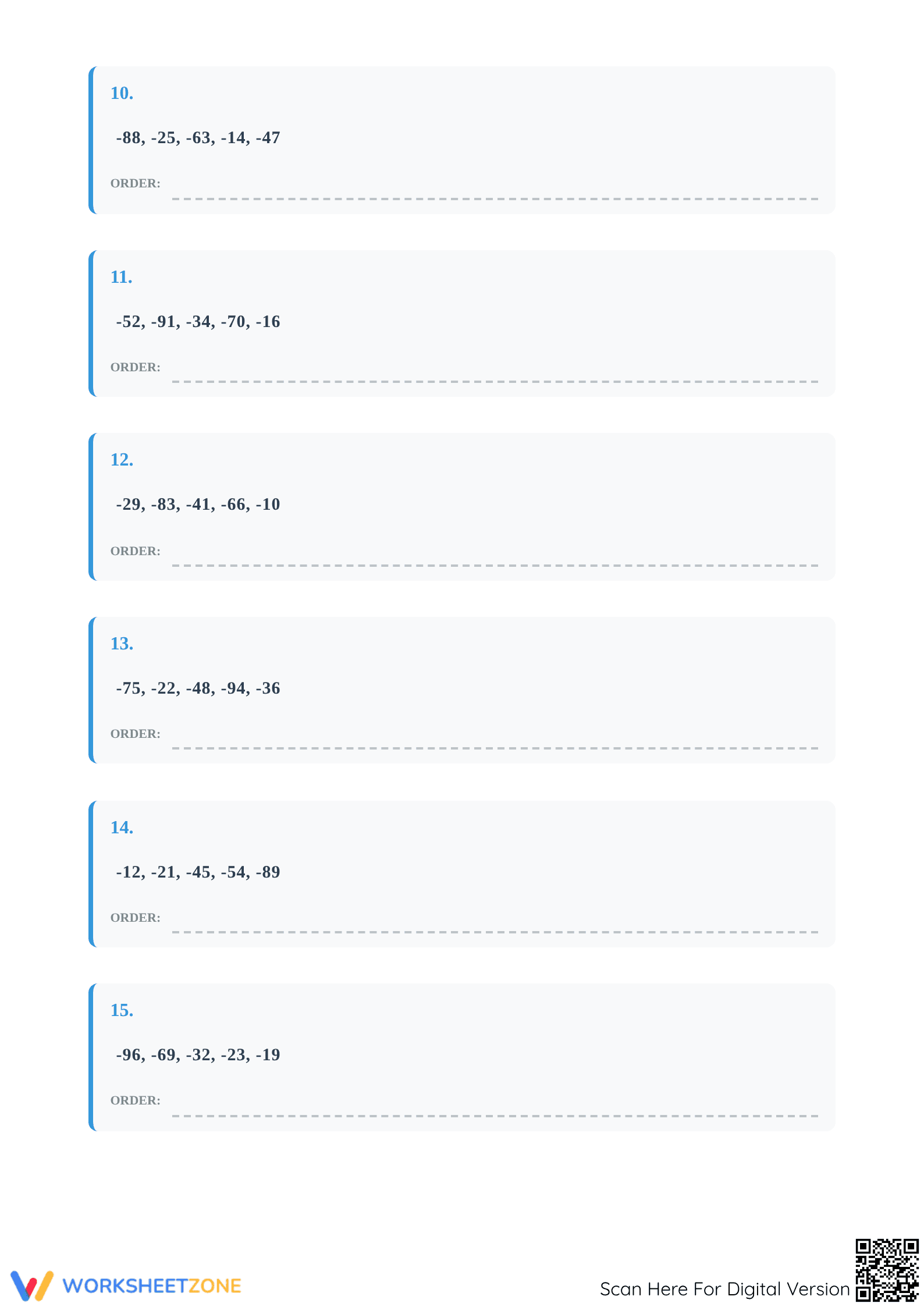
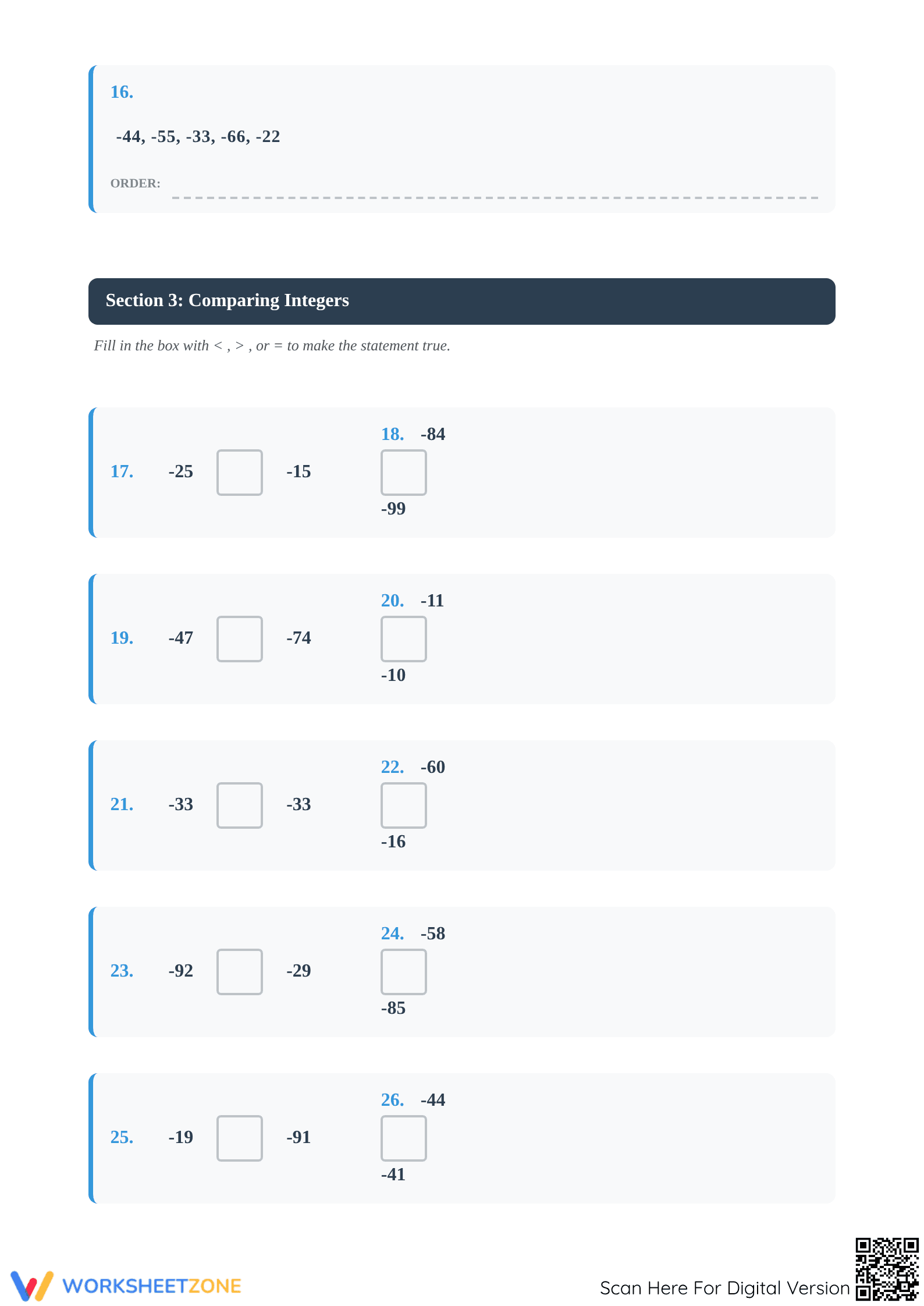
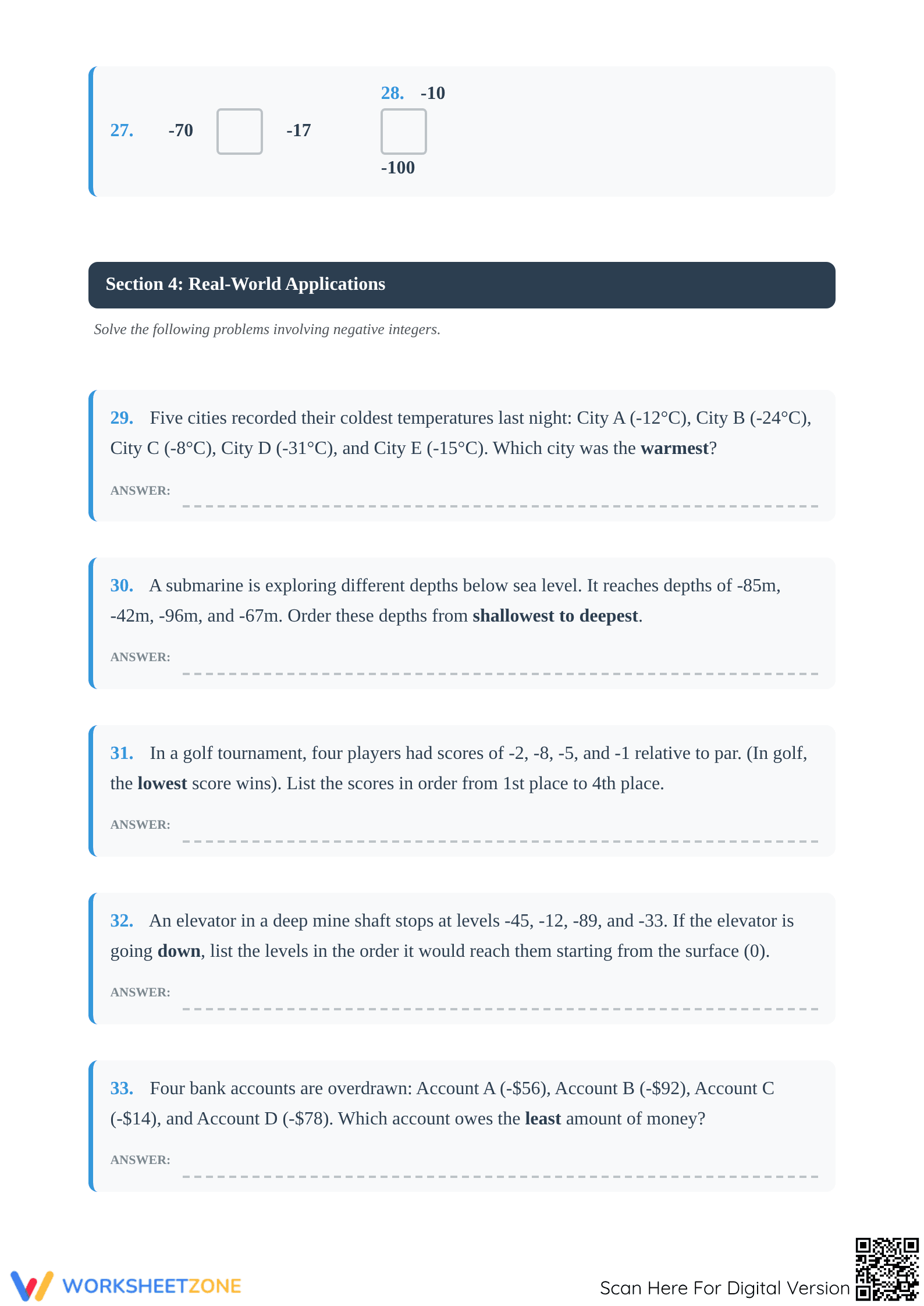
This 5-page PDF packet features 33 distinct tasks designed to build fluency with negative values. It includes four dedicated sections: ascending order sets, descending order sets, symbolic comparisons using inequality signs, and a final section of real-world word problems. The layout provides ample workspace for student calculations, accompanied by a complete answer key for rapid grading and immediate feedback.
- Guided Practice: The first eight problems offer sets of five negative integers, prompting students to arrange them from least to greatest, reinforcing the core concept of negative magnitude.
- Supported Practice: Section three transitions to direct comparison, where students insert <, >, or = symbols between pairs of numbers, requiring them to evaluate relative positions on a mental number line.
- Independent Practice: The final section presents five word problems involving temperature, ocean depth, and finance, challenging students to apply their knowledge to authentic scenarios.
This structured sequence follows a gradual-release model, shifting from procedural sorting to conceptual application in real-world environments.
The primary focus is 6.NS.C.7.B, which requires students to "write, interpret, and explain statements of order for rational numbers in real-world contexts." By requiring students to identify the "warmest" temperature or "least" debt from a list of negative values, the worksheet directly addresses this performance expectation. Both standard codes can be copied directly into lesson plans, IEP goals, or district curriculum mapping tools.
Use this resource as a post-lesson assessment after introducing the concept of the number line and absolute value. For a formative assessment observation, watch how students handle problems 29-33; students who struggle with these often understand the "rule" of negative numbers but haven't yet internalized the conceptual meaning. Expected completion time is roughly 35 minutes.
Designed for Grade 6 general education students, this also serves as an excellent intervention tool for Grade 7 or 8 learners requiring remediation in number systems. It pairs naturally with a vertical number line anchor chart or a direct instruction lesson on debt and elevation.
According to the RAND AIRS 2024 report on mathematical literacy, student proficiency in conceptualizing non-positive values is a leading indicator of success in introductory algebra. This worksheet targets the specific cognitive hurdle of "negative magnitude," where learners must reconcile that -99 is numerically smaller than -10 despite having a larger absolute value. By providing 33 scaffolded opportunities to practice 6.NS.C.7.B, this resource bridges the gap between abstract number theory and practical application. The inclusion of real-world scenarios—such as underwater depths and financial overdrafts—aligns with the Fisher & Frey (2014) model of purposeful practice, which emphasizes that mathematical skills must be rooted in context to achieve long-term retention. Teachers can utilize this packet to generate measurable data points for student progress reports, ensuring that every learner develops a robust mental model of the number system before advancing to operations with rational numbers.


