


























Views
Downloads



Ordering Adjectives Worksheet | Grade 4 Essential
Paste this activity's link or code into your existing LMS (Google Classroom, Canvas, Teams, Schoology, Moodle, etc.).
Students can open and work on the activity right away, with no student login required.
You'll still be able to track student progress and results from your teacher account.
This Grade 4 English Language Arts worksheet provides comprehensive practice for mastering the conventional order of adjectives. Students learn to arrange multiple descriptors—such as size, age, and color—to create natural-sounding sentences. By the end of these exercises, learners will demonstrate fluency in the OSASCOMP pattern, improving both their descriptive writing and grammatical accuracy.
At a Glance
- Grade: 4 · Subject: ELA
- Standard:
CCSS.ELA-LITERACY.L.4.1.D— Order adjectives within sentences according to conventional patterns like size and color- Skill Focus: Adjective Sequencing (OSASCOMP)
- Format: 5 pages · 22 problems · Answer key included · PDF
- Best For: Grammar centers and independent practice
- Time: 30–45 minutes
What's Inside: This 5-page instructional packet includes a detailed Grammar Guide that breaks down the eight categories of adjective order: opinion, size, age, shape, color, origin, material, and purpose. The resource features 22 distinct tasks across three formats, including sentence reordering, multiple-choice identification, and original sentence creation. A full 5-page answer key is provided for immediate feedback and easy grading.
Skill Progression
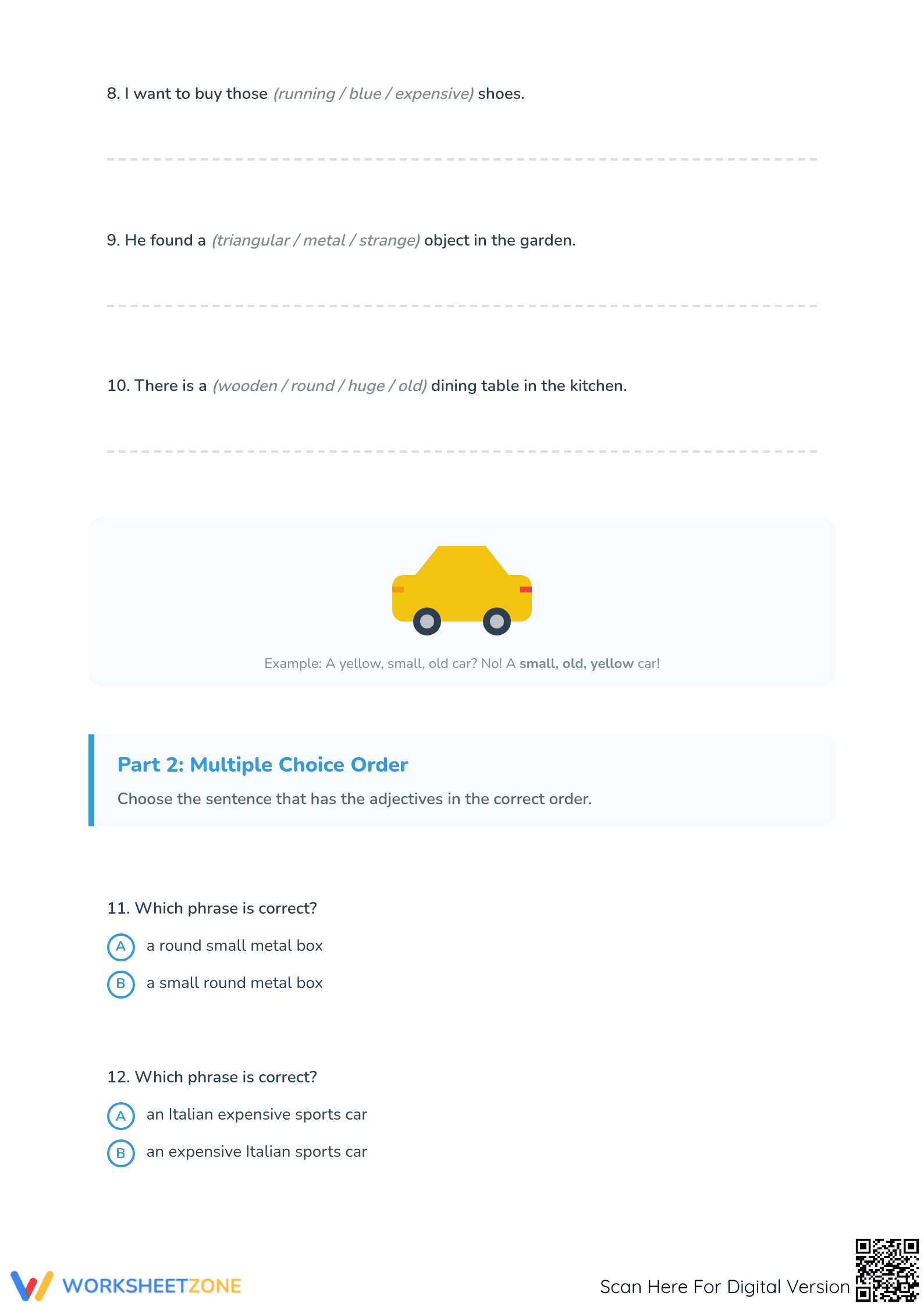
- Guided Practice: 10 reordering tasks where students rearrange provided adjectives into the correct sequence using the grammar guide as a scaffold.
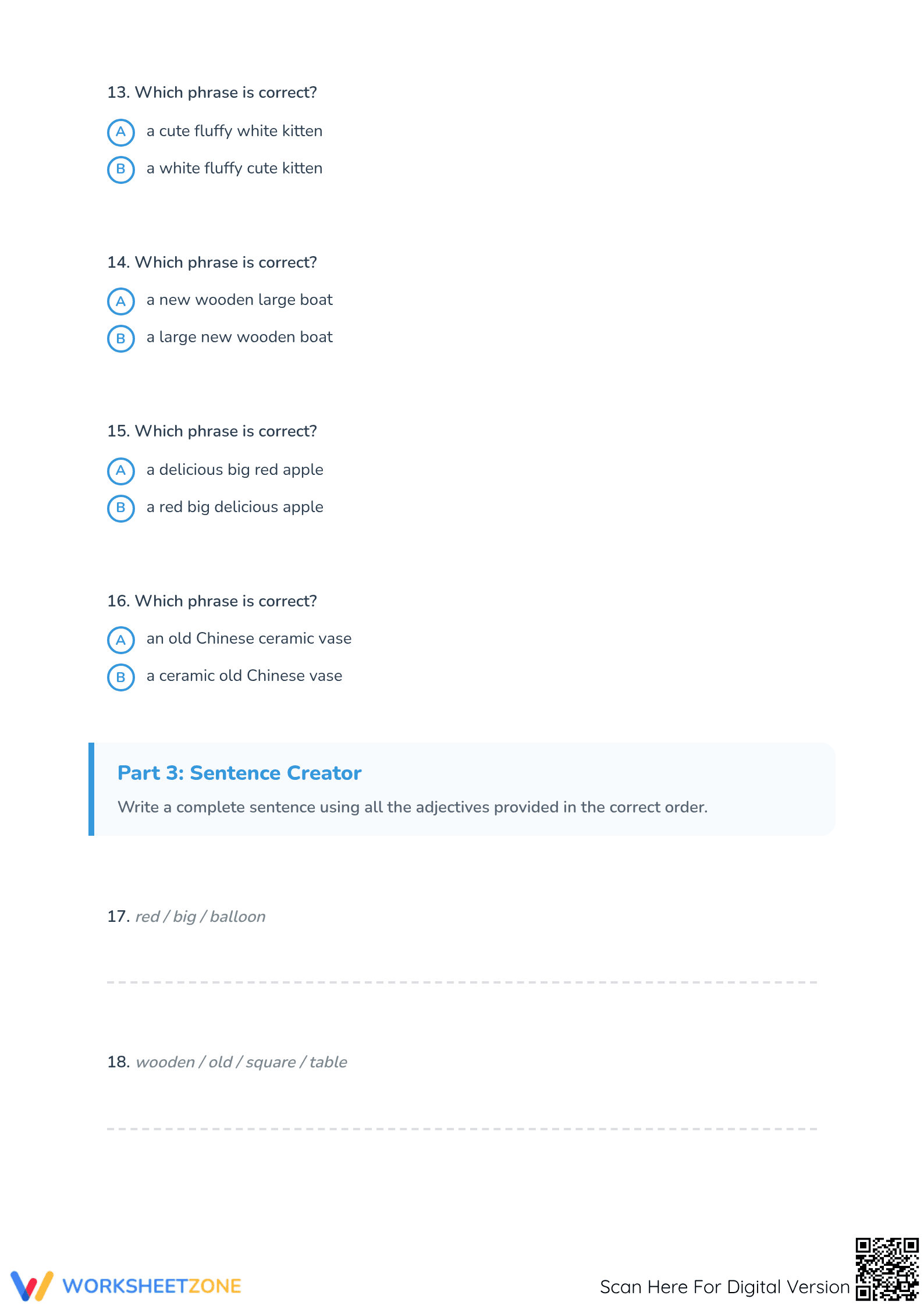
- Supported Practice: 6 multiple-choice questions that challenge students to identify the grammatically correct phrase among common distractors.
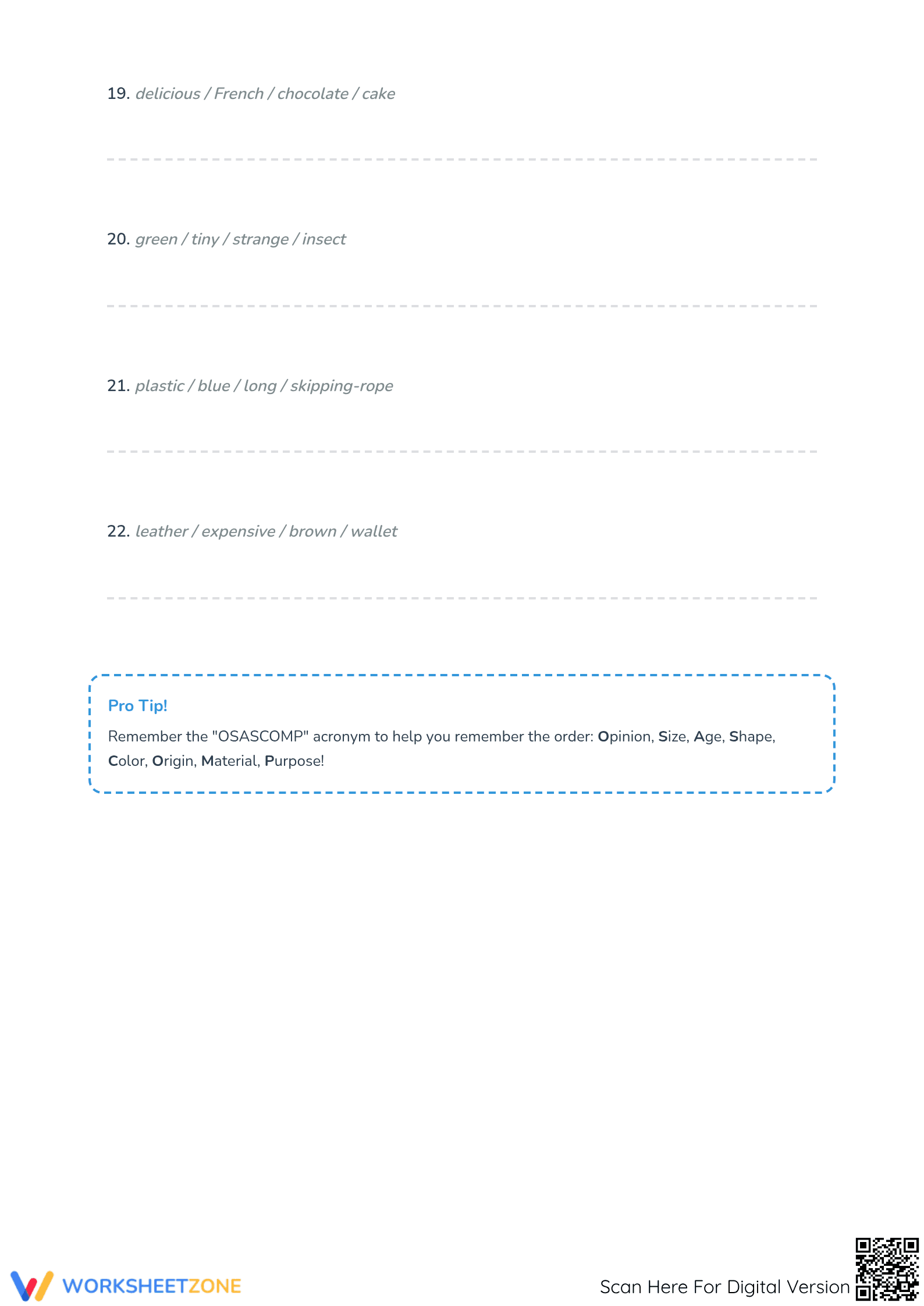
- Independent Practice: 6 sentence creator prompts where students must integrate specific adjectives into their own original sentences.
This structured approach follows a gradual-release model, moving students from recognition to independent application of complex grammar rules.
Standards Alignment
This resource is specifically designed to meet `CCSS.ELA-LITERACY.L.4.1.D`, which requires students to order adjectives within sentences according to conventional patterns. It also supports general writing fluency by encouraging precise descriptive language. Both standard codes can be copied directly into lesson plans, IEP goals, or district curriculum mapping tools.
How to Use It
Use this worksheet during the elaborate phase of a grammar lesson. After introducing the OSASCOMP acronym, have students complete the first page in pairs to discuss why certain adjective sequences sound more natural than others. For formative assessment, observe students during the Sentence Creator section to see if they can apply the rules without looking back at the guide. Expected completion time is 35 minutes.
Who It's For
This resource is ideal for fourth-grade students, but it also serves as an excellent intervention tool for fifth graders or English Language Learners (ELL) who struggle with the nuances of English syntax. It pairs naturally with descriptive writing prompts or mentor texts that feature rich, multi-adjective descriptions and complex noun phrases.
According to research by Fisher & Frey (2014) on the gradual release of responsibility, students acquire complex linguistic structures most effectively when instructional materials move from highly scaffolded guides to independent generative tasks. This worksheet applies that principle to CCSS.ELA-LITERACY.L.4.1.D by providing a permanent reference guide alongside 22 tiered problems. By focusing on the plain-English skill of adjective sequencing—specifically the OSASCOMP pattern—the resource ensures that students do not just memorize a list but internalize the natural rhythm of correct English syntax. This alignment with evidence-based pedagogical practices makes the worksheet a reliable tool for achieving mastery in lexical word classes. The inclusion of a multi-page answer key further supports self-directed learning and immediate error correction, which are critical components of effective grammar instruction in the upper elementary grades.


