


























Views
Downloads
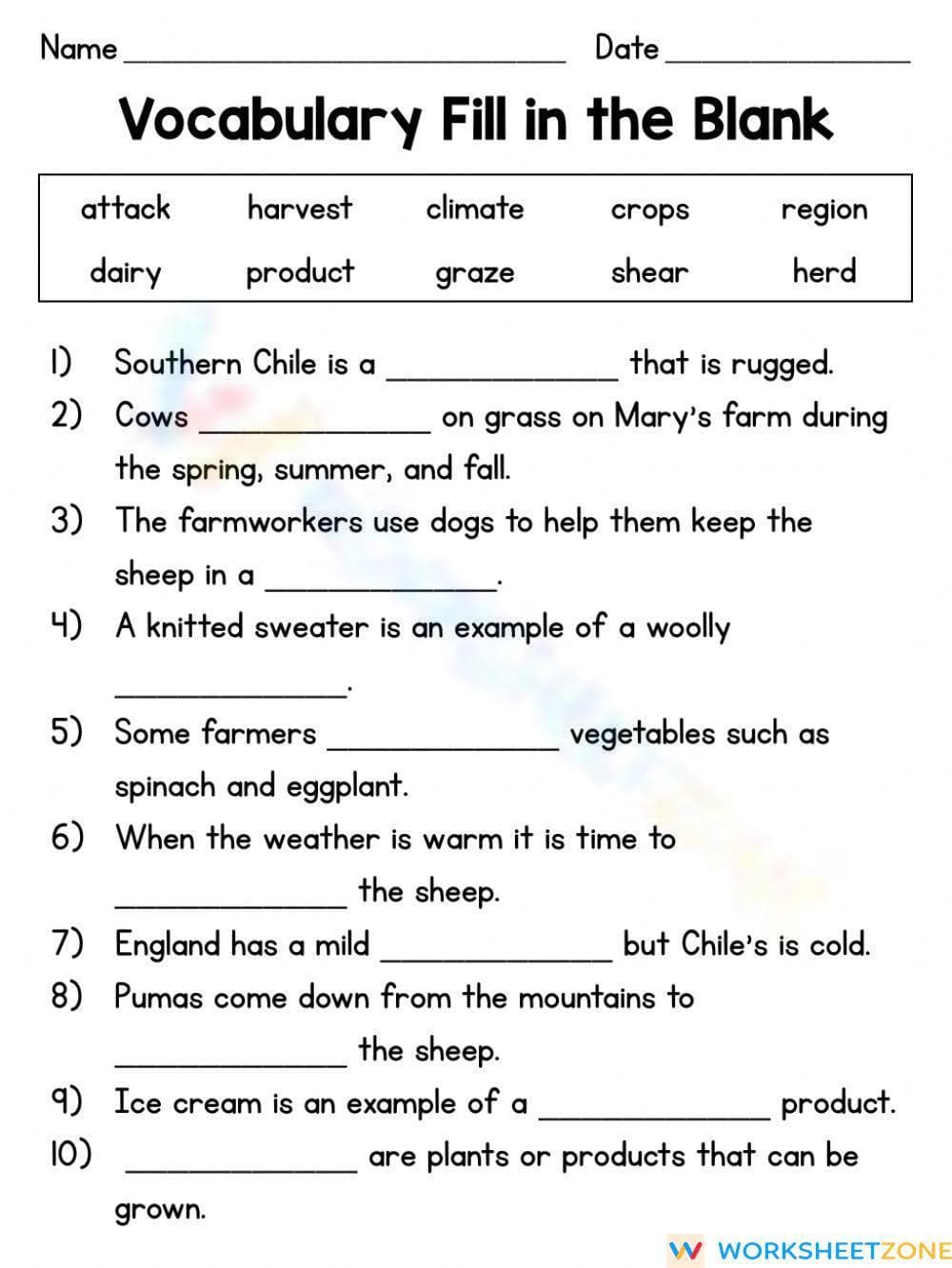

Grade 2 Farm Vocabulary — Printable No-Prep Worksheet
Paste this activity's link or code into your existing LMS (Google Classroom, Canvas, Teams, Schoology, Moodle, etc.).
Students can open and work on the activity right away, with no student login required.
You'll still be able to track student progress and results from your teacher account.
This printable Grade 2 farm vocabulary worksheet strengthens language acquisition through contextual application. Students analyze sentences describing agricultural concepts to correctly identify and place domain-specific terms from a provided word bank. By bridging the gap between isolated vocabulary and meaningful usage, this resource ensures students master essential terminology related to farming.
At a Glance
At a Glance
- Grade: 2 · Subject: English Language Arts
- Standard:
CCSS.ELA-LITERACY.L.2.6— Use acquired words and phrases to describe agricultural and farm-related concepts- Skill Focus: Farm Vocabulary and Context Clues
- Format: 1 page · 10 problems · Answer key included · PDF
- Best For: Independent vocabulary practice or ELA morning work
- Time: 10–15 minutes
What's Inside
This focused one-page resource features a structured word bank containing ten specific agricultural terms, including technical words like "shear," "graze," and "region." Below the word bank, students encounter ten numbered sentences that require critical thinking to complete. The layout is clean and spacious, providing ample room for young learners to write their responses clearly and legibly.
Zero-Prep Workflow
The three-step implementation is designed for maximum efficiency in busy classrooms. First, print the single-page PDF (30 seconds). Second, distribute the worksheets for independent completion during centers or as a quick assessment (1 minute). Third, use the included answer key for rapid grading or whole-class review. Total teacher preparation time remains under two minutes, making it ideal for sub plans.
Standards Alignment
The primary focus is CCSS.ELA-LITERACY.L.2.6, which requires students to use words and phrases acquired through reading and responding to texts. This worksheet specifically targets domain-specific words that are essential for comprehending informational texts about agriculture. This standard code can be copied directly into lesson plans, IEP goals, or district curriculum mapping tools to track student progress effectively.
How to Use It
This worksheet is best used during the independent practice phase after an introductory lesson on community or rural life. Use it as a formative assessment to observe how well students apply context clues to distinguish between concepts like "herd" and "graze." For a collaborative twist, have students peer-check their work using the provided answer key to encourage academic discussion. Completion usually takes 10 to 15 minutes.
Who It's For
This resource is tailored for second-grade students, though it serves as an excellent challenge for advanced first graders or a review for third-grade English Language Learners. The clear sentence structures support students developing their reading fluency while building content-area knowledge. It pairs naturally with non-fiction passages about life on a farm or anchor charts detailing agricultural cycles and animal care.
Aligned with the CCSS.ELA-LITERACY.L.2.6 standard, this vocabulary worksheet leverages research-based strategies for Tier 2 and Tier 3 word acquisition. According to the Fisher & Frey (2014) framework for gradual release of responsibility, providing a word bank alongside contextualized sentences offers the necessary scaffold for students to transition from receptive to productive language use. By focusing on agricultural terms such as "harvest," "climate," and "dairy," the activity builds the background knowledge required for higher-level comprehension of complex informational texts. Systematic exposure to domain-specific vocabulary in early elementary grades is a key indicator of long-term literacy success, as highlighted in EdReports 2024 analyses of high-quality instructional materials. This self-contained unit allows educators to assess student mastery of vocabulary in a manner that is both time-efficient and pedagogically sound, ensuring that all learners can accurately describe the world around them using precise academic language.


